










































Privacy Pirates
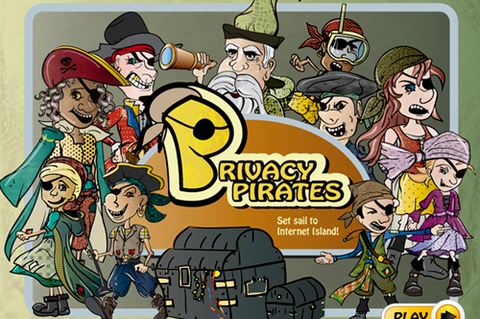
Launched in October 2011 by the Canadian non-profit organisation Media Awareness Network (MNet), this initiative centres on a web-based tutorial that introduces children, ages 7-9, to the concept of online privacy and teaches them to distinguish between information that is appropriate to give out and information better kept private - and to recognise how this may change in different contexts.
Privacy Pirates uses the edutainment strategy in an effort to protect children who are communicating over the internet. In the online game, children assemble a map leading to a pirate treasure (to introduce the idea that personal information has value). As they do this, they are asked a variety of questions about privacy and personal information on the internet. The focus is on positive feedback, rewarding children for correct choices instead of punishing them for wrong ones; correct choices are rewarded with an additional piece of the map.
The game's educational content is spread over two segments. In the first segment, set aboard the pirate ship, children meet the Mentor, who introduces them to the idea of privacy management, explains what personal information is, and lays out some of the essential ideas of the game, such as the importance of consulting a trusted adult before making a major decision about privacy and the permanence of online materials. In the second segment, children arrive on "Internet Island" and meet nine different pirates, each of whom has a distinct identity and represents a different topic such as passwords, contests and surveys, and privacy policies. Each pirate has a bank of randomly selected questions on that topic, which means that children can replay the game several times and still encounter new content. In a classroom setting, this also means that each student will have a different experience playing the game, which MNet foresees will lead to more valuable group discussions.
Throughout the game, players have access to the Mentor character who will give advice if needed by providing hints that suggest which strategy will lead to the right answer (without giving it away). This underlines the key skill of asking a trusted adult for help whenever a child is uncertain about the right choice and allows the game's educational content to be delivered on-demand and in a practical context. As the game goes on, the player's progress is tracked through the assembling of the treasure map on screen; once the player has assembled all six pieces of the map they are rewarded with the "treasure" (a congratulatory screen and printable certificate).
MNet has prepared the document "Privacy Pirates: Background Information for Parents and Teachers" to provide an overview of online privacy issues, as well as suggestions for playing the game with children and extension activities. Click here to access both the game and the document.
Children, Rights.
According to MNet, the commercial nature of children-oriented websites is a significant privacy concern because many of these sites solicit personal information in a variety of ways: some require children to register before they can access premium content, while others ask kids to submit their personal information - or their friends' - in contests and surveys, usually with access to additional content as the reward. (As well as doing it themselves, many of these sites also host advertising material that also solicits personal information). In addition, many popular sites give youth the opportunity to socialise with each other, raising the question of what information can safely be given out and what should be withheld. Furthermore, young children now have much more opportunity to post photos and videos online, thanks to webcams having become a standard feature in laptop computers, and the availability of photo and video functions in many cell phones. In the view of MNet, all of these factors mean that even very young children need to be taught how to safely and responsibly manage their and others' privacy in a wide range on contexts.
Privacy Pirates was developed with financial support from Google.
Media & Learning News, November 2011; "Privacy Pirates: An Interactive Unit on Online Privacy", by Matthew Johnson, October 13 2011; and Privacy Pirates website, December 7 2011.
- Log in to post comments