










































Privacy, Anonymity, Visibility: Dilemmas in Tech Use by Marginalised Communities
“LGBTQ activists in Kenya and low-income black and mixed-race housing activists in South Africa are marginalised and criminalised. The facts of their marginalisation and lack of rights cannot be ignored, and perhaps have to be the primary subject of T4T&A activities and engagement.”
This paper synthesises reflections and learnings from two studies in Kenya and South Africa about how marginalised communities use technologies commonly applied in transparency and accountability work, and the limits of their use of these technologies. The research, which involves lesbian, gay, bisexual, trans, and queer (LGBTQ) people in Nairobi, Kenya, and economically marginalised housing and urban development rights in Johannesburg, South Africa, is intended to inform future technology for transparency and accountability (T4T&A) activities and is intended for technologists, managers, donors, community-based activists, and researchers.
The research was conducted by the Tactical Technology Collective for the Making All Voices Count initiative, which is being implemented by a consortium consisting of Hivos, the Institute for Development Studies (IDS), and Ushahidi. Making All Voices Count “is a programme working towards a world in which open, effective and participatory governance is the norm and not the exception. The programme’s research, evidence and learning contributes to improving performance and practice, and builds an evidence base in the field of citizen voice, government responsiveness, transparency and accountability (T&A) and technology for T&A (Tech4T&A).”
As stated in the report, T4T&A initiatives “intend to make the public functioning of government visible, and states accountable to citizens for their actions. This research assumes that privacy and anonymity are important tactics for activists using technology, especially in transparency and accountability work that challenges institutions and authorities. However, privacy is practically impossible to maintain on popular, commonly available, proprietary platforms, many of which are deployed in T4T&A activities.” For this reason, the study seeks to answer the following questions: Does lack of privacy limit activists’ work with technology and if so, how? What are the other risks and barriers marginalised people face in their use of technology? Why do the marginalised in a society not use T4T&A applications – even if they have access to digital devices?
To answer these questions, the study conducted semi-structured interviews with a total of 37 LGBTQ activists in Nairobi, as well as housing and urban development rights activists in Johannesburg. There was a particular emphasis on ensuring that study respondents were not active users of T4T&A applications, in order to identify why this was so.
The report explains the experiences of LGBTQ people in Kenya, who face many forms of interpersonal violence such street harassment for appearing different, bullying, assault, eviction from housing, public humiliation and shaming, corrective blackmail, extortion, sexual harassment at the workplace, and coercive sex. Their use of online platforms and social media is therefore influenced by fear of being uncovered and the need for anonymity, but at the same time, LGBTQ communities require a space to be heard and a space for knowledge sharing and support. This therefore needs to be taken into account when developing T4T&A projects. The paper describes two technology-based projects for LGBTQ communities - Utunzi and Speak Out - which offer valuable insights into the development and uptake of T4T&A projects in this community. “Both were imagined as a response to the struggle to manage visibility and anonymity”.
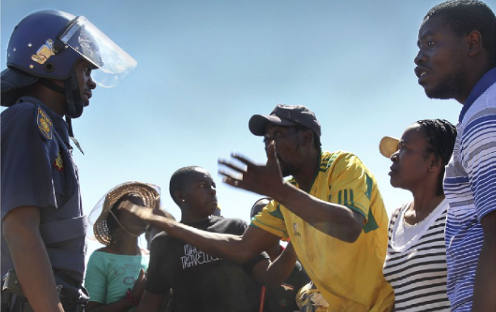
In the landscape of South African activism and engagement with housing and urban development issues, the marginalised who speak out about lack of services also face threats and intimidation by those in power. "Police monitoring, crowd control, and the use of force against black working-class residents of Johannesburg’s informal settlements continue to reduce activists’ capacities to participate securely in protest actions, and these offline risks are mirrored online." In addition, interviews with activists in low-income housing rights and urban development organisations identified three key factors that inhibit tech use: cost, language, and digital literacy. Lack of trust was also a common theme in interviews, which affected the use of online platforms seeking to promote T&A. People do not necessarily trust that the information they submit to a platform will be handled in a way that is secure, transparent, and free from corruption – or that it will actually have any visible impact. In addition, even if people do get access to technology and the information they need, they don’t really know how to engage with government actors and those in power. As stated in the report, “This points to the need for a theory of change to accompany the application of T4T&A tools in community work, one which focuses on assumptions about engagement between community members and government actors, and the need to overcome this lack of trust. It also highlights the importance of recognising the dynamics of different communities and movements.”
Overall, the report highlights the following reflections that emerged from both case studies:
- marginalised users have different needs for privacy and security online, and T4T&A activities need to integrate these concerns.
- collaborations across and within technology and activist movements and communities must recognise their different histories of engagement with politics, technology and the state.
- without the full enjoyment of human rights, marginalised people’s participation in T4T&A activities is bound to be limited.
In addition, “the documentation of marginalised people’s inability to control negative exposure online suggests that the language of openness, transparency and visibility needs to be rephrased with, and for, marginalised communities that face a range of threats from being online. Something that is ‘open’ may, on occasion, need to be closed, and visibility may need to be restricted for those who are perceived to be threatening, or merely outsiders.” It is therefore this selective transparency that should be the focus of T4T&A activities.
Click here to download a summary of the report.
Tactical Tech website on August 17 2016.
Image credit: Philip de Wet
- Log in to post comments