










































Not Just Conspiracy Theories: Vaccine Opponents and Proponents Add to the COVID-19 'Infodemic' on Twitter
University of Maryland (Jamison, Sangraula, Quinn); The George Washington University (Broniatowski, Smith); Johns Hopkins University (Dredze)
"...urge scholars of misinformation to go beyond the most visible forms of misinformation to highlight the complexities and subtleties that make an 'infodemic' so challenging."
In February 2020, the World Health Organization (WHO) deemed the large volume of both accurate and inaccurate health information that accompanied the COVID-19 pandemic to be an "infodemic" - a serious challenge to effective health communication. As the most accessible and least filtered source, social media is likely to be most vulnerable to misinformation. However, this article proposes that focusing only on the most blatant forms of misinformation and the actors sharing them risks oversimplifying the COVID-19 information ecosystem. It details a study that assessed content from vaccine accounts on Twitter to understand how existing online communities contributed to the "infodemic" during the early stages of the pandemic. It also explores what the findings mean for efforts to limit online health misinformation.
The researchers identified the 2,000 most active Twitter accounts in the vaccine discourse from 2019, based on the total number of messages containing the keyword "vaccine" from January 1 to December 31 2019. They limited their analysis to English-language accounts and tweets but did not include any geographic bounds.
One-quarter of all accounts (n=498; 25%) posted primarily vaccine content. Of the 2,000 accounts in the sample, 45% (n=905) opposed vaccination, 24% (n=479) were in favour of vaccination, 15% (n=311) were no longer publicly available on Twitter, and 15% (n=305) did not indicate a clear position on vaccines.
The researchers found that vaccine proponents tended to represent doctors, researchers, or health organisations, but also included non-medical accounts. Doctor/researcher accounts represented 6% (n=114), and health organisations represented 5% (n=102) of all accounts, with the majority (95%) of accounts in favour of vaccines.
In addition to tweeting about vaccines, vaccine opponents tweeted about conservative politics (e.g., supporting major Republican political figures (most commonly President Trump) or opposing major Democratic political figures or identities) and conspiracy theories (e.g., holding that technology (5G Wireless, etc.) is part of a plot to harm citizens). Among accounts that were retweeted at least once, vaccine opponents were retweeted significantly more frequently than vaccine proponents, with accounts retweeting information disseminated from a handful of anti-vaccine activists. Only 17% of the sample appeared to be bots.
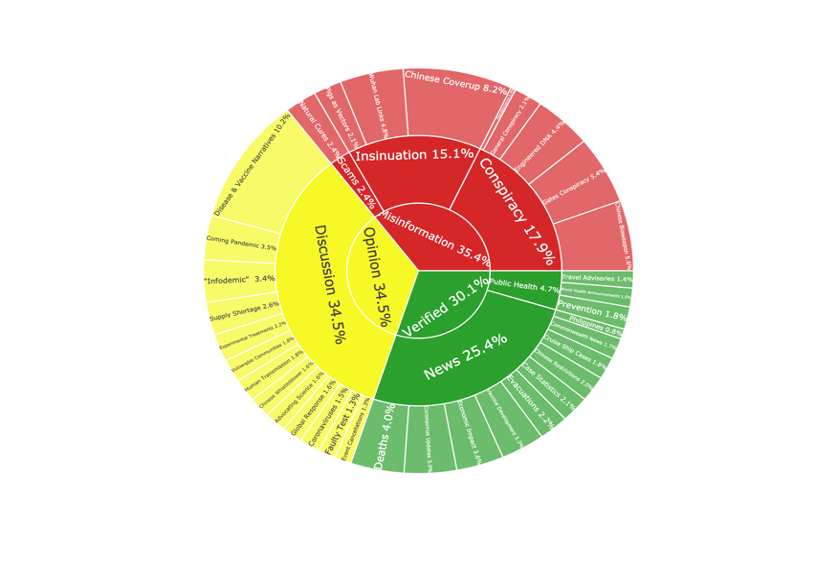
On February 20 2020, the researchers collected the most recent tweets for each account and automatically extracted 35 distinct topics of conversation related to COVID-19 (roughly 80,000 tweets). Across both vaccine proponents and vaccine opponents, the largest single topic of conversation was "disease and vaccine narratives", a discussion-based topic where users made comparisons between COVID-19 and other diseases - most notably influenza (often downplaying the severity of the novel coronavirus). According to the researchers, these messages likely added to public confusion around the seriousness and nature of COVID-19 - confusion that persists.
Topics were categorised as: more reliable (public health updates and news), less reliable (discussion), and unreliable (misinformation). Misinformation included conspiracy theories, unverifiable rumours, and scams promoting untested prevention/cures. Vaccine opponents shared the greatest proportion (35.4%) of unreliable information topics; vaccine proponents shared a much lower proportion of unreliable information topics (11.3%). However, proponents still shared 43.4% "less reliable" topics (compared to 34.5% of opponents sharing these types of topics).
Two key takeaways from the study: (i) Vaccine opponents use a variety of content, including both reliable and unreliable sources, to make their arguments; and (ii) although it is less common, vaccine proponents are not exempt from spreading misinformation.
The researchers note that, in the context of an "infodemic", efforts to address and correct misinformation are complicated by high levels of scientific uncertainty surrounding the novel coronavirus.
In conclusion: "Focusing on only the most conspicuous forms of misinformation - blatant conspiracy theories, bot-driven narratives, and known communities linked by conspiracist ideologies - is one approach to addressing misinformation, but given the complexity of the current moment, this strategy may fail to address the more subtle types of falsehoods that may be shared more broadly."
The Harvard Kennedy School (HKS) Misinformation Review, 1(3). Image caption/credit: Breakdown of topics for vaccine opponents. Colours: red = unreliable, yellow = less reliable, green = more reliable. For an interactive version of this figure, please click here. For an interactive version showing a breakdown of topics for vaccine proponents, please click here.
- Log in to post comments