










































Mwanzo Bora Nutrition Program (MBNP)
Running from 2012 to 2015, the Mwanzo Bora Nutrition Program (MBNP) is designed to improve maternal and child healthcare practices in Tanzania in the areas of antenatal care, exclusive breastfeeding, and complementary feeding. This five-year integrated nutrition programme is being implemented by a consortium led by Africare in partnership with BBC Media Action, and is funded by the United States Agency for International Development. Activities include social and behavioural change activities, such as mentoring three local radio stations to produce public service announcements (PSAs) on health and nutrition, strengthening capacity among partner civil society organisations, conducting peer education, and producing toolkits for parents.
The MBNP is working to raise awareness of under-nutrition and its impact on society while strengthening institutional capacity to respond to this issue. "The project supports innovative social and behavior communications change activities including mass media, training community health and agricultural extension workers to deliver consistent nutrition improvement messages, and working with peer support groups to improve nutrition behaviors and practices of caregivers, families and village leaders."
As part of the project, BBC Media Action mentored three local radio stations - Dodoma FM (Dodoma), Habari Njema FM (Manyara), and Ulanga FM (Morogoro) - to produce PSAs around behavioural outcomes associated with the project goals: seeking early antenatal care, exclusive breastfeeding for the first six months, and complementary feeding of babies over six months. Experienced BBC Media Action mentor-journalists worked with the radio stations to write and produce PSAs that stress the importance of attending antenatal classes early in pregnancy and taking iron and folic supplements during pregnancy and breastfeeding. The radio stations broadcast the PSAs from February 6 2015 until March 30 2015 several times during the day. The mentors also supported radio journalists to improve their coverage of nutritional health through news bulletins, call-in shows, and health programmes, as well at radio roadshow events.
The PSAs were designed based on field research to help understand more about the intended audience, including their media use and levels of nutritional health knowledge. A qualitative research study was conducted with nine focus group discussions across gender groups and the three regions where the PSAs were broadcast. Three focus group discussions were conducted for each PSA with women (pregnant or with children under two years old); men (pregnant spouse or children under two years old); and female mixed groups (mothers and mothers-in-law). Data from the focus group discussions were then triangulated with in-depth interviews with key stakeholders, including community health workers and village officers in all three regions.
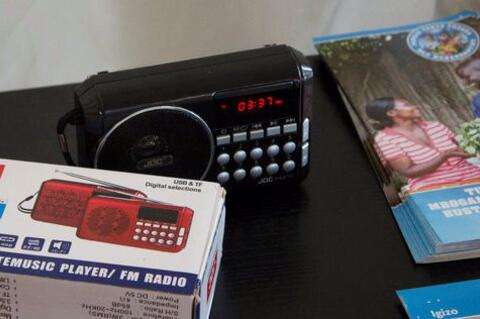
Another strategy was the production of Parent Multimedia Kits, which comprised vibrantly coloured knapsacks containing a range of educational activities and audio-visual learning materials to introduce parents to essential nutrition and social actions during the first 1,000 days of their child’s life. The kits contain books, a game about complementary feeding, leaflets, a radio for playing educational songs and dialogues, posters, door stickers, a calendar, and testimonial cards. The materials and kits were jointly developed by MBNP and the Tanzania Food and Nutrition Center. As of December 2014, MBNP had procured and distributed 2,382 social and behaviour change communication (SBCC) kits.
Maternal Health, Children’s Health
A qualitative study conducted in March 2015 "showed that the PSAs produced by local radio stations with the support of BBC Media Action contributed to increasing knowledge on the importance of the recommended practices, to shift attitudes, especially amongst key influencers in the household, and resulted in positive shifts in uptake." As well, the SBCC kits were assessed using a qualitative research approach to understand participants’ perceptions of the kit, its contents, and how the kit contributes to changing knowledge, attitudes, and behaviours about child health and nutrition. "Both men and women have positive views of the kit and enjoy participating in the Peer Support Groups (PSGs) where the kits are primarily used. BBC Media Action’s research found that knowledge of key behaviors during pregnancy is very high among those interviewed and that the kit, especially when used in concert with PSGs, is helping parents feel comfortable asking questions about nutrition lessons they do not fully understand. "
Africare, BBC Media Action, United States Agency for International Development
BBC Media Action website, BBC Media Action website, MultiSectoral Nutrition Program [PDF], and Africare website on August 24 2015.
- Log in to post comments