











































The Impact of HPV Vaccine Narratives on Social Media: Testing Narrative Engagement Theory with a Diverse Sample of Young Adults
Affiliation
Thomas Jefferson University (Leader, Selvan); Chapman University (Miller-Day); Clemson University (Rey); REAL Prevention, LLC (Pezalla, Hecht); Macalester College (Pezalla)
Date
Summary
"[T]he results of the study can inform future public health initiatives to increase HPV vaccination among an older age group, those over the age of 18, who are making vaccination decisions for themselves rather than relying on a parent."
Rates of human papillomavirus (HPV) infection are highest in young adults (aged 18-26), who can be vaccinated against HPV if they were not vaccinated as adolescents (aged 11-12). Narrative engagement theory predicts that narratives can provide the content for vaccine messaging that is more likely to be relevant to and resonate with young people and effectively engage an audience when considering health behaviour. Since young adults increasingly access health information on social media, this study tested the impact of a social media campaign with narrative-based health information on intentions related to HPV vaccination in the United States (US), where HPV vaccine uptake has been suboptimal compared to other routine vaccinations.
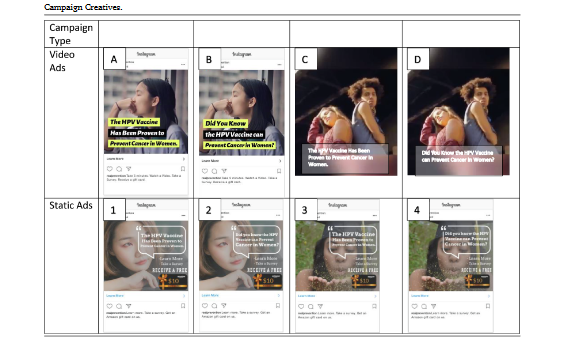
The study used social media to recruit young adult women to watch narrative-based videos addressing HPV vaccination and complete a survey about video engagement and intentions to: talk with a healthcare professional, talk with friends or family, and vaccinate against HPV. To recruit participants, the researchers created 15-second video ads and 4 static (single image) ads (see above). Participants watched one of 6 narrative-based videos designed to increase HPV vaccination rates among adult women (mean video length = 1 minute, 24 seconds). In general, this approach involves in-depth interviews to solicit vaccine decision narratives; the details and events of these decisions serve as the foundation of the prototypical stories depicted in the videos. Health facts, positive modeling of the behaviour, and a call to action are then woven into the story.
The study ran from August 12 2020 through September 26 2020 on Instagram platforms (Feed, Explore, and Stories) using Facebook Ad Manager. Across all ads, 1,332 link clicks led to 991 completed surveys that were reduced to 607 surveys (95% ages 18-26, 63% non-Caucasian; 58% sexually active). Higher video engagement was associated with stronger intentions to talk with a healthcare professional (r = 0.44, p =.01), talk with friends/family (r = 0.52, p =.01), and vaccinate against HPV (r = 0.43, p =.01).
The finding of an association between video exposure and vaccine intentions confirms predictions from narrative engagement theory about the types of videos that are effective in promoting behaviour change. The findings from this study also have implications for promoting research studies on social media. For instance, static ads were more effective than video clips in attracting audiences to take part in the study. Being able to move quickly to the study rather than watching a short video was preferred for our audience of young adults.. The findings from this study also have implications for promoting research studies on social media. For instance, static ads were more effective than video clips in attracting audiences to take part in the study. Being able to move quickly to the study rather than watching a short video was preferred for this audience of young adults.
Thus, this study indicates that, when promoting HPV vaccination, more engaging information leads to greater intentions to talk about the vaccine and get vaccinated. The researchers stress that it is important to still be vigilant when promoting HPV vaccination. Considering how anyone posting on social media must jockey for space with an almost-limitless number of other posts, which may contain misinformation, any credible, pro-vaccine message must stand out.
In conclusion: "this study lays the foundation for future research and interventions that aim to promote HPV vaccination on social media, in understanding how to reach key and diverse audiences with messages that are both credible and engaging."
Rates of human papillomavirus (HPV) infection are highest in young adults (aged 18-26), who can be vaccinated against HPV if they were not vaccinated as adolescents (aged 11-12). Narrative engagement theory predicts that narratives can provide the content for vaccine messaging that is more likely to be relevant to and resonate with young people and effectively engage an audience when considering health behaviour. Since young adults increasingly access health information on social media, this study tested the impact of a social media campaign with narrative-based health information on intentions related to HPV vaccination in the United States (US), where HPV vaccine uptake has been suboptimal compared to other routine vaccinations.
The study used social media to recruit young adult women to watch narrative-based videos addressing HPV vaccination and complete a survey about video engagement and intentions to: talk with a healthcare professional, talk with friends or family, and vaccinate against HPV. To recruit participants, the researchers created 15-second video ads and 4 static (single image) ads (see above). Participants watched one of 6 narrative-based videos designed to increase HPV vaccination rates among adult women (mean video length = 1 minute, 24 seconds). In general, this approach involves in-depth interviews to solicit vaccine decision narratives; the details and events of these decisions serve as the foundation of the prototypical stories depicted in the videos. Health facts, positive modeling of the behaviour, and a call to action are then woven into the story.
The study ran from August 12 2020 through September 26 2020 on Instagram platforms (Feed, Explore, and Stories) using Facebook Ad Manager. Across all ads, 1,332 link clicks led to 991 completed surveys that were reduced to 607 surveys (95% ages 18-26, 63% non-Caucasian; 58% sexually active). Higher video engagement was associated with stronger intentions to talk with a healthcare professional (r = 0.44, p =.01), talk with friends/family (r = 0.52, p =.01), and vaccinate against HPV (r = 0.43, p =.01).
The finding of an association between video exposure and vaccine intentions confirms predictions from narrative engagement theory about the types of videos that are effective in promoting behaviour change. The findings from this study also have implications for promoting research studies on social media. For instance, static ads were more effective than video clips in attracting audiences to take part in the study. Being able to move quickly to the study rather than watching a short video was preferred for our audience of young adults.. The findings from this study also have implications for promoting research studies on social media. For instance, static ads were more effective than video clips in attracting audiences to take part in the study. Being able to move quickly to the study rather than watching a short video was preferred for this audience of young adults.
Thus, this study indicates that, when promoting HPV vaccination, more engaging information leads to greater intentions to talk about the vaccine and get vaccinated. The researchers stress that it is important to still be vigilant when promoting HPV vaccination. Considering how anyone posting on social media must jockey for space with an almost-limitless number of other posts, which may contain misinformation, any credible, pro-vaccine message must stand out.
In conclusion: "this study lays the foundation for future research and interventions that aim to promote HPV vaccination on social media, in understanding how to reach key and diverse audiences with messages that are both credible and engaging."
Source
Preventive Medicine Reports. 2022 Oct; 29: 101920. https://doi.org/10.1016/j.pmedr.2022.101920
- Log in to post comments