










































Applying Principles of Behaviour Change to Reduce SARS-CoV-2 Transmission
University College London (West, Michie); King's College London (Rubin); Public Health England (Amlôt)
"...enactment of key personal protective behaviours is vital in order to reduce the transmission of SARS-CoV-2 and other respiratory viruses. Interventions to target individual behaviours such as these could potentially lead to substantial population-level effects..."
The behavioural sciences seek to understand the psychological, biological, social, and environmental factors that influence behaviour, with a view to developing interventions and policies to help achieve societal, organisational, or personal goals. This paper focuses on adherence to behaviours required to reduce COVID-19 virus transmission (which is itself occurring through human behaviour). The authors argue that there is a need to develop and evaluate interventions to promote effective enactment of personal protective behaviours, providing an analysis to help guide this.
Isolation and social distancing are measures that have been undertaken around the world in response to COVID-19, but adherence to these behaviours faces strong practical, motivational, and social barriers and also imposes considerable costs, which are borne disproportionately by people who are already disadvantaged. As the authors explain, there are other behaviours communities can enact to protect themselves and others: using tissues to catch expelled droplets from coughs or sneezes, wearing face masks as appropriate, washing hands frequently, disinfecting objects and surfaces, practicing physical distancing, and not touching one's eyes, nose, or mouth.
In the absence of high-quality intervention evaluations, the authors draw on behaviour-change principles to generate ideas as to what strategies to adopt. The "behaviour change wheel", which is derived from a synthesis of 19 major behaviour-change frameworks, sets out 9 broad categories of intervention (see below) that can be included in any behaviour change strategy.
The first stage in the process involves undertaking a "behavioural diagnosis" using the capability, opportunity, motivation, and behaviour (COM-B) model. The motivational part of COM-B is elaborated in the PRIME theory of motivation, which recognises that any behaviour can be influenced by both reflective and automatic processes. The main tenets of PRIME theory and details about more specific models are summarised in Table 1, which also provides examples of possible implications of the models for interventions to promote personal protective behaviours. For instance, here is the recommendation gleaned from PRIME theory: "Messaging to the public should aim to create a strongly felt 'need' to engage in protective behaviours rather than just a belief that one 'should' do them. People should be supported to develop plans that are specific and strongly linked to identity through development of personal rules (for example, always washing hands when entering one's home). Interventions should recognise the balance of impulses and inhibitions at key moments, and promote development of habits that come into play when needed. Educational materials should include modelling of desired behaviours."
Table 2 in the paper provides a preliminary behavioural diagnosis for each of the protective behaviours. For instance, with regard to maintaining physical distance, the "C" (capability) principle in COM-B involves understanding the importance of this and developing ways of achieving it in challenging situations; the "O" (opportunity) principle entails, in part, strengthening norms to support the behaviour, including social rules about contactless greetings; and the "M" (motivation) principle helps us understand that people must feel a need to maintain physical distance at all times, even when doing so conflicts with motives such as not wanting to appear rude.
Table 3 summarises criteria (APEASE) for evaluating intervention options:
- Acceptability: Is it judged to be acceptable by all key stakeholders?
- Practicability: Can it be delivered as intended, at the scale intended, and in the context intended?
- Effectiveness: Will it deliver the desired outcome in the intended population?
- Affordability: Can it be afforded within an acceptable budget?
- Spill-over effects: Is it likely to have additional negative or positive consequences?
- Equity: Is it likely to increase or decrease inequalities in society?
The authors apply the principles in Table 1 to the behaviours in Table 2 and evaluate these using criteria in Table 3. This leads to a set of illustrative recommendations, as set out in Table 4. Based on the authors' analysis, different personal protective behaviours will require different types of intervention. They do offer general principles with regard to the 9 types of intervention (as identified in the behavioural wheel):
- Education: Promote understanding of the benefits of the behaviours and on how and when to enact them effectively, address concerns about the potential costs, and provide specific guidance on how to minimise adverse spill-over effects. It should take into account varying levels of educational level and varying circumstances.
- Persuasion: Generate a feeling of responsibility toward others in families and the community and a sense that the behaviours are valued by groups with which the group identifies. It should promote concern and active engagement rather than anxiety and defensive avoidance.
- Incentivisation: Use social reward, including thanking people and praising them, to make people feel positive about having engaged in the behaviour.
- Coercion: Focus on the behaviour, not the person. Where threat of punishment is used, this should be clearly set out, accepted as appropriate by the community, and applied in a way that is seen as equitable and proportionate. As far as possible, any sanctions applied should be immediate (e.g., on-the-spot fines).
- Training: Demonstrate the behaviour in full and component-by-component, provide a schedule for practice, and show common mistakes and how to rectify them.
- Restriction: Set clear and specific social rules around behaviours, with boundaries that are readily understood, explaining the rationale, and providing specific examples of what is and is not acceptable.
- Environmental restructuring: Create or provide access to indoor and outdoor spaces that support the behaviour, offer environmental cues that promote the behaviour, ensure that people have the material and financial resources they need to enact and sustain the behaviour, and ensure that social and organisational rules and norms are supportive of the behaviour.
- Modelling: Show people with whom the group identifies enacting the behaviour in ways that are culturally appropriate and realistic to achieve.
- Enablement: Improve capability through, for example, therapeutic interventions to address mental health barriers to adherence or interventions to extinguish or build habits and create if-then rules.
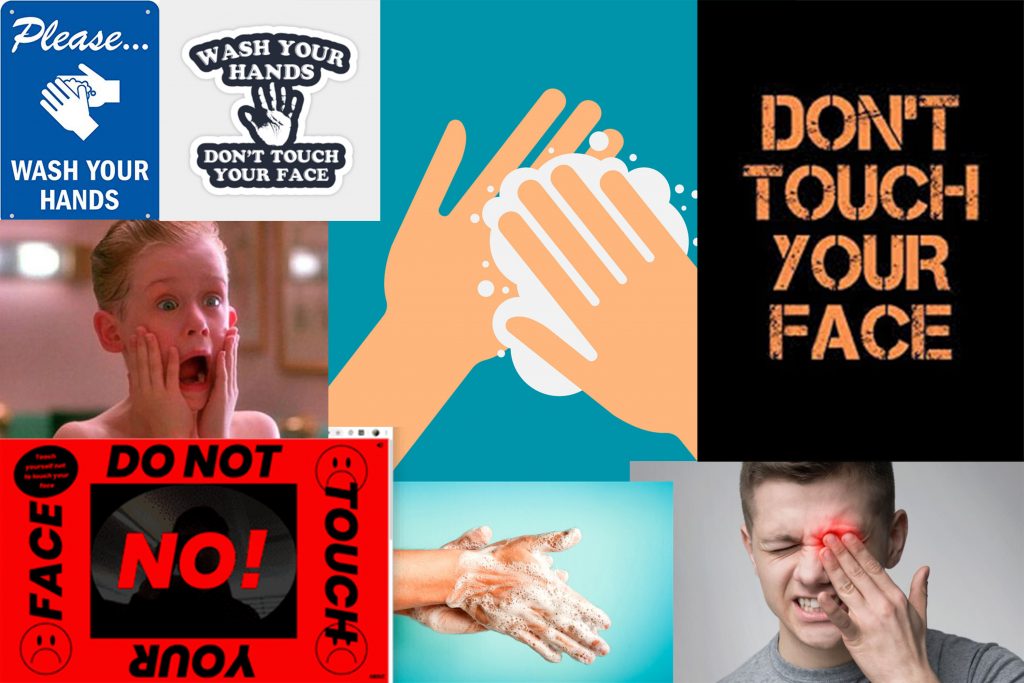
The authors argue that, of the personal protective behaviours, one may merit particular attention: not touching the T-zone of the face. Although they concede that it is hard to imagine that a behaviour as trivial as this could make a difference in addressing a global pandemic, they contend that: the potential impact may be high if it can be achieved, it requires no additional facilities, and it appears to have no negative spill-over effects. The key question is whether effective interventions can be found to achieve this.
In conclusion: "Given the urgency of the current situation, there may be merit in establishing an online hub for helping with the design of pragmatic evaluations, piloting of interventions, and rapid reporting of experiences and outcomes using a standardised approach."
Nature Human Behaviour (2020). https://doi.org/10.1038/s41562-020-0887-9 - sourced from Compass, May 12 2020. Image credit: https://washyourhandsdonttouchyourface.com/
- Log in to post comments