










































Much Ado about Flu: A Mixed Methods Study of Parental Perceptions, Trust and Information Seeking in a Pandemic
National Centre for Immunisation Research and Surveillance, The Children's Hospital at Westmead
Effective communication and public health messaging is understood to be a key component in both the planning phase for a health emergency such as a pandemic and during the emergency itself. Conducted in Sydney, Australia, this study aimed to gain an understanding of parental information seeking, trusted sources, and needs in relation to pandemic influenza A 2009 (pH1N1) to inform future policy planning and resource development.
The researchers explain that the pandemic communication strategy in Australia involved communication of hygiene and social distancing measures in May 2009, information about the availability of the pH1N1 vaccine in September 2009, availability of the pH1N1 vaccine for children in December 2009, and further vaccination information in March 2010.
This mixed methods study involved a quantitative survey (431 completed surveys) and 42 qualitative semi-structured interviews with parents of children aged 6 months to 5 years. It was part of a broader study examining the health, social, and economic impacts of vaccinating children attending childcare against influenza.
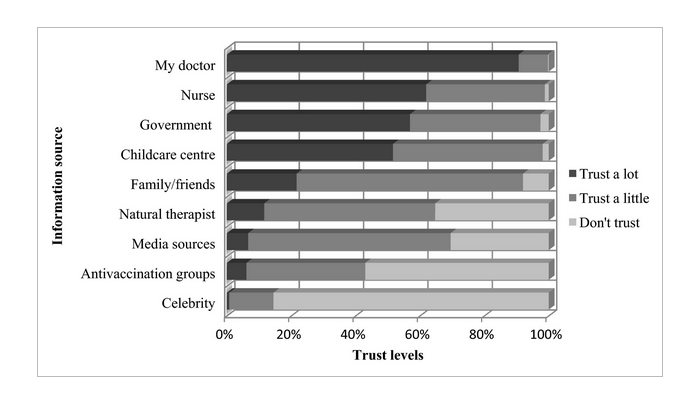
Selected quantitative findings: A chi-squared analysis revealed no significant associations between demographic variables and information sources, with the one exception of parental education level and trust in natural therapists (defined as Complementary and Alternative Medicine [CAM] practitioners, which include naturopaths, homeopaths, and herbal medicine practitioners). Parents with a university education were less likely to trust their natural therapist, compared with parents without a university education (61% vs 76%, odds ratio (OR) 0.5, 95% confidence interval (CI) 0.3-0.9). Parents reported that people they "trusted a lot" with regard to influenza information included their doctor (90%), nurses (59%), government (56%), and childcare centres (52%). The media was only "trusted a lot" by 7% of participants. Celebrities and antivaccination groups were not well trusted.
Selected qualitative findings - on information needs: The Australian government did provide information at key points throughout the pandemic period, yet the overwhelming perception of parents in this study was that, apart from initial messages about hygiene measures, little other information was forthcoming. For example, parents expressed a sense of urgency about needing to know what signs and symptoms of illness should prompt action, and they appeared frustrated at the lack of information provided on this topic. There was an expressed need to be able to differentiate between pandemic influenza and seasonal influenza symptoms; many parents wanted a checklist to guide them.
Selected qualitative findings - on trusted sources: Parents perceived hospitals to be better prepared and equipped to deal with the pandemic, with some parents feeling that general practitioners (GPs) lacked pandemic-specific knowledge. Parents reported high media usage and reliance throughout the pandemic, due to the rapidly changing situation. Indeed, the mildness of the pandemic compared to initial predictions, the intensity of the media coverage, and the lack of exposure to pH1N1 by them or their family or friends led to a sense of disillusionment and loss of trust in many parents. While the survey indicated that the mass media ranked low on the list of trusted influences, media reliance was considered necessary, if untrustworthy. Parents who actively sought pandemic information were discerning about information quality and expressed a preference for reliable, authoritative websites.
Based on the findings, the researchers provide several recommendations for pandemic preparedness; for example:
- The finding of the centrality of the media's role, despite a stated view of its lack of trustworthiness, concurs with emergency situation literature and post-pandemic evaluations of communication efforts. These suggest the need for clear, carefully crafted, and tailored messages with a key role for health professionals. Doctors, government health department representatives, and researchers could be utilised in both traditional media spaces and in non-conventional settings such as on popular programmes. Providing and promoting a hotline staffed by trusted sources such as doctors and nurses could assist in disseminating advice to guide appropriate presentation at emergency departments. In addition, factsheets developed by trusted sources (including hospitals) could be available physically in GP surgeries, hospitals, schools, and childcare centres, and on websites.
- Resources for use during a pandemic should take into account the preferred search terminology expressed by parents - for example, the use of the more informal "flu" rather than "influenza". To optimise search engine retrieval, metadata underpinning resources could use this as a variant term so that resources can be effectively located by parental internet searches.
In conclusion: "Understanding and considering the range of views, information needs, and preferences for searching and sources expressed by parents during the pandemic period provides useful context for developing tailored information materials and messages. Using and further promoting trusted sources via the media, as well as using existing trusted sources such as childcare centres and schools, could assist in disseminating public health messages in the event of future pandemics."
Influenza and Other Respiratory Viruses 2018 Jul 13;12(4):514-521.
- Log in to post comments