










































Rights in Pakistan: Workplace Harrassment Law and Right to Vote
Author: Bilquis Rehman, February 8 2018: Dr. Rehman writes on women´s rights in the workpace and facilitating youth voter education -
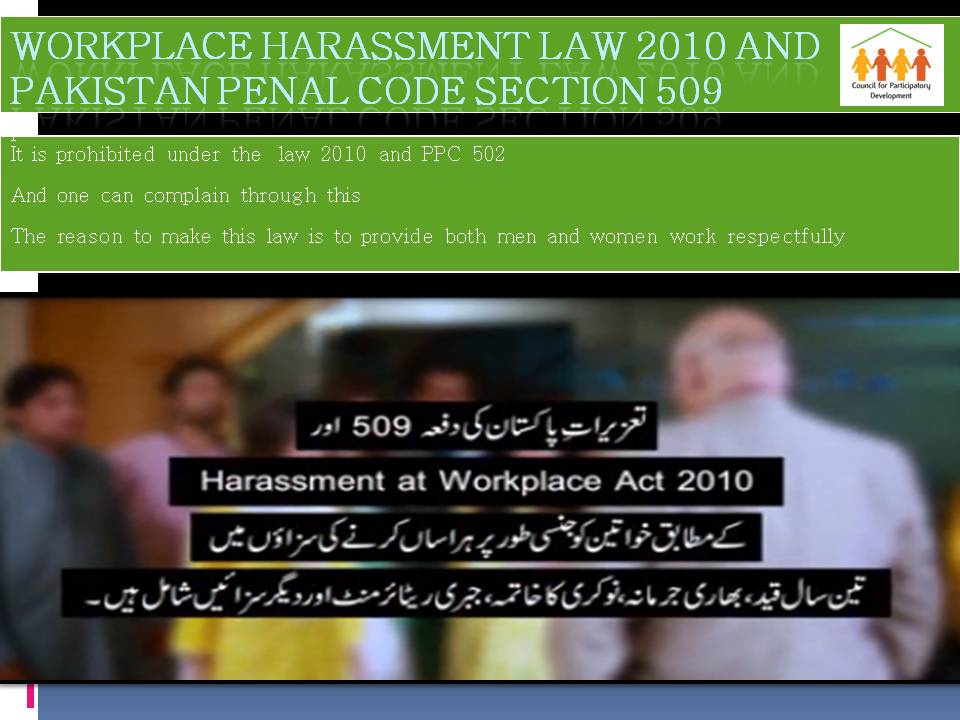
Workplace Harassment Law 2010 and Pakistan Penal Code Section 509: Enabling workplace a better place for women
Civil Society Representatives and Goverment Officials join hands for synchronizing their efforts for the "harassment at workplace law" implementation through a rigorous awareness campaign. Workplace Harassment Law 2010 and Pakistan Penal Code Section 509 are aimed to enable a better workplace for women. This law has been passed by the effort of Civil Society organisations working for ten years, and now a continuous struggle is going on to enforce them through Government efforts since 2010. The Council for Participatory Development is working along with all stakeholders to involve people from different sectors in a campaign through seminars and social media posting.
Right to vote ! Youth Participation
Pakistan’s Constitution enables its citizens, through their democratic rights, to vote, irrespective of any kind of discrimination. Every citizen age 18 and above has the duty to cast their vote for selecting their representative for Parliament. Pakistan has a parliamentary system in which the executive and legislature are elected directly by public voting of constituencies on first-past-the-post (FPTP) system through a secret ballot. A first-past-the-post (FPTP) voting method is one in which voters indicate on a ballot the candidate of their choice, and the candidate who receives the most votes wins: this is described as winner takes all. First-past-the-post voting is a plurality voting method. FPTP is a common in many countries.
Understanding this duty and exercising the right to vote is essential for everyone, and this awareness is much needed in Pakistan, although in 2013 the voters’ turnout was much improved compared to previous years, but still it is 55 %. Especially, women exercised their right to vote less than other constituencies. The Voters’ education campaign is run by the Election Commission of Pakistan, with support from NGO’s and other stakeholders. The Council for Participatory Development facilitates the process of educating youth in changing their behavior. Girls and boys from the universities were approached to conduct awareness sessions for them, while youth from multiple other backgrounds and areas have been approached in their own localities. The session helps in generating a healthy debate among youngsters about why youth should participate in the process of the election by casting their votes. Problems around the electoral process were also highlighted during the session, and they were also informed that new technologies have been linked with the process of voting and soon will be implement in the upcoming election. The election commission office representative tried to satisfy youth queries regarding discrepancies in the electoral process. They were given the guidance that once people start utilizing their own rights by casting their votes, then multiple issues can be handle by selecting the right candidates.
Click here for the Council for Participatory Development Facebook page.
As with all of the blogs posted on our website, the content above does not imply the endorsement of The CI or its Partners and is from the perspective of the writer alone. We do not check facts and strive to retain the writer's voice, as is detailed in our Editorial Policy.
- Log in to post comments