










































Learn to Discern (L2D)
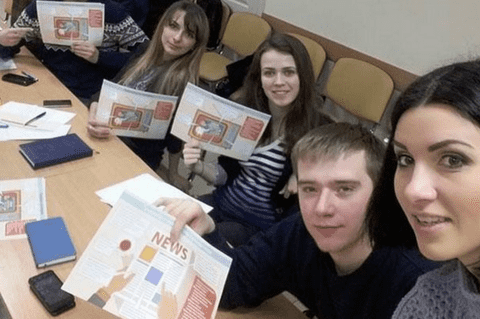
Implemented from July 2015 through March 2016 in 14 oblasts of Ukraine by IREX through the Citizen Media Literacy Project (CMLP), Learn to Discern (L2D) is a demand-side response to the problem of manipulative information. IREX believes that citizens must be able to separate fact from fiction and recognise manipulation and hate speech, and they must demand and seek out independent, fact-based journalism. L2D approach is a companion to supply-side solutions such as alternative content production and support of independent, ethical, and truthful journalism. L2D was developed and carried out with funding from the Canadian government and in partnerships with local organisations Academy of Ukrainian Press (AUP) and StopFake.
L2D was designed to help citizens detect and resist the influence of misinformation and propaganda by: enhancing citizen capacity to detect censorship, question and verify expert credentials, identify hate speech, avoid emotional manipulation, and verify news sources and content. By building citizens' ability to distinguish trustworthy news from fakes, L2D increased public demand for truthful reporting in the 14 eastern, southern, and central target oblasts. The customised skill-building and awareness-raising approach is based on the principle, "It is not about what you read, but how you read it!" Rather than endorse specific sources as reliable, the workshops and public information campaign focused on helping participants improve their critical thinking skills, assess their media consumption habits, and detect bias and manipulation.
Project activities included:
- Media literacy training development: L2D developed an interactive, user-centred media literacy training curriculum, tailored for Ukrainians, that provides trainees with practical tools they can use to protect themselves from propaganda. Staff also designed a self-guided distance learning course and video game to help teach media literacy in a fun, engaging way and to enable continued learning after the project's end. Click here to view the course in Ukrainian.; the game can be played in English (a demo version) or Ukrainian.
- Media literacy cadre formation: L2D worked with the AUP to create a cadre of 428 mixed-age, mixed-occupation grassroots media literacy trainers in target oblasts.
- Media literacy trainings for citizens: L2D trainers conducted trainings and consultations for over 15,000 citizens representing various sectors, such as unions, police units, high schools, and libraries. Participants learned to spot red flags such as use of hate speech and cross-check the information they consume against other sources. Trainers adapted the L2D curriculum to provide participants with tailored instruction and supplemental resources. Click here to access an excerpt from the trainer's guide, "Citizen Media Literacy Training" [PDF].
- Public media literacy campaign: L2D conducted a highly visible public media literacy campaign (with public service announcements (PSAs), billboards, and print and social media components) in Russian and Ukrainian to amplify trainings' effect in each oblast, encourage follow-on engagement, and reach those who were unable to attend L2D trainings in person. The media literacy campaign reached approximately 2.3 million Ukrainians and raised awareness and demand for skill-building in the area of critical information consumption.
Media Literacy
According to IREX, since late 2013, "a sharp increase in Kremlin disinformation and propaganda has threatened to upend democratic progress and political stability in Ukraine....Ukrainians live in a propaganda-filled environment where half-truths and 'alternative facts' play on fears, confusion, national identities, and patriotic feelings....The disinformation problem is exacerbated by structural weaknesses in Ukraine's media sector such as media ownership of major channels by oligarchs and political elites....Citizens' perceptions and opinions are shaped as they try to navigate a disorienting information deluge colored by influences from the Kremlin, Ukraine's political parties, and oligarch-controlled media that drown out independent and objective voices. Against this backdrop, Ukrainians remain poorly informed and confused about crucial governance reforms; many are becoming increasingly cynical and apathetic about the country's future. While barely one in four Ukrainians trust the media, media consumption and its influence on Ukrainians remains high. Yet even cross-checking news sources to verify them - the most basic form of media literacy - is not standard behavior and about half of the population never cross-checks the news they consume."
L2D trained more than 15,000 people of all ages and professional backgrounds. L2D also reached more than 90,000 people indirectly: 91% of direct participants (trainees) shared their new knowledge and skills with an average of 6 friends, relatives, or colleagues. Project evaluation found that L2D resulted in:
- Enhanced citizen capacity to discern the reliability of news sources and their content (in other words, media literacy): an observed 24% increase in participants' ability to distinguish trustworthy news from fake news, a 22% increase in those who cross-check the information in the news they consume, and a 26% increase in participants' confidence in analysing news.
- Increased demand for truthful reporting: 54% of those who viewed the information campaign reported a need for skills on how to discern untruthful reporting, representing more than 1 million Ukrainians.
An exit survey of the L2D citizen trainers in 2016 found that at least 174 of them intended to pass on the skills even after the end of the project. A spot-check conducted more than a year after the programme's end in Kharkiv revealed several examples of such initiatives: a training for teachers at Kharkiv region boarding schools; a local roundtable on propaganda and media literacy; and an academic course based on L2D methodology planned for 2018 at Kharkiv National University of Economics. In addition, IREX received reports from some librarians who were engaged as L2D trainers that they use the materials in their work to educate their patrons. Several trainers also reported receiving small grants to continue using L2D materials and train more people.
CMLP was implemented by IREX in partnership with the AUP and StopFake. The project was funded by the Canadian Department of Foreign Affairs, Trade, and Development's Stabilization and Reconstruction Task Force.
L2D website, "Ukrainians' self-defense against information war: What we learned from Learn to Discern", by Tara Susman-Peña and Katya Vogt June 12 2017 - all accessed on October 23 2017; and email from Katya Vogt to The Communication Initiative on October 30 2017.
- Log in to post comments