










































Beliefs, Perceptions and Health-Seeking Behaviours in Relation to Cervical Cancer: A Qualitative Study among Women in Uganda following Completion of an HPV Vaccination Campaign
Karolinska Institute (Hasahya, Berggren, Sematimba); Karolinska University Hospital (Hasahya); Lund University (BerggrenSematimba, Nabirye, Kumakech)
"Despite earlier information campaigns to introduce human papilloma virus (HPV) vaccination, which also targeted cervical cancer, misinterpretation and misunderstanding of the subject remain high."
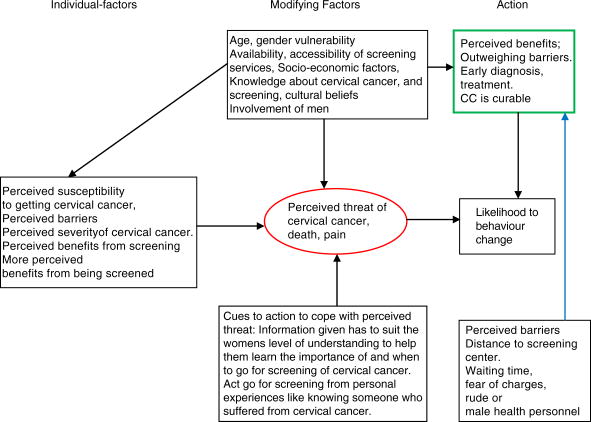
This project explored beliefs, attitudes, perceptions, and health-seeking behaviours in relation to cervical cancer among women in Uganda after an HPV vaccination project had been rolled out. Implemented by Programme for Appropriate Technology in Health (PATH) in Uganda's Nakasongola and Ibanda districts from 2008 through 2009, the HPV vaccination programme sought to reach girls aged 10–14 years and parents, particularly women. Drawing on the health belief model (HBM) (see above and Appendix 1) to explain and predict health-seeking behaviours, its services included HPV vaccination, cervical cancer screening, and preventative treatment and sensitisation campaigns. A qualitative study design was used, with 6 focus group discussions (FGDs) of 60-90 minutes each that included 36 women, aged 25–49 years, with no previous history of cervical cancer symptoms or diagnosis. In February and March 2013, the FGDs were held in natural settings that were familiar to the participants, in classrooms where parent meetings were usually held in each school.
Three themes emerged (Appendix 4) during the content analysis:
- feeling unprotected and unsafe - Participants strongly expressed their fears regarding the dangerous, horrible, and incurable nature of cervical cancer. The perception of cervical cancer being spread by men particularly exacerbated their fears. They also believed that health workers quite often did not share their findings with clients after diagnosis but instead preferred to keep the findings a secret.
- misbelief and wondering about cervical cancer - It was emphasised by most participants that a lack of knowledge about cervical cancer explained their poor health-seeking behaviour in relation to cervical cancer screening. The belief and perception that screening could diagnose both cervical cancer and HIV/AIDS made many women decline for fear of knowing their status. Some wondered how their husbands would react if they came home with the news of having been diagnosed with HIV as well.
- fear of the test procedure - The screening procedure was perceived by many as being painful, done with unsterilised equipment, and being embarrassing for one to show private parts to a strange man. They emphasised that their poor health-seeking behaviour in relation to cervical cancer was also due to having few diagnostic and treatment facilities in the community. Women living in remote rural areas needed to make long and costly journeys to get to screening centres.
Reflecting on these findings, the researchers note that perceived severity of cervical cancer alone without the perceived benefits of early screening does not motivate women to seek out screening services. The attitude of reluctance or hesitance to go for screening can be explained as a lack of acknowledgment of the fact that they are susceptible to cervical cancer and that they would benefit from screening. In terms of perceived barriers to seeking cervical cancer screening, participants in all FGDs as in earlier studies emphasised lack of knowledge, economic constraints, inaccessibility of health services, cultural beliefs, and the belief that cervical cancer is an incurable disease as hindrances, which calls for further qualitative studies.
The researchers stress the importance of health promotion efforts that focus on improving women's knowledge of risk factors by providing the women with information about the benefits of early screening, early detection, and its association with lower incidence and mortality rates from cervical cancer. According to a study cited here that was conducted in low- and middle-resource countries, factors affecting women's rates of cervical cancer prevention uptake included socio-cultural norms, clinical requirements, and the type of services delivered. It also showed that women from rural areas had a limited understanding of female reproductive organs and associated diseases. These factors are important in guiding the targeting of strategies – for example, production of educational material and identification of channels through which the audience can be reached. Health education materials, the researchers say, should be appropriate for and ideally matched to the educational levels of particular intended audiences.
In going forward, "[a]ction should be taken to understand their beliefs and perceptions to provide for effective delivery of public health programmes. This could be promoted by the use of multisectional approaches, addressing culture-specific issues, and provision of sensitive and competent services. To this end, suitable ways of encouraging uptake, ensuring flexibility of screening appointments, provision of appropriate educational materials, and enhancing the interpersonal linkage between health personnel and clients ought to be considered for the purpose of narrowing the knowledge gap."
Global Health Action, Volume 9, 2016 - sent in HPVflash: A News Update from the PATH Cervical Cancer Prevention Team, March 28 2016.
- Log in to post comments