










































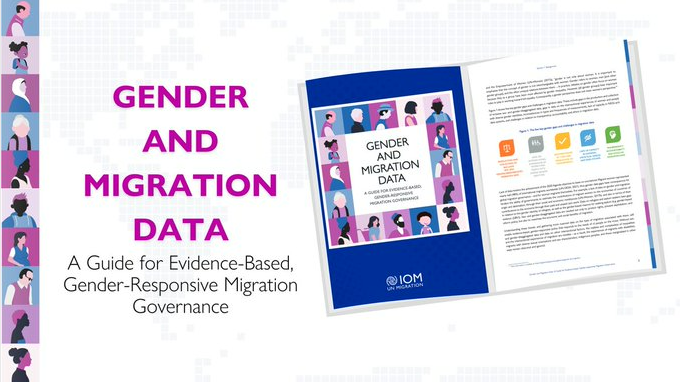
Gender and Migration Data: A Guide for Evidence-Based, Gender-Responsive Migration Governance
"Incorporating gender in migration data is a key contribution towards the global efforts to end gender inequality through gender-responsive migration governance."
Gender is a significant factor in shaping every stage of the migration experience - from deciding to migrate, to transiting across borders, and to working or settling in the country of destination, or choosing to return home. However, migration data are often disaggregated by sex but rarely by gender. The purpose of this International Organization for Migration (IOM) resource is to provide concrete guidance to policymakers, national statistical offices (NSOs), and practitioners on why it is important to promote gender-responsiveness when collecting, producing, using, analysing, and disseminating migration data for policy - and how.
The basic concept of gender-responsiveness is that policies at all levels and stages of the policy cycle should ensure the protection of human rights of all through the recognition of and response to the specific needs and challenges of those who are often marginalised and in situations of vulnerability, including women, girls, and those with diverse gender identities. Gender and diversity analysis can help identify how existing attitudes, norms, and policy practices in social and political institutions that surround policymakers limit the range or implementation of policy options they consider or propose. Gender and diversity analysis is a tool to evaluate and monitor the construction, collection, and analysis of migration data in order to enhance gender-responsiveness of migration policies/legislation.
To that end, the document proposes a set of 5 steps to be considered in order to implement a gender-responsive approach to migration data:
- Rethink categorisation, and formulate gender-responsive policy to guide migration data collection and use.
- Integrate ethical considerations into migration data collection.
- Build capacities, and invest in data infrastructure.
- Collect and use sex- and, whenever possible, gender-disaggregated migration data.
- Adopt a whole-of-society and whole-of-government approach in data collection, analysis, and evaluation, and use gender-responsive data to inform migration policy and practice.
This guidance aims to address migration data gaps in a manner relevant to all stakeholders. It includes recommendations on enhancing gender indicators and gender-based methods in data production, protection, dissemination, and use. The document provides succinct information on the extent to which gender is captured through macrolevel global data sets, along with a discussion of key issues relevant to gender and migration data.
The guide is organised into three main sections: Section 1 presents the background on the rationale and the main goals of the guide; Section 2 provides an overview of the international context and the state of the art in gender and migration data; and Section 3 offers guidelines for action at the national (and local) level to strengthen migration data work from a gender perspective. In concluding, IOM includes a message on advocacy: "a high level of political will and commitment is required to produce gender-responsive data, analyse them, and inform migration policy and governance based on the findings. Similarly, enacting gender-responsive data construction, collection and analysis requires a commitment to foster institutional capacities pertaining to gender and migration, and implementation of strategies to achieve them."
English, French, Russian, Spanish 64
64 (English, Russian, Spanish); 71 (French)
IOM website, July 8 2022.
- Log in to post comments