










































WHO Competency Framework for Health Authorities and Institutions to Manage Infodemics: Its Development and Features
University of Lucerne and Swiss Paraplegic Research (Rubinelli); World Health Organization, or WHO (Purnat, Lamichhane, Briand, Nguyen); US Centers for Disease Control and Prevention (Wilhelm, Traicoff); United Nations Children's Fund, or UNICEF (Thomson); Brown University (Wardle)
"This calls for a global participatory effort featuring researchers and practitioners to engage with communities and promote individuals' resilience to infodemics..."
In the context of the COVID-19 pandemic, social media have not only kept people connected and informed but have created an "infodemic": an overabundance of information, including mis- and disinformation. In April 2020, the World Health Organization (WHO) Information Network for Epidemics (EPI-WIN) produced an agenda for managing the COVID-19 infodemic. EPI-WIN also articulated the need to create a competency framework for infodemic management (IM) to assist institutions in reinforcing their IM capacities and implementing effective IM processes and actions. This paper presents the resulting WHO framework for IM, which was released on September 20 2021.
As explained here, the WHO Competency Framework for Infodemic Management outlines key actions that focus on measuring and monitoring the impact of infodemics during health emergencies, detecting and understanding the spread and impact of infodemics, and designing, deploying, and evaluating interventions that protect against infodemics. The framework serves as a reference tool to be applied according to local priorities and needs within the different countries. It has various potential uses, including assisting institutions in strengthening IM capacity by hiring, staff development, and human resources planning.
The competency framework was developed in 5 main steps that link together conceptual work (steps 1 and 2) and participatory research with the relevant stakeholders (steps 3, 4, and 5). These steps are detailed in the article but, in brief, at the heart of the process is a qualitative study with 25 people with academic and/or professional IM background/experience. Interviews with these participants were conducted online between December 2020 and January 2021; 2 stakeholder panels were conducted to revise the framework.
The competency framework contains 4 primary domains, each of which comprises main activities, related tasks, and knowledge and skills. These concepts are:
- Social listening: the systematic collection, analysis, and interpretation of people's questions, concerns, information voids, and narratives, including mis/disinformation, that are exchanged through off-and online communication channels. Social listening insights are analysed with insights from other kinds of epidemiological, behavioural, information ecosystem, and health information system insights through integrated analysis to diagnose barriers and enablers of people's adherence to health guidance and enactment of health behaviours.
- Narratives: the identification of narratives that refer to a theme of conversation online, including mis/disinformation, and to the design, dissemination, and evaluation of narratives that can strengthen resilience to infodemics.
- Distrust: points to the importance of trust in health authorities, health response, and the need to identify distrust of recommendations and to promote and evaluate the impact of interventions to build institutional collaboration and engagement to protect people and lower the risks of the disease.
- Interventions: actions aimed at flattening the epidemic (epi) curve and building resilience to infodemics among populations.
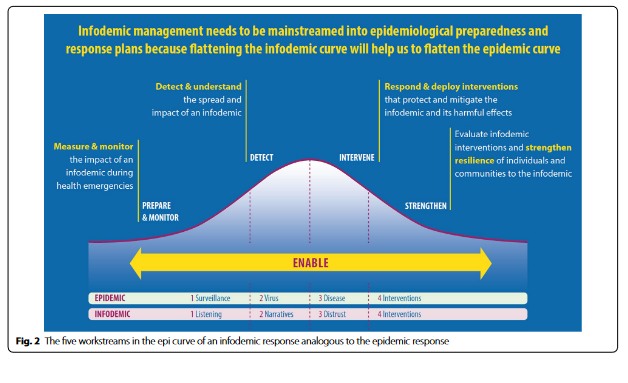
The main IM concepts are then operationalised in 5 streams that provide an overview of the main activities needed to flatten the epi curve:
- Measure and monitor the impact of infodemics during health emergencies, using standardised metrics and tools to track the evolution of infodemics among individuals, communities, societies, and health systems in both digital and physical information environments. This workstream is based in the IM domain of the competency framework called "prepare and monitor" in the figure above.
- Detect and understand the spread and impact of infodemics. A common approach among institutions is needed to understand how information and mis- and disinformation is spread and how it affects online and offline behaviour among different populations. This workstream is based on the IM domain of the competency framework called "detect" in the figure above.
- Respond and deploy interventions that mitigate and protect against the infodemic and its harmful effects. An evidence base is needed to identify interventions that are effective in different contexts and for different types of acute health events. This workstream is based on the IM domain of the competency framework called "intervene" in the figure above.
- Evaluate infodemic interventions and strengthen the resilience of individuals and communities to infodemics. Common evaluation frames are needed to improve the development of interventions and programmatic responses to infodemics. This workstream is based on the IM domain of the competency framework called "strengthen" in the figure above.
- Enable the development, adaptation, and application of tools for the management of infodemics. There is a need to enhance the transferability of lessons learned from IM and evidence-based interventions between contexts, countries, and infodemics. This workstream is based on the IM domain of the competency framework called "infodemic management" in the figure above.
Participants in the qualitative interviews highlighted some main guiding principles on what IM managers specifically should do in the domains of: (i) institutional capacity; (ii) ongoing education; (iii) targeted communication ("Messages have to be relevant to people according to where they stand, their knowledge and their health literacy"); (iv) interactivity; (v) inclusion; (vi) quality of information; (vii) what is known/unknown; (viii) scientific literacy; and (ix) partnership ("Institutional collaboration and cooperation are here essential; indeed, IM benefits from joining resources to share expertise, practices and resources, and learn from those").
Table 3 lists the main IM disciplines in alphabetical order and the main IM skills, contextualising them according to the domains and activities for which they are most needed.
The article notes a major gap between research and practice in infodemiology that could be bridged by efforts to:
- Develop and adopt shared classification and taxonomies of disinformation.
- Understand how information originates, evolves, and spreads on different platforms and channels and quantify the impact. There are many social listening tools and methods for data collection (online and offline) available.
- Use approaches from the behavioural and cognitive sciences, among other disciplines, to understand how misinformation affects behaviour in different populations, with a main focus on vulnerable populations.
- Design, implement, and evaluate interventions at different levels of action and that address individual-, community-, cultural-, and societal-level determinants of trust and resilience against misinformation.
- Develop regulatory and ethical principles to mitigate the spread of harmful health information at different levels of society.
- Strengthen IM capacities in health organisations and institutions by building and reinforcing related processes and empowering interdisciplinary workforces.
WHO is now tasked with monitoring the implementation of the competency framework and collecting case studies and data on its validity, use by institutions and organisations, and utility/value to further advance research and practice in the field. This process of monitoring will also inform revisions of the current framework and provide more quantitative data to complement the qualitative analysis that grounds it.
In conclusion, IM "is a process and not an end state; overall, it can be effective in maintaining or restoring confidence in health systems and authorities. However, to do so, this should be done continuously - not just when there is an outbreak. IM...cannot be isolated from a more general reflection on people's right to information and expression, which, along with the principles of autonomy and self-determination, is one of the core components of democracy....Moreover, it should also be feasible to collaborate...at the global level, specifically to support countries that might face difficulties in finding resources."
Human Resources for Health 2022, 20(1):35; and WHO website, August 1 2022. https://doi.org/10.1186/s12960-022-00733-0.
- Log in to post comments