










































What Role Does Lifeline Preparedness Play in Enabling Effective Communication in a Crisis? Case Studies from Myanmar and Nepal
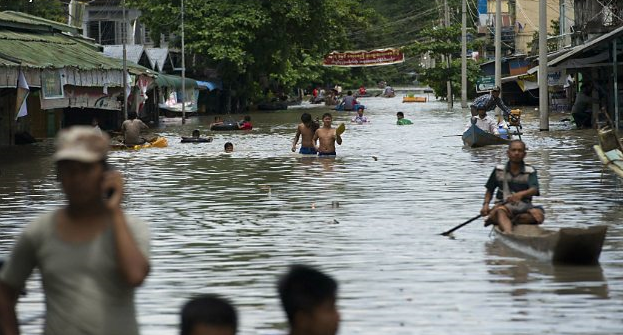
"[A]ll too often, coordination of communication is a challenge in a crisis. The media doesn't traditionally work in partnership with aid workers and the government; they actually often mistrust each other, as the media usually plays an important role in holding the other two accountable. But getting information to people in need after a disaster requires them all to work effectively together." - Katy Williams, BBC Media Action
To equip humanitarian, government, and media practitioners with the knowledge, skills, and processes they need to meet the communication needs of people caught up in a crisis, BBC Media Action carries out emergency preparedness work, including training with practitioners from across these fields. BBC Media Action's resulting Lifeline is media programming that aims to alleviate people's suffering and help them survive and recover in the aftermath of a humanitarian disaster. (See Related Summaries, below). This study focuses on 2 cases in countries where BBC Media Action has completed such preparedness work, subsequently responded to disasters with programming, and conducted evaluations. These are the flooding in Myanmar following Cyclone Komen in July 2015 and the Nepal earthquake in April/May 2015. It brings together key findings from across the 2 cases on what worked to help prepare BBC Media Action and partners to produce Lifeline broadcasts that sought to meet audience information and communication needs.
In brief, one major aspect of Lifeline is training, which aims to build relationships with the ultimate goal of improving coordination during a sudden onset emergency. The Lifeline training modules draw on the Organisation for Economic Co-operation and Development/Development Assistance Committee (OECD/DAC) criteria of humanitarian aid, wider sector learning on what is effective in crisis situations, and good communication practice. For example, training participants are asked to create engaging content that is accurate, relevant (useful, practical, and timely), and effective in giving people affected by crisis a voice and enabling them to take action. Beyond training, BBC Media Action country offices in disaster-prone areas have developed preparedness plans that map hazards, key response actors, and response options. Preparedness also includes developing tools and resources such as a manual to guide local media in producing Lifeline broadcasts and pre-prepared messages to broadcast immediately after a rapid onset emergency.
The first case study is that of Myanmar, where BBC Media Action has been carrying out preparedness for Lifeline activities since 2014. After Cyclone Komen hit on July 30 2015, BBC Media Action approached its long-term partner MRTV about broadcasting a Lifeline programme on its national radio station. By August 3, a BBC Media Action team had relocated to MRTV offices and the radio magazine show Shin Than Chin Kan Lan Mya (Linking Hands to Keep Living) was on air. Emergency programmes in the first 2 weeks focused on how to access safe drinking water and hygienic sanitation practices, how to stay safe if evacuated, and how to protect family health. Two 5-minute radio programmes were repeated 6 times a day on MRTV, as well as a 2-minute Lifeline bulletin that was translated into 5 local languages and broadcast on MRTV's ethnic FM radio stations. After 2 weeks, the format changed to a bi-weekly, 15-minute programme focused on how flood-affected people could recover their livelihoods and deal with the destruction in and around their homes. After its first month, Linking Hands was reduced to a weekly programme. At the end of October, it went off the air.
BBC Media Action had carried out Lifeline preparedness work in Nepal from 2012-2014; many of the trainees were involved in the response to the April 25 and May 12 2015 earthquakes. BBC Media Action and the BBC Nepali Service started broadcasting Lifeline messages within 8 hours of the earthquake in the latter's daily news bulletins. The day after the earthquake, a special Lifeline programme was broadcast in the time-slot and under the name of the long-running radio debate show Sajha Sawal (Common Questions), providing life-saving information via approximately 270 radio stations through the BBC Nepali Service and the Association of Community Radio Broadcasters (ACORAB). On May 4, the Lifeline team launched radio magazine show Milijuli Nepali (Together Nepal), with 15-minute episodes broadcast twice a day, 6 days a week across the entire country as a result of partnerships between BBC Nepali Service, British Forces Broadcasting Services, and 400 other radio stations. Milijuli Nepali was informed by needs assessments and audience feedback, incorporating secondary data sources and primary research conducted by BBC Media Action through Facebook and mobile app surveys in the most affected districts. This information was shared with humanitarian actors through online dashboards to help them tailor their communication to meet communities' needs.
For each case study, the report looks at what Lifeline preparedness work achieved at different levels (i.e., practitioner level, organisation level, and system level) and whether it met audience needs. To cite only one example: "Milijuli Nepali stood out because it focused on solutions, and because stories from affected people made the programme relevant and appealing. The programme had a strong focus on including voices from affected villages, with people sharing the challenges they faced and how they dealt with them. Audience members felt that these stories, the language, presentation, dialects and people included in the programme made it relevant and appealing. They felt that the programme stood apart from others because it focused not on damages, casualties or destruction, but on how people managed to survive and address the challenges they faced." In general, the evaluation finds that:
- BBC Media Action production teams and other local media practitioners were able to produce programmes that audiences considered relevant, trustworthy, and useful - thanks to the knowledge and skills they gained during Lifeline training.
- Preparedness work, including the training, built valuable relationships between people working in the media, government, and humanitarian agencies. Lifeline trainees were able to leverage these relationships when disaster struck - collaborating to ensure vital, accurate information was broadcast quickly to the people who needed it.
- Audiences took action individually and collectively after being inspired by hearing solutions to the problems they faced and listening to stories from others affected by the crisis. They also appreciated the opportunity to make their voices heard and ask questions on air.
The report reflects on some of the strategies that led to Lifeline working in these ways. For example:
- With regard to the BBC Media Action staff: Training a critical mass of BBC Media Action staff in Lifeline principles enabled them to lead the Lifeline communication response and support others who had not been trained. Lifeline leads in each country kept staff up to date with Lifeline preparedness and maintained relationships with partners. Crisis simulations were found to be effective in giving staff confidence to produce Lifeline programmes, although some said refresher training and the opportunity to work through more scenarios would also have been useful.
- With regard to building relationships - in part through training: Strong relationships with trusted media partners sped up the emergency communication response. Training humanitarian partners gave them awareness of the role BBC Media Action and media can play in a crisis and helped them to understand what information would be useful to audiences; this also meant they were open to working with media. Training local media practitioners stimulated a wider-reaching emergency communication response, as they incorporated Lifeline content in their programmes. Lifeline training gave local stations the ability to switch to a Lifeline approach during the crisis and to incorporate audience voices in programmes. Training different organisations together and collaborating in preparedness enabled media practitioners to contact others for information during the crisis.
- Having key tools and plans ready sped up programme production. For example, having a joint preparedness plan with a national partner led to a quick, collaborative response. Furthermore, having ready-to-use messages that were appropriate to the context, in the right languages, agreed between different actors, and tested with communities was useful in the initial stages of the crises. Media practitioners used Lifeline production manuals, translated into appropriate languages, as guidance when creating their own Lifeline content.
- Dedicated resources enabled quick decision-making.
Email from Kavita Abraham Dowsing to The Communication Initiative on November 21 2016; and "Lifeline programming: bringing together humanitarians, media and governments", by Katy Williams, November 16 2016 - accessed on November 28 2016. Image credit: Ye Aung Thu/AFP/Getty Images
- Log in to post comments