










































Weathering Crisis. Ensuring Media Viability, Continuity and Resilience
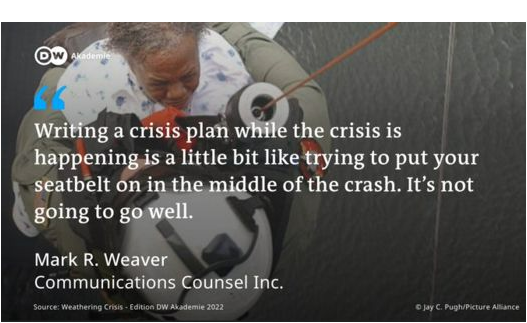
"While most disasters can't be prevented, careful thought, preparation and training make it more likely a news organization will be able to keep its audiences informed during a disaster - and remain viable through the recovery period afterwards."
This discussion paper stresses the importance of careful preparation to increase media viability in the face of crisis and offers strategies and tools to help media become more resilient. Published by DW Akademie, the paper identifies common practices for success and features case studies and recommendations for increasing organisational resilience to natural and man-made crises and disasters.
As explained in the paper, "News professionals routinely cover crises and disasters that affect others. But few take seriously the need to prepare themselves for events likely to threaten their organization's viability and ability to continue reporting when the public needs them most. There are many reasons news managers tend to underestimate the risks they face. But the threats to news media viability that the 21st century has delivered - economic erosion, climate change, pandemic and war – make clear that news organizations cannot afford to be naïve about their risk exposures. The time to prepare for the next crisis is now."
Media viability is already at risk. Media around the world work under growing economic stress, and many are also under pressure from authoritarian governments, political instability, and climate change. Media viability is defined in the paper as "the ability of media outlets and media landscapes to produce high-quality journalism in a sustainable way." This ability does not just include ensuring that a media outlet has the resources - money, time, and expertise - to produce news and information that is balanced, factual, accurate, and that serves society in times of need, but it also means making them more resilient when threats become crises or disasters. Resilience is defined as "the ability of a news organization to withstand long-term market disruptions, remain financially strong and continue operating. Equally important, being resilient means anticipating and adapting to the full range of residual risks that inevitably follow in the wake of crises and disasters and can threaten viability on multiple fronts."
The paper looks at what constitutes a threat and discusses the effects of being unprepared for a crisis, citing the impact of COVID-19 on media viability as an example. It also looks at why news media are not prepared for disasters, which is often a combination of economics, human psychology, and organisational culture.
In an effort to support media in becoming more viable and resilient in the face of crises, the paper discusses DW Akademie's framework for building media resilience and viability. This strategy focuses heavily on preparation - taking action to harden the news organisation before a crisis or disaster begins. According to the strategy, this preparation should begin with a detailed and realistic annual assessment of all of the potential risks a news organisation might face in the near future, including: political and economic risks; civil or social unrest; pandemic risks; natural disasters such as weather, climate, or regional geological risks; and man-made disasters.
The second step in a media resilience strategy is disaster planning, which includes specific detailed plans for management, finance, human resources, facilities, news coverage, production and distribution, and digital security. For example, a critical aspect of preparation is identifying, acquiring, and safely storing the emergency equipment and supplies that are necessary to operational continuity and resilience during the types of crises identified during risk assessment. Preparation also includes securing the supply chain for mission-critical items and finding alternative suppliers.
Another important part of disaster planning is creating a crisis communication plan, which, as a first step, includes appointing and training a small team of people who will develop the organisation's specific communication strategy for whatever crisis strikes. Training of staff is a key part of preparation and includes training in the organisation's disaster plans, safety procedures for different types of crises and disasters, and first aid. A resilience plan also requires assessing and addressing the residual risks that follow the initial crisis. These may include government crackdowns, economic downturns, population loss, regional infrastructure collapse, or physical risks, such as violence against journalists or the structural failure of the news organisation's office weeks or months after the crisis has seemingly passed.
Throughout, the discussion paper highlights the resilience strategies of a number of media organisations that have faced crises in the past. Based on the context of their strategy, each case study offers a list of the top 5 recommendations for remaining resilient. The organisations featured and accompanying recommendations are:
- Mizzima, a multimedia news organisation in Myanmar - with recommendations for resilience while working under political restrictions.
- KirkukNow, an independent news website in the disputed territories in Iraq - with recommendations for resilience when working in a hostile environment.
- L'Orient le Jour, a bilingual publication in Beirut, Lebanon - with recommendations for resilience in the face of human-made disasters.
- Times-Picayune/Advocate, New Orleans - with recommendations for resilience in the face of natural disasters.
- El Faro, a digital media outlet in El Salvador - with recommendations for resilience while working under political pressure and in an environment marred by violence.
- Rappler, Philippines - with recommendations for resilience when working under intense political pressure.
- Aga Khan University, Kenya - with recommendations for resilience in the face of recurrent crises.
To assist media organisations with practical tools for becoming more resilient to crises, the paper refers to the Media Resilience Scanner, an online crisis preparation, management, and recovery tool developed by DW Akademie for news organisations.
DW Akademie website on April 25 2022. Image credit: © Jay C. Pugh/Picture Alliance via DW Akademie on Twitter
- Log in to post comments