










































Voter Opinion and Involvement through Civic Education (VOICE) Program
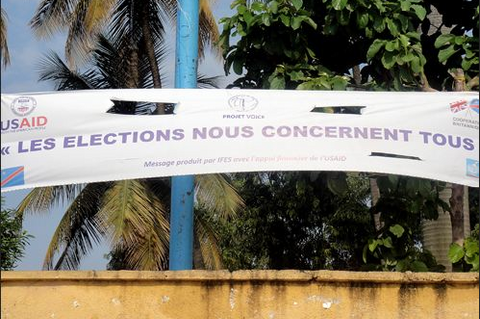
Launched in 2009, the Voter Opinion and Involvement through Civic Education (VOICE) Program worked to improve the capacity of the Congolese people to understand the decentralisation process mandated by a 2007 law and to engage in the November 2011 elections. This involved educating citizens about decentralisation and the electoral cycles, motivating citizens, particularly marginalised groups, to engage in government and participate in elections, and fostering local capacity to implement civic and voter education campaigns. A project of the International Foundation for Electoral Systems (IFES), funded by the United States Agency for International Development (USAID), the project used music, picture tools for facilitators called boîtes à images, or image boxes, radio, and community outreach.
Through VOICE, IFES worked with Congolese non-governmental organisations to encourage citizens, including marginalised groups, to engage with the government and participate in elections while building local capacity for future civic education campaigns. VOICE activities focused on rural areas often isolated by poor communications and transportation infrastructure, as the Congolese Independent Electoral Commission had found that they did not adequately reach rural voters during the 2006 general elections.
One of the key communication strategies was the use of boîtes à images, or image boxes, to visually communicate information about the political process. This is basically a series of drawings illustrating various educational messages, for example, an image may depict the process of getting in line to get registered to vote, which is supposed to elicit a discussion on the registration process and allow the facilitator to deliver key messages to the participants. According to IFES, the images allow trainers to overcome high rates of illiteracy and encourage face-to-face community discussions of political issues in any of the country’s five national languages.
IFES, in partnership with Search for Common Ground (SFCG), also organised and implemented a song contest to find a song that would motivate the Congolese to vote in the upcoming elections. They announced the competition through a network of community radios around the country. A total of 14 artists and community radio stations entered. The contest had three categories: Best Song in French, Best Song in Swahili, and Best Song for Youth. Two thousand CDs were produced and distributed to 14 partner radio stations in Bandundu, South Kivu, Maniema, and Katanga. Each winning artist and radio station also shared a cash award of 1,000,000 Congolese Francs ($1,113 US). DJ GAYTT, artist and radio star from Bukavu (South Kivu Province), won the prize for Je Vous Invite, a song that encourages voters to cast their ballot during the November general election. Click here to listen to the song on Youtube.
Rights, Governance, Elections
In order gain insight into the effect of the VOICE programme, IFES implemented the VOICE Impact Evaluation study. According to IFES, this is one of the first times that such a study had been conducted on an adult civic education programme in the field of democracy and governance. See video below for an interview with Daniel Laurent, Program Manager for Francophone West Africa, and Rola Abdul-Latif, Senior Research Specialist at IFES' Applied Research Center, who talk about why such studies are useful, what the VOICE Impact Evaluation study revealed, and whether these studies will continue to be implemented in the future.
International Foundation for Electoral Systems, United States Agency for International Development (USAID), Search for Common Ground (SFCG)
IFES website, IFES website, and Election Management [PDF] on September 7 2012.
- Log in to post comments