










































Using Minecraft for Community Participation
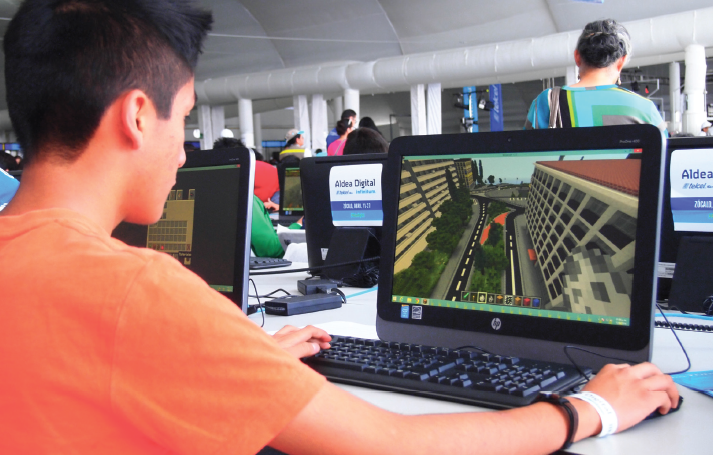
The purpose of this manual is to provide an overview and a step-by-step guide to the use of Minecraft, the "sandbox" computer game, as a community participation tool in urban design projects. As part of its mandate to promote socially and environmentally sustainable towns and cities, advocate adequate shelter for all, and set out norms and best practice for sustainable urbanisation and urban poverty reduction, the United Nations Human Settlements Programme (UN-Habitat) has been working with Mojang, the makers of Minecraft, since 2012 on Block by Block. Through the programme, UN-Habitat uses Minecraft as a community participation and engagement tool in the design and implementation of public space projects. To date, Minecraft has been used for community participation on every continent.
"The gameplay of Minecraft is perhaps best imagined as a complex 'digital Lego'. The creative and building aspects of Minecraft allow players to build structures out of textured cubes in a three-dimensional generated world. Creative mode enables gamers to easily create buildings similar to those produced by complex 3D modelling software, with the additional benefit of being able to construct structures together through the multiplayer setting. As a result, the building process is more similar to real-life construction projects with multiple workers carrying out different roles simultaneously, than traditional digital 3D model-making with only one designer."
This manual outlines the methodology for using Minecraft for community participation. In brief:
- Based on images, plans, Google Maps, and other available materials, a Minecraft model is produced by UN-Habitat's Minecraft consultants.
- UN-Habitat arranges for a Minecraft expert to provide Minecraft training and support.
- Project staff, with the support of the Minecraft expert, hold workshops (usually of two to four days in length) with community participants, project staff, and partners in order to: train participants in the basics of Minecraft modelling; facilitate a dialogue on issues regarding the space; produce Minecraft models incorporating the proposed design ideas; and collate the ideas that are included in the models. The participants are divided into groups of 2-4 people, with one computer provided for each group.
- Project staff facilitates a final workshop where the refined models are shown to stakeholders to generate discussion.
- The Minecraft proposals feed into the professional design work.
Publishers
24
UN-Habitat website, October 20 2017. Image caption/credit: A participant redesigning a public square in Mexico City ©Pontus Westerberg, UN-Habitat
- Log in to post comments