










































Using a Formative Research Rapid Assessment Method to Support the Development of a HIV/AIDS Antiretroviral Therapy Communication Campaign in Kenya
Communication Partners International (Turk); Abt Central Asia Republics Quality Health Care Project (Elkins)
"Given the critical nature of ART [HIV antiretroviral therapy] to improved health outcomes, the lack of consideration of formative research - including message pretesting - to inform the communication strategy design, can have dire implications for effective HIV prevention, treatment and care programs in developing country contexts."
Published in the Journal of Infectious Diseases & Therapy, this article describes the process and results of a study designed to identify specific audiences for an ART communication/social marketing campaign and gauge the attitudes and opinions of this audience segment in relation to ART. The motivation of this exploration was the evidence-based recognition of the importance of effective communication, including informed decisions on appropriate messages and communication channels, in supporting protective behavioural responses to HIV/AIDS - including adherence to ART. The context for the study was Kenya, as a result of the proposed roll-out of the ART programme in the country.
The formative research stage involved an HIV/AIDS rapid assessment and response (RAR) methodology involving consultations with stakeholders and discussions with programme beneficiaries in Kenya. This approach was grounded in the belief that qualitative methods, including observational research, case study approaches, semi-structured and in-depth interviews, narratives, and personal diaries, "can act as powerful tools for understanding culturally-specific influences." The formative research involved discussions with 72 participants. This included 23 key informants: doctors, ARV [antiretroviral] Taskforce and Ministry of Health representatives, and staff from non-governmental organisations (NGOs) community based organisations (CBOs), and faith-based organisations (FBOs). Programme beneficiaries comprised a convenience sample, 49 participants from patient populations comprising people living with HIV/AIDS (PLWHA), and their family members from 3 provinces of Kenya.
Consultations with key informants were conducted through semi-structured interviews (SSIs). Questions focused on: clinical providers prescribing of ART, their perceptions of patient understanding on how to take ART and how they could improve patient adherence to ARV treatment regimens, what they currently do to support and counsel PLWHAs who are taking ART, and 3 main barriers and potential benefits patients may perceive as important to ART adherence. Information was also elicited on anticipated intended audiences for the communication campaign and specific ART communication support needs required by clinical providers.
Formative research with programme beneficiaries was then conducted through focus group discussions (FGDs), as "this approach has been found to encourage participation from people who may be reluctant to be interviewed on their own or who feel they have nothing to say." FGDs also "do not discriminate against people who cannot read or write". To ensure free flow of information, non-governmental organisation (NGO) staff members were trained as moderators and were also responsible for getting signed clearances from participants involved in the research.
Specifically, each FGD comprised 8-10 participants and lasted, on average, 2 hours. To facilitate participant involvement and relaxed group dynamics, given the stigmatising nature, interviews were conducted within NGO offices, which a number of programme beneficiaries frequently visited. Questioning was related to respondent knowledge, attitudes, and beliefs toward HIV/AIDS and ART. Translation and back-translation of instruments was conducted by staff from NGOs to ensure semantic, conceptual, and normative equivalence of concepts, items, and scales. Groups were moderated in a mix of English, Kiswahili, and Luo languages, in keeping with the local vernaculars.
The FGDs' warm-up sessions were used to identify any stigmatising attitudes to HIV/AIDS patients. A number of communication needs were also investigated during the FGDs, such as participant-trusted information sources, knowledge of treatment partner networks, and community ART information needs. Other information elicited concerned programme beneficiary knowledge about ART and perceived attitudes and perceptions toward the therapy, as well as perceptions on the quality of care. As some patients had already embarked on the therapy, additional questioning related to ART uptake, treatment, and adherence issues. A supplementary questionnaire with 5 point Likert scales and 6 items related to ART was provided to participants following completion of the main discussion.
"As there were high levels of stigma identified toward PLWHAs, onsite summaries were seen as most effective in synthesising themes across all groups. Notes were compiled in Word format, directly onto laptops by note-takers working closely with interpreters during each session. Notes were compiled in a question-by-question format to capture what individuals had to say in regard to each topic theme. On-site summaries were supplemented through dialogue between the moderators and translators immediately, following discussion sessions. This assisted in clarifying any potentially ambiguous themes."
Analysis of the data was carried out in two iterative stages: individual responses (in the case of SSIs) and within-group (in the case of FGDs). The first stage of analysis involved writing up key issues emanating from stakeholders and beneficiary groups. Summary memos on each case's approach were compiled for both groups, following which, cross-case analysis took place.
A number of key themes were identified from the analysis and were expressed, in the context of a communication programme, as core categories of a "barrier" or "benefit" to ART. Barriers to ART subsumed 11 themes. Comments by respondents referring directly to each theme were quantified to provide frequencies based on participant's identification of these potential ART barriers. The predominant themes emanating from the barrier analysis, as well as indicative quotes from respondents related to the themes, are provided in Table 1 in the paper. In short, the qualitative study findings identified "a number of gaps in knowledge, poor attitudes and perceptions among HIV positive participants and supporting family members, which could undermine the successful roll-out of ART in Kenya. These included a lack of perceived community awareness and accurate knowledge about ART treatment options, coupled with a number of myths and misconceptions, and poor attitudes and perceptions to ART. Patient perceptions of the quality of service from providers were also poor. This contrasted sharply to stakeholder perceptions of their own high quality of service. Any of these 'barriers to behaviour change' could significantly impact on ART health seeking behaviour or treatment adherence."
The second category related to the benefits associated with ART. A total of 8 themes emerged under this category. Indicative quotes associated with each of these themes are outlined in Table 2 of the paper. (The most frequently cited perceived benefit of ART identified was: strength, better health, and quality of life (42%), but a number of other benefits also ranked highly with participants, including good counselling and advocacy (35%).)
Following completion of the formative research study, the qualitative data results were amalgamated with the desk review on existing HIV/AIDS and ART knowledge, attitude, and behaviour studies to provide insights into message designs, communication channels, and strategic approaches for an ART communication campaign and subsequent outcome evaluation.
An excerpt from the article follows: (footnote numbers have been removed by the editor)
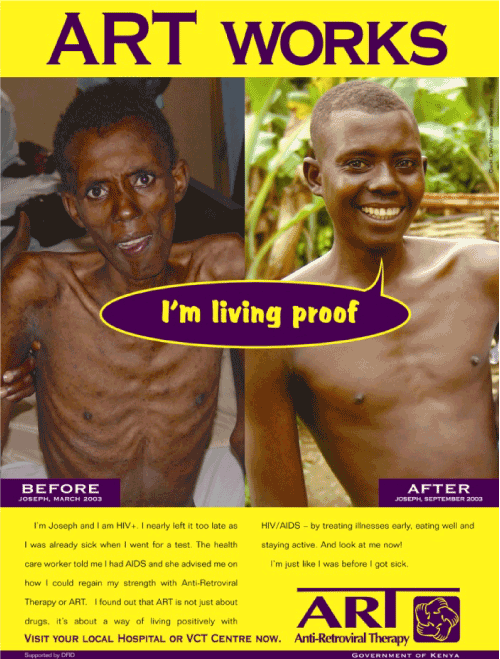
"The themes identified in the formative research study and secondary data analysis greatly assisted in the development of the communication strategy, creative approaches, and more specifically, the tailoring of messages. This included the use of 'transformational appeals' in TV, radio spots and print materials, demonstrating how patient body morphology could return to a previous, 'healthy state', (Figure 1), including the ability to once more become productive within a family and community setting.
Other important creative approaches emanating from the findings included the modelling of more empowering, doctor/patient relationships using social learning theory approaches, by depicting more desirable scenarios in communication materials of how health providers should relate to patients. A useful adjunct to the RAR approach was that important themes gleaned from the study led to the development of key behavioural indicators for the post-intervention study instrument design."
For more information, contact: Tahir Turk at tturk@cpimail.net
Emails from Tahir Turk to The Communication Initiative on January 22 2014 and February 26 2014.
- Log in to post comments