










































The Unintended Consequences of COVID-19 Vaccine Policy: Why Mandates, Passports and Restrictions May Cause More Harm than Good
University of Washington (Bardosh); University of Edinburgh (Bardosh); London School of Hygiene & Tropical Medicine (de Figueiredo, Doidge); Johns Hopkins University (Gur-Arie); University of Oxford (Gur-Arie, Jamrozik); Intensive Care National Audit and Research Centre - ICNARC (Doidge); University of Toronto (Lemmens); Harvard Medical School (Keshavjee); Dalhousie University (Graham); Johns Hopkins School of Public Health (Baral)
"Mandatory population-wide vaccine policies have become a normative part of pandemic governance and biosecurity response in many countries. We question whether this has come at the expense of local community and risk group adaptations based on deliberative democratic engagement and non-discriminatory, trust-based public health approaches."
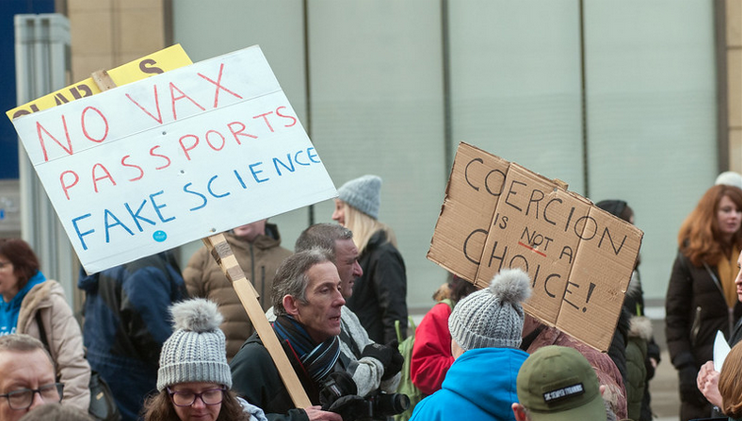
Since 2021, mandatory proof-of-vaccination policies have been implemented and justified in various ways by governments and the scientific community to control COVID-19. Mandate and passport policies have provoked community and political resistance around the world, including in the form of mass street protests. This paper reflects on these vaccine policies and outlines a set of hypotheses for why they may have far-reaching unintended consequences that could be both counterproductive and damaging to public health, especially within some sociodemographic groups. The interdisciplinary social science framework proposed here may guide researchers, policymakers, civil society groups, and public health authorities in approaching the issue of unintended social harm from these policies, including on public trust, vaccine confidence, political polarisation, human rights, inequities, and social well-being.
The interdisciplinary social science framework proposed here considers four domains:

- Behavioural psychology: Although studies suggest that mandatory COVID-19 vaccination policies are likely to increase population-level vaccination rates to some degree, insights from behavioural psychology suggest that these policies are likely to entrench distrust and provoke reactance (motivation to counter an unreasonable threat to one's freedom); findings from various experiments are shared to support this claim. Furthermore, the public interpretation of these policies has occurred within the context of public announcements and media coverage that have oversimplified the science, struggled to communicate potential adverse events, and overstated vaccine efficacy on transmission. "When mandate rules are perceived to lack a strong scientific basis, the likelihood for public scrutiny and long-term damage to trust in scientific institutions and regulatory bodies is much higher." Also, public and political discourse has normalised stigma against people who remain unvaccinated, a phenomenon evident in the tone and framing of media articles, for example. Such messaging has not only been increased polarisation but "is likely to be ineffective at promoting vaccine uptake..." The authors also explain why "COVID-19 vaccine policies have the potential to erode vaccine confidence, trust and the social contract in the particular context of the pandemic..."
- Politics and law: The analysis focuses on how vaccine mandates, passports, and restrictions can erode civil liberties, exacerbate political polarisation, and risk furthering disunity in global health governance (e.g., the "focus on 'the unvaccinated' as the cause of health system collapse diverts public attention away from global equity failures and deep structural challenges facing public health capacity in many countries").
- Socioeconomics: Historically, marginalised groups, including those facing economic challenges, tend to have less confidence in vaccination programmes - raising the possibility that mandatory COVID-19 vaccine policies may fuel existing inequity. "Altogether, rather than enhancing human agency and strengthening communities and social cohesion, many current vaccine policies - including monthly fines for non-compliance (eg, Greece and Austria) - may work to disempower individuals and contribute to long-term psychosocial stress and disharmony." Other impacts in this category include those on the health system as a whole, as many countries may lose frontline staff due to mandates, and in terms of the exclusion from work and social life that may ensue for those unwilling to be vaccinated.
- The integrity of science and public health: As the authors argue: "When members of the public perceive mandates to be ethically and legally problematic and in violation of established norms of informed consent and proportionality, this will erode trust in public health and scientific institutions and even courts that endorsed or actively promoted such policies..." Moreover, governments have refused to disclose the details of contracts with manufacturers, and various practices (discussed here) "do not reinforce confidence that authorities are being transparent or applying optimal standards for regulatory safety, efficacy and quality for these novel vaccines - standards which should arguably be more stringent given the legal precedent for mandates and passports."
As the authors explain, mandatory vaccination policies need to be proportionate and designed to achieve a clearly defined goal. To be justified, punitive mandates, passports, and segregated restrictions should be: proportionate; not more restrictive than necessary; effective in preventing transmission and protecting the healthcare system from collapse; and the only options. As illustrated in this paper, the authors believe that current vaccine policies have failed on these fronts and are no longer fit for purpose.
The COVID-19 vaccine policies in place are not only scientifically questionable, the authors contend, but they impinge on human rights, promote stigma and social polarisation, and adversely affect health and well-being. These policies may lead to a widening of health and economic inequalities, have detrimental long-term impacts on trust in government and scientific institutions, and reduce the uptake of future public health measures, including routine immunisations. Calling for open multidisciplinary discussion and debate, the authors argue that COVID-19 vaccine policies should be re-evaluated in light of their potential negative consequences. "Leveraging empowering strategies based on trust and public consultation, and improving healthcare services and infrastructure, represent a more sustainable approach to optimising COVID-19 vaccination programmes and, more broadly, the health and well-being of the public."
The authors conclude by urging investments in public health capacity, especially healthcare providers who build relationships of trust working in communities, as well as by improvements in data transparency, media independence, and broad public debate and scrutiny about COVID-19 vaccine policies. Such strategies could go a long way toward maintaining population trust, helping people better understand the risks and benefits of the continued use of current vaccines, and informing research on future policies and practices so we are ready for the next pandemic.
BMJ Global Health 2022;7:e008684. Image credit: Tim Dennell via Flickr (CC BY-NC 2.0)
- Log in to post comments