











































Gender-Equitable Approaches to Engage Men in Family Planning Communication and Decisions in India: Using Evidence Review and Human Centered Design
Summary:
In line with Indias Family Planning (FP)2020 commitment and Sustainable Development Goals, it is pertinent to engage men as catalysts for change as supportive partners, to advance gender equity and improve uptake of contraceptives. Evidence suggests that men, especially in LMIC contexts, function as de-facto heads of the households and are key-decision makers on all issues pertaining to finances, healthcare, family size and childrens upbringing. While FP decision making is majorly mens domain, the carrying out of FP measures is considered womens domain. Further, large, national FP programs in India have historically targetted women, further limiting mens engagement and ownership of FP. To understand the continuum of communication and decision-making in couples and role men play in determining couples FP choices, we undertook a research with a multi-disciplinary approach; comprising global evidence review and an immersion study in states of Uttar Pradesh and Bihar, the FP programming hotspots in India. The study focussed on gathering the gap in evidence around socio economic and especially behavioural context to commonly known FP uptake and patterns in these states. Findings suggest that gender norms have a significant role to play in couple-making phases and have layered influence on spousal communication and decision-making. Our research informs that in a highly gendered social context, with fragmented knowledge and unequal power relations, spousal communication on matters of contraception are sparse and inequitable at best. This research presents innovative, gender-transformative and scaleable approaches to meaningfully engage men in FP.
Background/Objectives:
Men play important roles in regulating womens access to reproductive health services through control over household finances, her mobility, and limiting credible information on health and retaining healthcare decisions in their hands. However, in LMIC contexts, women carry the burden of unplanned, unintended pregnancies and with lack of support from their partners, find themselves in precarious situations. Rigid masculinity norms further exacerbate decision making processes among couples. There is a clear and an urgent need to understand behavioural hooks that may be used effectively to address gender inequitable processes influencing contraceptive use and ultimately, reproductive outcomes for men and women.
Description of Intervention and/or Methods/Design:
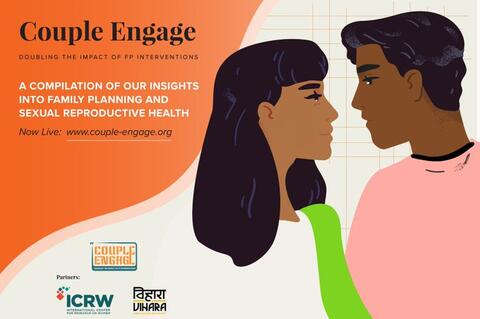
Couple Engage is a multi-disciplinary project which braids research through HCD, ethnography and evidence synthesis. It seeks to build behavioural evidence on expanding male engagement in FP as supportive partners to women., as well as engaging them as agents of change in families and communities. In Phase 1, a global evidence review was conducted using systematic review methodology on behavioural and programmatic insights through a final list of 71 academic articles from JStor and PubMed. In Phase 2, an immersion visit was conducted with a qualitative-exploratory framework using participatory and design research tools. The respondents were 35 young married couples from 18-29 years. Three engagements were conducted, in the first two engagements, interactions were held with husband and wife separately and in the third, a joint interaction was held. Further, discussions with 11 groups of unmarried and married men, and interviews with 28 key informants were conducted.
Results/Lessons Learned:
The research provides substantive evidence around ways to engage men to take responsibility and prioritize FP. Findings show that in the initial stages of couple-making, men go an extra mile to please their partners and initiate both verbal and non-verbal communication to improve their sense of couple connectedness. The research suggests that men and women communicate frequently around sex but not effectively. It provides a great intervention opportunity to engage with men by initiating shared activities like sharing screen time by playing games or cooking together and couching FP messaging in the same. The research points towards various opportunities in domains of sex, finances, couples aspirations as possible entry points across their life path to ensure service delivery from both demand and supply side is seamless. It provides us with pathways which can be used to initiate and sustain a constructive dialogue with men on FP.
Discussion/Implications for the Field:
This research is ground-breaking in allowing us to understand gender equitable, context specific hooks and triggers for behaviour change in men, from their own perspective, while situated in a near universal reality of marriage as a structural context to FP in India. It presents behavioural pathways which can be used to engage men in FP, contributing both towards research and programming. It provides insights on enhancing reproductive empowerment for women, thereby, serving a dual purpose for forwarding the field. The research contributes as evidence to FP2020 commitment and SDGs to build strategies for programmes as to what works.
Abstract submitted by:
Kuhika Seth - International Center for Research for Women (ICRW)
Aishwarya Sahay
Kapil Vachhar - Vihara Innovation Network
Pranita Achyut - International Center for Research for Women (ICRW)
In line with Indias Family Planning (FP)2020 commitment and Sustainable Development Goals, it is pertinent to engage men as catalysts for change as supportive partners, to advance gender equity and improve uptake of contraceptives. Evidence suggests that men, especially in LMIC contexts, function as de-facto heads of the households and are key-decision makers on all issues pertaining to finances, healthcare, family size and childrens upbringing. While FP decision making is majorly mens domain, the carrying out of FP measures is considered womens domain. Further, large, national FP programs in India have historically targetted women, further limiting mens engagement and ownership of FP. To understand the continuum of communication and decision-making in couples and role men play in determining couples FP choices, we undertook a research with a multi-disciplinary approach; comprising global evidence review and an immersion study in states of Uttar Pradesh and Bihar, the FP programming hotspots in India. The study focussed on gathering the gap in evidence around socio economic and especially behavioural context to commonly known FP uptake and patterns in these states. Findings suggest that gender norms have a significant role to play in couple-making phases and have layered influence on spousal communication and decision-making. Our research informs that in a highly gendered social context, with fragmented knowledge and unequal power relations, spousal communication on matters of contraception are sparse and inequitable at best. This research presents innovative, gender-transformative and scaleable approaches to meaningfully engage men in FP.
Background/Objectives:
Men play important roles in regulating womens access to reproductive health services through control over household finances, her mobility, and limiting credible information on health and retaining healthcare decisions in their hands. However, in LMIC contexts, women carry the burden of unplanned, unintended pregnancies and with lack of support from their partners, find themselves in precarious situations. Rigid masculinity norms further exacerbate decision making processes among couples. There is a clear and an urgent need to understand behavioural hooks that may be used effectively to address gender inequitable processes influencing contraceptive use and ultimately, reproductive outcomes for men and women.
Description of Intervention and/or Methods/Design:
Couple Engage is a multi-disciplinary project which braids research through HCD, ethnography and evidence synthesis. It seeks to build behavioural evidence on expanding male engagement in FP as supportive partners to women., as well as engaging them as agents of change in families and communities. In Phase 1, a global evidence review was conducted using systematic review methodology on behavioural and programmatic insights through a final list of 71 academic articles from JStor and PubMed. In Phase 2, an immersion visit was conducted with a qualitative-exploratory framework using participatory and design research tools. The respondents were 35 young married couples from 18-29 years. Three engagements were conducted, in the first two engagements, interactions were held with husband and wife separately and in the third, a joint interaction was held. Further, discussions with 11 groups of unmarried and married men, and interviews with 28 key informants were conducted.
Results/Lessons Learned:
The research provides substantive evidence around ways to engage men to take responsibility and prioritize FP. Findings show that in the initial stages of couple-making, men go an extra mile to please their partners and initiate both verbal and non-verbal communication to improve their sense of couple connectedness. The research suggests that men and women communicate frequently around sex but not effectively. It provides a great intervention opportunity to engage with men by initiating shared activities like sharing screen time by playing games or cooking together and couching FP messaging in the same. The research points towards various opportunities in domains of sex, finances, couples aspirations as possible entry points across their life path to ensure service delivery from both demand and supply side is seamless. It provides us with pathways which can be used to initiate and sustain a constructive dialogue with men on FP.
Discussion/Implications for the Field:
This research is ground-breaking in allowing us to understand gender equitable, context specific hooks and triggers for behaviour change in men, from their own perspective, while situated in a near universal reality of marriage as a structural context to FP in India. It presents behavioural pathways which can be used to engage men in FP, contributing both towards research and programming. It provides insights on enhancing reproductive empowerment for women, thereby, serving a dual purpose for forwarding the field. The research contributes as evidence to FP2020 commitment and SDGs to build strategies for programmes as to what works.
Abstract submitted by:
Kuhika Seth - International Center for Research for Women (ICRW)
Aishwarya Sahay
Kapil Vachhar - Vihara Innovation Network
Pranita Achyut - International Center for Research for Women (ICRW)
Source
Approved abstract for the postponed 2020 SBCC Summit in Marrakech, Morocco. Provided by the International Steering Committee for the Summit. Image credit: Kuhika Seth via Twitter