










































Training Manual for Face-to-Face Migrant Worker Engagement: Socially Distanced, Humanly Connected
"Community engagement is an approach ensuring that communities, especially those at risk and who are vulnerable, are active stakeholders based on transparent and open information flows, in the deliberations, consultations, decision-making, design, implementation and measurement of initiatives and systems that affect them."
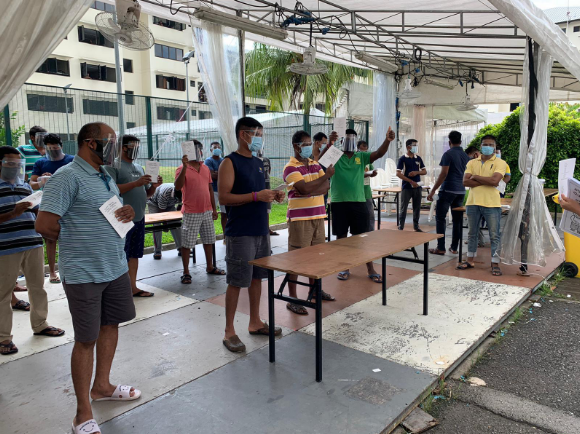
This training guide aims to support field mobilisers, public health personnel, government authorities, and organisations who need to implement on-the-ground, face-to-face risk communication and community engagement (RCCE) in the event of a COVID-19 outbreak, especially in the context of large, closed communities. It comprises training guidelines and offers practical suggestions and activities for volunteers and mobilisers seeking to engage and empower migrant workers.
The guide captures the learnings and work of My Brother SG, an RCCE network born out of the COVID-19 pandemic (see Related Summaries below). In March 2020, the first cases in Singapore's foreign workers were identified. Within a short time, more than 53,000 diagnoses were made in a population of over 300,000 migrant workers. My Brother SG explains that, in any outbreak, RCCE is one of the key pillars of an outbreak response. However, RCCE is often overlooked. My Brother SG created this guide, alongside other resources, including health booklets, posters, and comics found on the My Brother SG website, to meet the needs of the migrant worker community in Singapore.
The guide includes instructions for activities to help volunteers engage migrant workers in migrant worker facilities meaningfully and safely. The overall training objectives include: (i) equipping mobilisers with the skills and confidence needed to engage migrant workers in large, closed communities so as to earn their trust and support RCCE efforts, ultimately decreasing transmission rates of COVID-19; and (ii) improving the feedback loop and two-way dialogue between migrant workers and health authorities. The desired outcomes include: (i) an increase in trust and rapport between migrant workers and health authorities; (ii) an increase in the agility, adaptability, and flexibility in the outbreak response to respond to evolving ground needs; and (iii) a decrease in the negative impacts of COVID-19.
The activities in this guide are formulated based on core principles anchored in the Minimum Quality Standards and Indicators for Community Engagement by the United Nations Children's Fund (UNICEF). These standards ensure the creation of an enabling environment for communities to be listened to, and in turn to engage in the processes and with the issues that affect them. To that end, while volunteers should feel free to allow their distinctive facilitation styles to emerge, adopting basic principles grounded in community participation, such as practising listening and encouraging two-way dialogues instead of adopting a top-down didactic approach, is crucial. The focus of the approach is on "creating safe spaces of vulnerability and authenticity, providing platforms through which emotional connection, powerful conversations and genuine leadership can be launched from, in spite of potential cultural and language gaps between mobilizers and community participants."
Publishers
29
My Brother SG website, October 14 2021. Image credit: My Brother SG
- Log in to post comments