










































Technology Tools in Human Rights
The Engine Room
"Human rights documentation is a core part of human rights advocacy. And while there is a rich history and community of practice in collecting, storing, organising, analysing, and communicating human rights data, the landscape is quickly changing."
Produced by The Engine Room, this report is an effort to detail available technologies that are designed for human rights documentation, understand the various perspectives on the challenges human rights documentation initiatives face when adopting new tools and practices, and analyse what is working and what is not for human rights documentation initiatives seeking to integrate new tools in their work.
The majority of this report's insights come from 2 series of interviews: 16 conducted between February and April 2016, funded by the Oak Foundation, and 20 related to The Engine Room's work producing DatNav (see Related Summaries, below) in partnership with Amnesty International and Benetech. The interviews were conducted with 3 main groups of actors: HRDs using and deciding between tools, intermediaries supporting initiatives to adopt and sustain new tools for HRDs, and tools developers designing for diverse needs and expectations. While the HRDs the researchers spoke to worked throughout the world (from regions including South and South-east Asia, sub-Saharan Africa, and the Middle East), tool developers were generally based in Europe or the United States (US). Most interviewees emphasised that many HRDs are working in environments where resources are scarce and where experience with technology is limited. In those contexts, HRDs were unaware of more complex, specialist technology tools or found them difficult or impossible to use. These interviews were supplemented by desk research on tool functionality and other case studies.
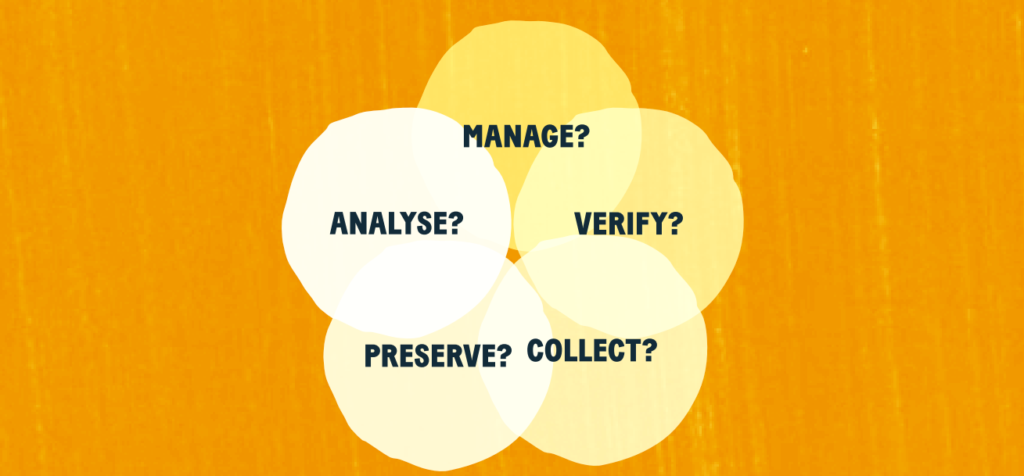
The findings indicate that HRDs are using technology tools in a variety of ways:
- Communication - to share their findings more broadly, such as through videos and press releases and to connect online with groups working on similar issues.
- Analysis - to identify patterns that otherwise would have been less visible without technology tools, such as repeated attacks in certain areas, and presenting this data on maps, charts, or interactive online features.
- Information management - to catalogue, store, and manage information about incidents and events related to human rights cases, as well as sharing it with others working on similar issues.
- Identifying new incidents - using digital tools and digital data to discover, verify, or corroborate violations - for example, by scanning social media or online video networks or by using mobile messaging platforms.
- Historical archiving - to scan paper documents, classify and tag them, make them machine-readable, encrypt them, and make backups in case they get lost.
Primary takeaways from the research:
- Traditional methods still apply: The environment in which HRDs are working has not dramatically inherently changed due to technology and data.
- In high-pressured situations such as that of HRDs, methodologies used need to be concrete and reliable.
- Priorities of HRDs centre around their particular issue: Digital technologies often come as an afterthought, rather than being integrated into established strategies for communication or campaigning.
- Sustainability of tools and maintenance is a big barrier to engaging with them and can cause fatigue among users having to change their practices often.
- Past failed attempts at using tools make future attempts more difficult.
- HRDs understand their context best: Tools recommendations coming from external parties sometimes do more harm than good.
- There is a lack of technical capacity within HRD initiatives. As a result, when tools are introduced, groups become reliant on external parties for technical troubleshooting and support.
Knowing where to start when an organisation or an individual has decided they need a technology tool to perform a certain function for them was raised multiple times as the very first barrier. For those who don't speak English, this becomes even harder. In general, choosing tools seems to happen in a relatively ad hoc way.
HRDs said that simplicity, familiarity, and ease of use were by far the most important criteria when choosing tools. Having tools in local languages made a big difference to this, and being able to ask for and receive help in languages other than English helped people to feel comfortable with new tools. Many used paper forms as their primary form of information capture. Software tools like Word and Excel were mentioned more than any others, while Google Drive and Dropbox were often mentioned as tools for sharing information and managing documents online. Tools for collaborating on documents and files across borders were particularly mentioned as a gap. Many organisations rely upon Google Drive for ease, needing a way of sharing and collaborating on the same document in close to real time. The ease of setup (signing up for a Google account) and the user-friendly nature of the tools and support documentation, along with the reliability of the tools, made it a much more appealing choice for many than a self-hosted alternative.
Many HRDs knew of the potential security risks associated with using tools like Google Drive but chose to use it regardless. In some contexts, using technology to document human rights violations was identified as a potential risk: Wendy Betts, director of eyeWitness to Atrocities, said: "In some places, even owning a smartphone that can film is problematic." Video was identified as especially problematic within Zimbabwe, where one activist said: "Zimbabwe is a country that has a higher level of paranoia and pointing your phone at a group of people like you're taking video can be seen as an aggressive act."
This study is intended as a scoping study rather than to provide concrete recommendations. That said, several common threads came up throughout the interviews and desk research:
- For tools developers: (i) Communicate clearly about your tool; (ii) Work with partner organisations from the beginning; (iii) Reality-check your assumptions often; and (iv) Be humble and collaborative.
- For HRDs: (i) Join communities like the Responsible Data Forum to keep up to date with current responsible data news and trends, and think about the holistic security impact of using certain tools; (ii) Get second opinions before committing to a certain tool or to working with a certain set of developers; (iii) Be realistic (no technology tool is going to "solve" social issues or problems, and getting people to change their behaviour is difficult); and (iv) Think long term; ask up front about sustainability issues.
The appendix summarises and shares information about tool functionalities in the following categories: data collection, data verification, data storage, and database (existing content).
Slimline C4D Network Twitter Trawl: 5 - 11 December 2016, and Engine Room website, December 13 2016.
- Log in to post comments