










































Taming the Beast: Harnessing Blockchains in Developing Country Governments
Independent Researcher, International Development Expert
"While still technologically evolving, blockchains offer unique traits and benefits that could make a difference if deployed strategically within governments in developing countries."
Developing countries became test-beds for Bitcoin and blockchain technology pilots, beginning in 2015, but, to date, no developing country has developed a national blockchain strategy, according to Raúl Zambrano. A blockchain is a digital ledger supported by the integration of 3 existing technologies: peer-to-peer (distributed) networks; cryptography; and consensus algorithms. In this paper, Zambrano develops a conceptual framework to explore how governments and the public sector in developing countries can harness blockchain technology to tackle key development challenges.
The paper first presents an analytical framework that brings together technology, development, and state capacity. Zambrano places governance at the centre of assessment of the potential impact of digital technologies such as blockchains on sustainable development efforts. In this light, the issue of state capacity is fundamental and is defined here as entailing: (i) institutional capacity (e.g., the legal capacity to sustain the rule of law in the long run); (ii) fiscal capacity; and (iii) infrastructural capacity. This paper uses digital government broadly defined as public investments on information and communication technologies (ICTs) to modernise the public sector, increase state capacity, and scale up the provision of public goods. In the context of a democratic governance approach mentioned, "the net outcome of successful ICT investments in public institutions should not be limited to access, efficiency and effectiveness. More relevant are the strengthening of democratic institutions where transparency and accountability shine the most and citizen and stakeholder engagement becomes part of daily life."
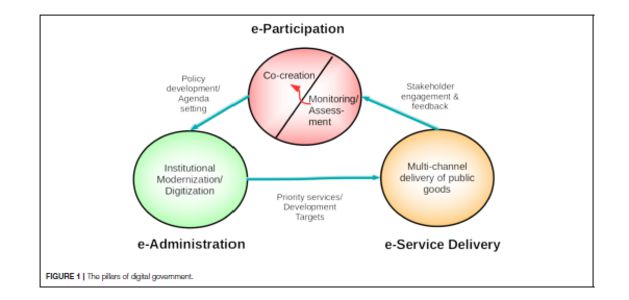
Figure 1, above, presents 3 pillars of digital government and its interconnections. Per Zambrano: "For developing country democracies, the key entry point is engagement with stakeholders to define policy agendas, identify key challenges, and prioritize interventions. Governments should then be able to identify the public entities that need to be involved according to existing legal mandates. Allocation of public resources is then finalized and changes in the provision of selected public goods should eventually improve. Stakeholders can then provide feedback and demand changes and improvements."
The paper then presents an overview of blockchain technology from the perspective of the public sector in developing countries, using the conceptual framework presented in the previous section as a guide. Zambrano describes a blockchain as "a programmable digital layer operating within a distributed network, requiring cryptographic tools for access and transaction management, and using consensus algorithms for adding or appending new blocks of transactions to the ledger." He then presents key blockchain traits based on the contribution that each of its 3 underlying technologies furnishes. Standalone traits include: resilience; pseudonymity; immutability; and incentives. Traits stemming from the integration of the technologies include: consensus; transparency; and security. (Table 1 summarises these key traits.) Table 2 presents a blockchain typology for the public sector.
The third section reviews the current status of research on blockchains and development and blockchains in governments, complemented by an examination of relevant on-the-ground examples. Zambrano looks at several "layers" of this landscape, including efforts that link blockchains to existing and emerging issues without necessarily referencing development or the SDGs (e.g., the Blockchain for Social Impact Coalition - BSIC) and entities using blockchain to support the achievement of the SDGs - e.g., the Blockchain Commission, a partnership of 3 non-profit entities launched at the United Nations in 2017. "The current approach to deploy blockchains in support of development is centered on the elaboration of relevant use cases, which might be openly linked to development goals. Once completed, they are then pitched to social ventures, development organizations or even governments in the Global South to secure either funding or support - or both - for small pilots."
Zambrano points to "a giant gap when it comes to deploying blockchains in developing country governments", with on-the-ground evidence from blockchain deployments within governments being "incipient at best". However, he does explore a few examples of blockchain pilots and projects in developing countries that are led by governments. To cite one: Estonia's Guardtime offers the government a solution called KSI (Keyless Service Infrastructure), which allowed for the decentralised verification of public records, data, and access points without having to use a digital signature. Instead, KSI uses one-way hashing and a decentralised ledger in supporting existing e-governance platforms and services.
The paper continues with a discussion of the proposed framework and research findings, highlighting both challenges and opportunities for governments. Zambrano stresses that having governments as part and parcel of the overall equation demands serious consideration of the relationship between state capacity and both development and digital technologies. A core issue here is the lack of local capacity to effectively harness blockchain, even if the platform is open source and thus has no per-user licensing costs. Such capacity is not merely technical but also scientific and managerial, as governments and partners should fully comprehend the inner workings of the technology. Yet many countries in the Global South lack adequate cryptographic expertise, have weak public key infrastructures (PKIs), and are not very familiar with consensus algorithms. Furthermore, while peer-to-peer networking is readily available, limited internet access may pose constraints to widespread utilisation.
Blockchains can also have potential in enhancing state capacity. Many developing countries have designed decentralisation or devolution strategies where both policymaking and fiscal management shifts from central governments to those in regions, states, and municipalities. Implementation of such policies has however been challenging, particularly in low-income countries. Governments could set up one blockchain platform, a GovChain, to cater to all local governments. Financial resources could thus flow within the Gov-chan vis smart contacts, while local government offices can use the platform to support other government activities such as public information disclosure. Early implementations indicate that adequate institutional support and endorsement are critical, especially from the public entities promoting digital government that had already identified a range of priorities as key targets.
The evidence compiled so far suggests that the technology can deliver when explicitly linked to both digital government institutional instances and digital government priorities and gaps. But the first question developing countries need to ask, Zambrano urges, is if blockchain technology is the most optimal solution for the issue at stake. Several models for making such a decision have already been developed and, he says, should be further refined to fit developing country contexts. Selecting the adequate platform will mostly depend on the type of digital government priority.
The paper closes with basic guidance for development practitioners interested in enhancing current programming using blockchains as an enabler. For example, Zambrano suggests that governments in the Global South should capitalise on existing South-South and North-South cooperation agreements and networks to extract more information on ongoing blockchain deployments in the public sector.
In conclusion, though on-the-ground evidence of blockchain implementation in developing countries is still emerging, and while risks abound due to the limitations of the technology itself and its complexity, "early evidence suggests that blockchains can add value when deployed as part of a team of digital technologies working in sync. ....Indeed, blockchains have been touted as an 'institutional technology' that could bring dramatic changes within governments (and all other sectors)...And that would undoubtedly be a critical achievement that could contribute to resilient long-term sustainable development."
Frontiers in Blockchain 2:27. doi: 10.3389/fbloc.2019.00027.
- Log in to post comments