










































Stop Transmission of Polio (STOP): Communication Team
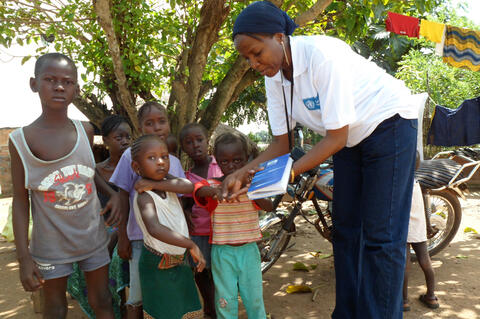
Many countries affected by polio have a shortage of skilled public health staff available to fully support the global effort to eradicate the disease. The Stop Transmission of Polio (STOP) programme, led by the Centers for Disease Control and Prevention (CDC) and co-sponsored by Rotary International, the World Health Organization (WHO), and the United Nations Children's Fund (UNICEF), helps address this shortage by training and deploying volunteers to support in-country immunisation programmes. Acknowledging that effective programme communication and social mobilisation are important components of the polio eradication initiative, in September 2006, the STOP programme sent its first participants into the field to work specifically in communication. The STOP programme coordinates with both UNICEF and WHO in the recruitment, training, and placement of these participants.
Following approximately 2 weeks of training and orientation held in Atlanta, Georgia, United States (US), STOP teams, including the communication team, spend 5.5 months in the field (departing 2 times per year, in January and June). STOP communication participants assist WHO, UNICEF, and ministries of health by:
- Developing and implementing national and subnational polio communications plans;
- Developing appropriate messages and materials for the public, health-care providers, vaccinators, and the media; and
- Serving on committees to ensure effective coordination among various communications partners.
While planning, monitoring, and evaluating communication activities for polio supplemental immunisation activities (SIAs), STOP communication participants work under difficult conditions with people of different cultures. So, as part of the requirements to join the team, they are asked to have skills such as: development of health-communication messages or activities based on communication science and marketing constructs; writing for the media, including articles, talking points, and background documents; experience with information, education, and communication (IEC) strategies; and fluency in English as well as a second language.
Here is a story from a STOP volunteer on the communication team: Camilla, a health communication specialist from Brazil who first developed experience in social mobilisation and communications working in remote Amazon areas for the Brazilian Ministry of Health and other country health foundations. Often, this health outreach involved traveling for several hours on a small boat in the tributaries of the Amazon River. During her first STOP assignment in Angola, Camilla developed communication materials and strategies to encourage vaccination among groups that were unfamiliar with polio vaccination. In some areas where she worked, landmines presented a danger to both children and those who vaccinate them. For her next assignment, she hopes to continue to reach high-risk groups and encourage them to vaccinate their children. "What excites me are the stories," Camilla explains. "I always ask myself, 'How can I help people to really understand why their children need to be vaccinated?' Understanding cultural practices and roles that are barriers to vaccination can help public health workers develop strategies that overcome resistance."
Click here to learn more about the STOP programme.
Immunisation and Vaccines
Since 1999, more than 1,850 STOP volunteers have worked in 70 countries. The January 2013 41st STOP programme had 181 volunteers from 13 countries to be deployed to 27 countries.
CDC, Rotary International, UNICEF, and WHO, with support from the Bill and Melinda Gates Foundation.
"STOP Polio: Coming Together to End Polio Once and For All" on the CDC website and Communications page on the STOP website - both accessed on April 3 2013.
- Log in to post comments