










































Singing to the Lions - A Facilitator's Guide to Overcoming Fear and Violence in Our Lives
“From research and news reports we see that violence is a worldwide phenomenon that occurs in many settings – in our countries, neighborhoods, home and schools. If not treated, the effects of violence are especially harmful to children and can affect them for the rest of their lives. The results can be felt in future generations.”
The Singing to the Lions facilitator’s guide describes the steps for running a workshop for children to give them the skills to resolve the impact of violence and abuse in their lives, and to heal. This includes learning skills to respond effectively to current instances of violence and abuse, to create layers of social protection, and to start to resolve earlier negative and destructive experiences. Violence, as it is understood in this guide, refers to experiences of physical, sexual or emotional abuse, injury, exploitation or significant loss – or the threat thereof. The types of violence that are considered in Singing to the Lions are varied and include (but are not limited to):
- Bullying in response to a child’s disability or difference
- Fighting within the home
- Child abuse and child trafficking
- All types of sexual exploitation
- Forced migration
- Torture, imprisonment or murder of family members
- War and armed conflict
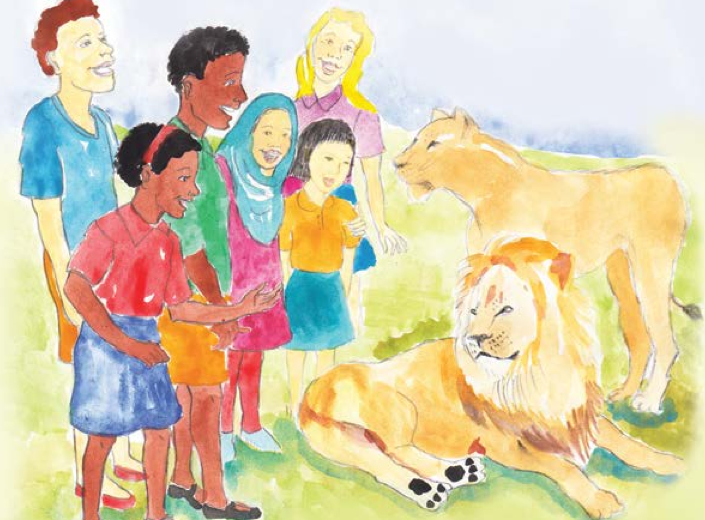
The workshop is intended for participants aged 11 to young adults, but can also be used to help adults take action on aspects of their lives that cause fear and, in so doing, become better parents and caregivers. The workshop uses games, art, drama, calming techniques, and songs. As explained in the guide, “[I]t is based on principles of psychosocial resilience, cognitive psychology and narrative therapy. In the workshop, lions represent fear. By singing, people demonstrate their ability to overcome their fear. The workshop’s premise is that there are two ways people can respond to fear and violence in their lives. One is to try to lessen the impact of the fear by reaching out for help, strengthening connections with friends and loved ones, and developing problem-solving skills. Realizing their talents and skills also helps people feel better about who they are, which in turns lessens the feelings of fear. And they can remind themselves that they have overcome past difficulties, so they can do it again. Another way is to control the way they respond to fear so that it doesn’t overwhelm them. They do this by practicing breathing techniques and other calming exercises. Singing to the Lions teaches these skills by allowing participants to experience them, all the while having fun. By the end of the workshop, participants will have learned that they can transform their lives and no longer feel dominated by fear. Suggested follow-up activities, such as youth clubs, reinforce the lessons learned for ongoing groups.”
In addition to the facilitator’s guide, there is a supplement that provides background information, guidance on monitoring and evaluation (M&E), recommendations on how to train facilitators, an outline for a one-day orientation workshop (for example, for local government officials and community leaders), and suggestions on how to handle sensitive issues that might arise. An experienced facilitator can lead the workshop without external training, but training is recommended for less experienced facilitators. There is also a data entry sheet and a handout about the workshop.
Developed by the Catholic Relief Services (CRS), the tool was internationally reviewed and pilot-tested in Zimbabwe, Uganda, and Sierra Leone.
Publishers
English, Spanish and French
CRS newsletter, August 17 2017, and CRS website on August 19 2017.
- Log in to post comments