










































School-based Social and Behavior Change Communication (SBCC) Advances Community Exposure to Malaria Messages, Acceptance, and Preventive Practices in Ethiopia: A Pre-posttest Study
Jimma University (Kebede, Abebe, Sudhakar, Birhanu); United States Agency for International Development (Alemayehu)
"Community empowerment is a milestone to meet the ambitious plans of eliminating malaria by 2030."
The Roll Back Malaria (RBM) and the World Health Organization (WHO) malaria elimination framework includes social and behaviour change communication (SBCC) indicators focused on enhancing community empowerment and mobilisation towards malaria prevention, control, and uptake of services. This study hypothesised that school-based SBCC is an effective strategy for malaria prevention and control. It was focused on enhancing the community's malaria prevention and control skills by training primary school teachers, facilitating students' peer education, and ultimately reaching out to their families and neighbours with SBCC messages. This study aimed to assess the change in households' malaria message exposure, acceptance, and behaviours through empowered primary school students.
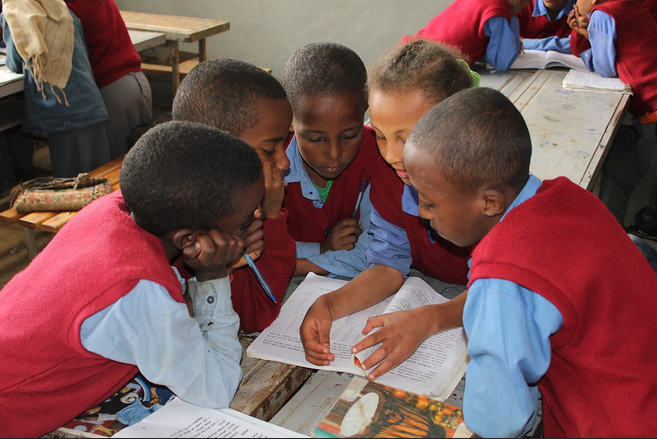
The SBCC strategy being evaluated involved engaging grade 5-8 students to reach out to their respective families. The Ethiopian education system pursues a peer learning approach whereby every student in primary school is a member of a student circle (also called student army). Each student circle is led by a group (army) leader, an academically top student, who is responsible for facilitating peer education under close supervision by focal teachers. There were two forms of facilitators' training. First, selected natural science teachers were trained to be school-level malaria SBCC focal persons (facilitators). Second, the student army leaders received training by these facilitators. The content of training included the basics of malaria such as cause, manifestations, prevention measures, and roles of the students. Essential malaria messages and doable actions were given due attention during training. After the training, the army leaders conducted peer-to-peer education among their group members, using a guiding flipchart with five separate session topics. Ultimately, the students, who were asked to educate their parents, were jointly followed by focal teachers and the project's local coordinators. There was a confirmation card that parents were asked to sign, to send back to school for documentation, and to cross-check after the students taught them the messages from each peer discussion session.
In this study, changes in the community's exposure to malaria messages through schools were expected to produce changes in knowledge, message processing and perceptions (susceptibility, severity, attitude, self-efficacy), message acceptance (perceived efficacy minus perceived threat = message acceptance in favour of danger versus fear control), and five key preventive practices (sleeping under an insecticide-treated net (ITN) every night, handling indoor residual spray (IRS) in a healthy way, cleaning the environment, seeking treatment from health facilities within 24 hours of the onset of fever, and completing the anti-malaria drugs provided by health professionals). These variables were also the RBM's SBCC indicators. Resources (ITNs, IRS, and anti-malarial drugs) required to enable execution of the practices were provided through health posts that are located in every ganda (village) and coordinated through malaria prevention and control officers at the district health office.
A community-based pre-posttest study was conducted in five districts of Jimma Zone, Ethiopia. The data were collected through face-to-face interviewer-administered methods among 762 and 759 household sat baseline (October 2017) and endline (March 2019), respectively. Proportion/mean differences were computed to compare both surveys on exposure, knowledge, perceptions, and practices at p <0.05. Finally, a regression analysis was conducted between key changes and school-based exposure.
Key findings:
- The study revealed a sharp increase in exposure to malaria messages from any source, with effect size (ES) of 65.7%, p <0.001. School-specific exposure grew to 57.8% (ES = 44.5%). The researchers compared the ratio of the content intensity of message exposure via school students to the general sources, compared between the endline and baseline, which showed a significant increment by ES = 24.1% at endline, p = 0.001. This data indicate that empowered students could disseminate 24% extra content of malaria messages compared to any other sources in their community.
- Comprehensive knowledge about malaria increased to 39.1% (ES = 14.8%). Identifying mosquito bites as a cause of malaria increased by ES = 20.8%.
- A slight reduction in risk perception (ES = 3.3%) and attitude (ES = 3.8%) and a higher rise in self-efficacy (ES = 8.5%) were observed.
- Community message acceptance in favour of malaria danger control was significantly improved by 10% - i.e., an increase in rational decision making to uptake preventive practices.
- ITN usage rose to 63.0% (ES = 25.8%), and giving priority to use ITNs for under-five-year-old children and pregnant women grew by 16.3% and 24.8%, respectively. Significant improvements were observed in treatment-seeking for fever (ES = 16.3%) and early treatment-seeking (ES = 15.5%). Not painting or plastering walls 6 months within spraying changed by ES = 61%. No significant change was observed in drug adherence.
- Regression analysis revealed that most of the variables indicated with improvements at the endline compared to baseline were correlated with the school-based exposure status and intensity of the messages. For example, ITN utilisation and not plastering walls within 6 months of spraying were higher among respondents with school-based exposure to malaria messages compared to households with no school exposure. Comprehensive knowledge was associated with the message content intensity, not mere exposure to school-based communication.
Reflecting on the findings, the researchers indicate that: "This school-based malaria SBCC produced a considerable change in exposure to malaria messages and practices. The introduction of school-based SBCC into the community reshuffled the common sources of and added to the contents of malaria messages. Approaching malaria communication through schools was promising in that it resulted in students' visibility as common sources of messages and higher penetration with more messages. Despite substantial positive changes in comprehensive knowledge, message acceptance, practices of ITN, timely treatment-seeking for fever, and IRS handling, the amount should still increase to meet national malaria strategic plans and guidelines....The study signals risk appraisal messages are still required for malaria prevention."
In conclusion: "Overall, school-based SBCC was an effective strategy to expose and advance the community's behaviors toward malaria prevention and control. [The researchers] recommend national malaria elimination plans and school health promotion programs to embrace school-based SBCC strategy and primary school students as change agents."
PLoS ONE 15(6): e0235189. https://doi.org/10.1371/journal.pone.0235189 - sourced from email from Sue Goldstein to The Communication Initiative on December 10 2021. Image credit: Global Partnership for Education (GPE)/Alexandra Humme via Flickr (CC BY-NC-ND 2.0)
- Log in to post comments