










































Red Ribbon Express (RRE)
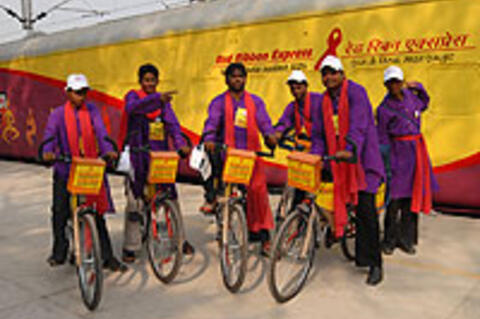
Provided by the Railway Ministry, the train itself is an 8-coach mobile education and exhibition centre using technologies such as interactive touch screens and 3D models. It has its own auditorium to host education sessions for anganwadi (child-care centre) workers, self-help groups, and non-governmental organisations (NGOs) serving youth and women. A separate coach provides six cabins for counselling and medical services.
The RRE aims especially to reach youth in India's most disadvantaged and remote communities with AIDS prevention before the virus reaches them. To support this goal, young people have played a central role. In 2007, Nehru Youth Centres, a network of young communicators, traveled on the train, making HIV and AIDS the talk of towns and villages across India. Six performing teams, each with 10 members, disembarked from the train on a fleet of bicycles to visit dozens of villages during each station stop. They staged plays and skits about stopping HIV infection and fighting AIDS stigma and discrimination. Another group of young campaigners travelling by bus will cover an even larger area than the cyclists at each stop. "Our role is to make people aware through folk media, theatre and street plays. We are going to give knowledge about what is AIDS," said Yoby Georgee, one of the Nehru Youth Centres activists working on the train.
In its first year-long journey, the train stopped at 180 stations and reached more than 50,000 villages in 22 states. To make people aware of, and motivated to participate in, RRE, prominent personnel have reportedly participated actively in drawing attention to the initiative. For instance, on World AIDS Day 2007, the well-known politician Sonia Ghandi joined high-ranking government officials and representatives of partner organisations at New Delhi's Safdarjang Railway Station to launch the RRE. Organisers have also used skills in mass media planning, development, and execution to develop a creative strategy that incorporates region-specific components and that gears messaging to specific groups they hope to reach. Communication tools being used to publicise RRE include what are intended to be compelling formats for radio, documentaries, television, print, etc. Sensitised journalists and photographers join the RRE at different states of its journey and continuously feed national level media newsworthy stories. Also, a series of events - e.g., involving local celebrities, organising festivals, etc. - in the villages and at the stations are designed to get people to visit the stations. In locations where mass media do not reach, trained communication activists/volunteers/folk artists are equipped with RRE-related material, keeping local language and traditions in mind.
To cite an example from the 2009/2010 journey - expected to halt at 152 stations in 10,000 high-HIV/AIDS prevalence villages in 141 districts - RRE arrived in Maharashtra on January 2 2010. Its first stop was at Amalner station in Jalgaon district. During its 28-day stay in Maharashtra, the 8-coach train is expected to stop at 13 stations and cover 11 districts. In this particular year's journey, foci were awareness and prevention messages and on-board treatment facilities.
Also in 2009/2010, RRE is supplementing its AIDS awareness journey with a special mandate: to mobilise mass awareness about swine flu, a pandemic that, as of late 2009, had killed 580 Indians and infected over 18,000. One coach of the train provides information on communicable diseases like swine flu. During its halt at different places, volunteers will disseminate information not only about AIDS prevention and services, but also about swine flu.
HIV/AIDS, Health.
NYKS, NACO, RGF, Indian Railways, UNICEF, and State AIDS Control Societies (SACS).
"Sonia Gandhi to Flag off AIDS Awareness Train on Tuesday" - forwarded by Avnish Jolly to the "SAFE - Social Action Foundation for Equity" Google group on November 29 2009; "Red Ribbon Express to Create Awareness on Swine Flu", December 2 2009; "Red Ribbon Express in Maharashtra from Monday, January 2 2010"; and "'Red Ribbon Express' Rides the Rails to Raise Youth AIDS Awareness in India", by Gerrit Beger. First image © UNICEF India/2007/Biswas; second image © NYKS.
Comments

This is a very noble
This is a very noble program. I wish it all the best.
Earth4Energy

- Log in to post comments