










































Promoting Community-Driven Change in Family and Community Systems to Support Girls' Holistic Development in Senegal
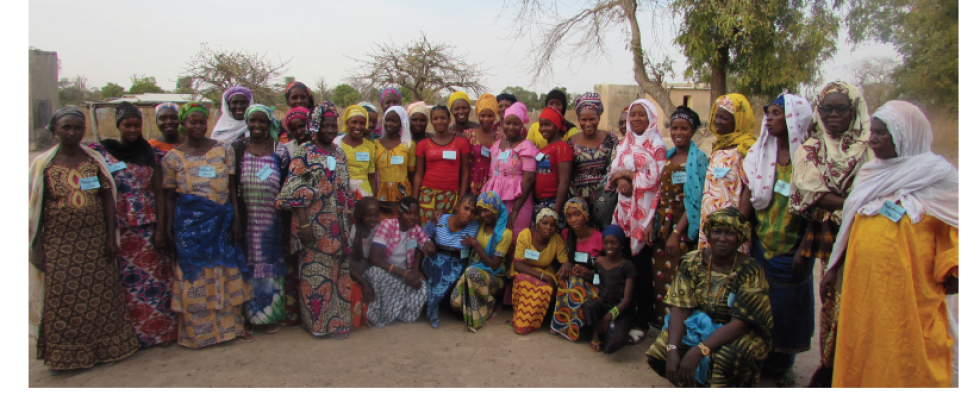
Grandmother Project (GMP) - Change through Culture
"In order to promote community-wide change, all key community actors must be involved. Also strong communication relationships between them are the foundation for open dialogue and reflection on existing social norms and on alternative concepts and practices."
This paper presents the story of the Girls' Holistic Development (GHD) programme, which aims to create an enabling environment around girls so they can flourish. This is achieved by directly supporting girls while at the same time encouraging community-wide consensus-building for adoption of social norms and attitudes that are more supportive of girls. It was designed and implemented by the nonprofit organisation the Grandmother Project (GMP) - Change through Culture in Southern Senegal. GHD started in 2008 and was developed over time through a process of action research and learning. On several occasions, external researchers conducted evaluations of the programme. The case study describes this programme, its impact to date, and the lessons learned that may be relevant to other African contexts and to other collectivist cultures in the Global South or Global North. (More information is available at Related Summaries, below.)
To begin, the paper presents the community context. Senegalese people's lives are influenced by Muslim and African values that include respect for elders, solidarity, generosity, and interdependency. African cultures are built on collectivist, or relational, values and accord greater importance to interdependency and support of group values and achievement than to autonomy and individual accomplishment. Families and communities support their girls as they grow up; however, there are some deep-seated social norms and practices that limit girls' development and well-being. For example, most families prioritise boys' education, and early marriage of girls, sometimes as young as 12, is prevalent, often with families playing a major role in identifying a spouse for their young daughters. For girls who stay in school beyond puberty, teen pregnancy is a frequent problem, and female genital mutilation (FGM) is widely practiced on baby girls.
The discussion of GHD's process over a 12-year period is divided into several parts:
- The preparation phase: At the outset, the international non-profit organisation World Vision (WV) asked GMP to develop a strategy to combat FGM in the Velingara area of Senegal. In order to develop what later became the GHD programme, the two initial activities were: (i) a rapid qualitative and participatory assessment - catalysing reflection on an issue that WV and GMP viewed as a problem, but that communities did not; and (ii) a series of dialogue-forums to discuss the results of the assessment with community actors - shaped by the idea that programmes that promote change in certain harmful traditions, e.g. FGM, should simultaneously promote positive cultural values and traditions. Forum participants stated that any efforts to promote the well-being of girls and to discourage FGM should involve grandmothers because they are responsible for preserving cultural norms and because they have a close relationship with the cutters (hence, they have the greatest possibility of discouraging them from continuing this practice). Based on these explorations, as well as key principles from community development, adult education, anthropology, and community psychology, the GMP team identified a set of concepts and methods that informed the design of the GHD intervention.
- The implementation phase (see Related Summaries, below, for details): The GHD programme builds social cohesion - strong communication relationships between community actors, which are the foundation for open dialogue and reflection on existing social norms and on alternative concepts and practices. In light of the role and influence of both formal and informal community leaders, the GHD activities primarily involve leaders of three generations (elders, adults, and adolescents), male and female, as well as traditional leaders. The objective of the activities is to catalyse dialogue and reflection to develop a consensus regarding the need for change (e.g., to abandon child marriage) and to collectively decide on actions to be taken to change existing norms and practices. Key community activities include (see Related Summaries, below, for details): intergenerational forums; Days of Praise of Grandmothers; grandmother leadership training; teacher workshops on integrating positive cultural values into schools; under-the-tree participatory learning sessions with girls, mothers, and grandmothers; grandmother-teacher workshops; all-women forums; and Days of Dialogue and Solidarity with religious leaders and other community elders.
- The programme evaluation phase: At the outset of the GHD programme in 2008, a Theory of Change (ToC) was developed with the GMP team in Senegal. To support the continuous learning process, a series of evaluations and studies were conducted by external researchers in collaboration with GMP staff. And in 2019, the Institute of Reproductive Health (IRH) at Georgetown University, in collaboration with the University of Dakar and in the context of the United States Agency for International Development (USAID)-funded Passages Project, evaluated the results of the GHD programme. (For access to a summary of and link to this document, see Related Summaries, below.). Key findings of the IRH research include:
- The dialogue-based approach has provided a platform for the community to discuss norms and practices that are harmful to girls and to identify their own solutions through consensus-building.
- GHD promotes change in culturally embedded social norms and practices related to girls' education, child marriage, extra-marital teen pregnancy, and FGM by both empowering girls and creating an enabling environment around girls in which family and community actors support change for girls.
- GHD interventions that focus more on involving community and family members than on adolescent girls can have greater impact on changing norms and behaviours that affect girls.
Based on the conclusions of the various evaluations and studies - and on the GMP team's lived experience with communities carrying out the programme - GMP revised the ToC in October 2020 (see page 17 of the case study for the diagram).
Through a process of ongoing implementation-analysis-learning, the following insights and lessons were identified that may be relevant in other contexts:
- In African communities, elders have status and power over younger generations and determine the social norms that structure family and community life. When an approach based on respect and dialogue is used, they are not automatically opposed to change.
- When programmes respect and build on cultural and religious roles and values that communities cherish, community actors are more receptive and more engaged. The opposite is also true.
- In non-western cultural contexts, grandmothers play a role in all aspects of the upbringing and development of children, especially girls. Using an assets-based approach, programmes should acknowledge and build on this cultural resource.
- Families are concerned about all facets of girls' upbringing and development. Communities are more receptive to programs that address various facets of girls' development, rather than single-issue strategies.
- Community involvement in programmes is greater when programmes address issues not only priority concerns of development organisations but also issues that are of concern to communities.
- Communication between three generations (elders, adults, and adolescents) should be strengthened in order to promote harmonious change within family and community systems rather than creating conflict between generations with differing opinions.
- Both formal and informal leaders, of all three generations and sexes, should be involved in all efforts to promote change in communities.
- Communication and education methods used with community groups should be based on adult education methods that elicit critical reflection among community actors rather than on persuasion and messages with passive beneficiaries, or audiences, to convince them to adopt expert-identified solutions.
- Communities are more open and engaged in programmes that encourage and reinforce positive roles, values, and practices while discouraging harmful ones.
- It is important for a programme to determine at the outset what the roles and influence are of different family and community actors in order to involve all categories of people who already influence or who could influence the issue being addressed.
Chapter 5 in Case Studies in Community Psychology Practice: A Global Lens, edited by Geraldine Palmer, Todd Rogers, Judah Viola, and Maronica Engel - sent via email from Judi Aubel to The Communication Initiative on May 19 2024; and emails from Judi Aubel to The Communication Initiative on May 11 2021 and May 22 2021. Image credit: Judi Aubel
- Log in to post comments