










































PRISM Tools: User Guide
"Organizations develop information systems to meet their information needs, promote evidence-based decision-making, manage knowledge, create transparency, and apply good governance. Thus, it is a management responsibility to maintain and sustain the information system."
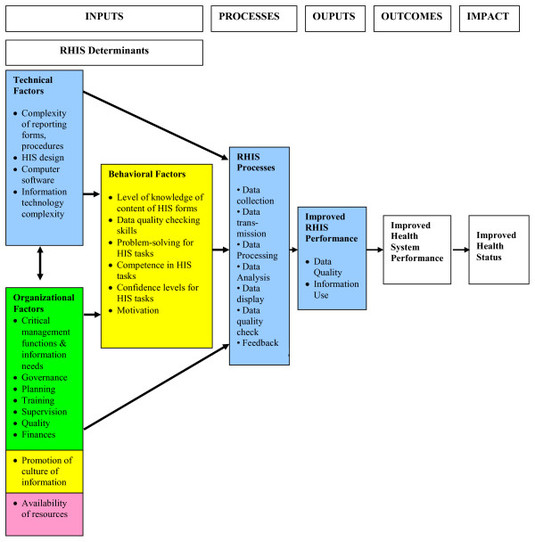
From MEASURE Evaluation and the United States Agency for International Development (USAID), this resource provides a guide to Performance of Routine Information System Management (PRISM), a conceptual framework for strengthening routine health information systems (RHIS) through better data quality and improved information use. Developed by MEASURE Evaluation and John Snow, Inc., PRISM broadens the analysis of RHIS performance to include 3 key categories of determinants that affect performance: behavioural (the knowledge, skills, attitudes, values, and motivation of the people who collect and use data); technical (the data collection forms, processes, systems, and methods); and organisational (the information culture, structure, resources, and roles and responsibilities of key contributors at each level of the health system). This guide is intended for government and non-governmental organisation (NGO) professionals and RHIS consultants who want to design, assess, strengthen, and evaluate RHIS performance at the national and sub-national levels.
The PRISM toolset includes the following data collection tools and instructions on how to use them:
- Performance Diagnostic Tool: determines the overall level of RHIS performance, i.e., the level of data quality and use of information. It captures the technical determinants of RHIS performance, such as level of complexity of data collection forms and user-friendliness of information technology (IT).
- Overview and Facility/Office Checklist: examines technical determinants, such as the structure and design of existing information systems in the health sector, information flows, and interaction between different information systems. It allows users to understand the availability and status of RHIS resources necessary for RHIS implementation at the facility and district levels.
- Organizational and Behavioral Assessment Tool (OBAT): identifies behavioural and organisational factors affecting RHIS performance. Behavioural determinants include level of data demand, motivation, confidence, task competence, and problem-solving skills. Organisational factors include level of promotion of a culture of information and the existence (or not) of a reward system.
- Management Assessment Tool (MAT): takes rapid stock of the RHIS management practices and aids in developing recommendations for better management.
The PRISM user guide is organised into chapters. The first chapter starts with a description of the PRISM framework and its tools. Next, each tool is described in a separate chapter (chapters two through six). Chapters on each tool begin with a description of the tool's uses, followed by a short description of the tool. Later, the chapters describe the strengths and limitations of each tool. The chapters end by explaining how to ask each question, review records, or make observations in the tools using an example of a filled tool. Chapter seven provides a summary of the data collected from each of the tools. A methodology for applying the tools is presented in chapter eight. Chapter nine covers how to use the PRISM data entry and analysis tool. The final chapter deals with how to interpret the findings; the authors describe this chapter as an essential read for understanding how to prepare a report after completing use of the tools.
Publishers
English.
174
Email from MEASURE Evaluation to The Communication Initiative on March 21 2012.
- Log in to post comments