










































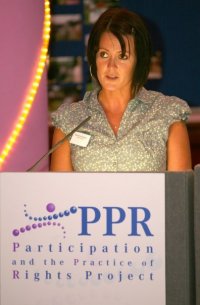
Participation and Practice of Rights Project (PPR Project)

The PPR Project is shaped by a rights-based approach, which involves empowering people, especially those from particularly vulnerable groups, to get fully involved in challenging the power relationships and structures which determine who makes decisions, whose voice is heard, and what issues are prioritised at government and statutory levels. (Click here to learn more about the Project's definition of "HRBA"). The focus is on promoting rights-based democratic practice on the basis of participation and on strengthening the direct accountability of the state and statutory bodies to communities through the understanding and implementation of international human rights standards.
The PPR strives to meet its objectives through:
- Holding introductory information sessions on human rights;
- Equipping groups and residents with the skills needed to assert their social and economic rights;
- Providing practical support in developing campaigns and strategies which seek to advance the implementation of international human rights standards in local communities;
- Training community activists in the use of human rights tools;
- Producing publications, including profiles of human rights violations in specific communities - click here to visit the Project website's resources section;
- Facilitating information sharing and mutual learning through an international network - in part through a Facebook page.
- Hosting seminars and conferences linking the work of local residents and community activists with national and international human rights advocates.
The following example serves to illustrate how these strategies look in practise. In North Belfast, the PPR Project works with a group of residents who live in a high-rise complex of flats known locally as the Seven Towers. Concerned that the flats are in poor condition, and that many individuals with children and people with health problems are inappropriately housed there, residents repeatedly complained to the Northern Ireland Housing Executive (NIHE). Despite their efforts, which have received high-profile media coverage, little has changed in the 30 years since the Seven Towers were constructed. In late 2006, local housing and community activists approached the PPR Project. Numerous meetings were held with these activists and the New Lodge Housing Forum (the local housing group) to gain a deeper understanding of the issues and strategies used to address residents' issues. To facilitate the process of engagement between the residents and the PPR Project, an event was held in a local community centre to allow residents to voice their concerns about living in the Towers. A short documentary was then compiled and screened for residents. Following this, the PPR Project conducted training on human rights and a HRBA with a group of residents in January 2007.
The PPR Project's process involves a participatory evaluation element. The PPR Project adopts a "bottom-up" approach with the aim of assisting communities in setting their own indicators, in relation to very specific issues selected by that community. Continuing with the above example: In April and May 2007, the Seven Towers residents began to devise a set of indicators, articulating in a tangible and measurable fashion what the "right to adequate housing" and "the right to health" mean to them and how the relevant statutory agencies could fulfil these rights over a defined time period - one year - and in relation to a specific set of issues (e.g., sewage ingress and drainage problems). The group aimed not only to resolve these issues but to structurally change the manner in which the NIHE went about addressing them, in order that the benefits of their work could be felt among other communities with similar problems. Each indicator was linked to a human rights standard, and a benchmark was set.
The Seven Towers indicators are monitored by the Seven Towers Monitoring Group (STMG), which was established in June 2007 following the "Evidence Hearing on the Right to Housing", hosted by the residents of the Seven Towers. The STMG has 4 members: two residents of the Seven Towers, one community activist, and one member of the PPR Project. The group has developed strategies to involve residents in a substantive, as opposed to token, change process. The STMG is responsible for the development of periodic progress reports which are submitted to the Minister for Social Development and her Department (the DSD), and the NIHE. The STMG meets with the NIHE quarterly to review progress. In addition, a ministerial representative from the DSD receives the reports and attends STMG meetings when necessary. The reports are also submitted to an international panel of housing rights experts. Meetings between the STMG, the NIHE, and the residents are held on a regular basis; residents draw up the agenda for the meetings.
Focus groups with 10 residents were carried out in March 2008 to explore barriers to the right to an effective remedy when reporting problems to NIHE. Then, 21 residents attended meetings in May 2008 to learn about monitoring results, plan future activities, and recruit additional members to the group. Residents organised an art project with 8 children residents in May 2008 on the "right to housing". They carried out a satisfaction survey in May 2008 among residents of one tower where the sewage system was replaced. Amongst future plans is an oral history project with residents to chart historical context and developments over time.
Democracy and Governance, Rights.
Click here to learn more about the indicator development process described above, and to access links to papers developed as part of the Seven Towers participatory evaluation process.
Click here to access the PPR Project's YouTube channel.
"Case Study 4 - The Seven Towers Monitoring Group: A Non-Institutional Mechanism for Participation - Belfast, Northern Ireland" in Participation and the Right to the Highest Attainable Standard of Health [PDF] indicates that, despite the existence of a framework for engagement in the Seven Towers project (see above), the STMG has experienced substantial barriers to their participation, such as non-acceptance by the NIHE of the participatory structure, non-availability of information, attempts on the part of the NIHE to bypass the STMG structure, and decision-making without participation. "To date, the indications are that the NIHE is cooperating with the structure out of duress and only really substantively engages with the group when pressure is applied through campaigning and the direct involvement of the Minister's office."
Representative community groups from across North Belfast and North Inner City Dublin; Combat Poverty Agency; Committee on the Administration of Justice; Irish Council for Civil Liberties; Irish Congress of Trade Unions; and Community Foundation NI [Northern Ireland].
"Case Study 4 - The Seven Towers Monitoring Group: A Non-Institutional Mechanism for Participation - Belfast, Northern Ireland" in Participation and the Right to the Highest Attainable Standard of Health [PDF], by Dr. Helen Potts; and the PPR Project website on July 20 2009.
- Log in to post comments