










































Malaria Control in Rural Malawi: Implementing Peer Health Education for Behavior Change
University of Malawi College of Medicine (Malenga, Kabaghe, Manda-Taylor, Kadama, McCann, Phiri, van Vugt, van den Berg); University of Amsterdam (Kabaghe, van Vugt); Wageningen University and Research (McCann, van den Berg)
"Community workshops on malaria are a potential tool for influencing a positive change in behaviour towards malaria, and applicable for other health problems in rural African communities."
Interventions to reduce the malaria burden are only effective if communities use them appropriately and consistently. Factors such as traditional beliefs hinder behavioural changes consistent with malaria prevention in Chikhwawa district, southern Malawi. In response, the Majete Malaria Project (MMP) used a health animator (HA) approach as a community engagement strategy to encourage health behaviour change for malaria control. This descriptive study reports on the feasibility, acceptability, appropriateness, and fidelity of using HA-led community workshops for malaria control.
MMP is based in communities surrounding the Majete Wildlife Reserve (MWR) in Chikhwawa, where plasmodium falciparum malaria is endemic, with transmission throughout the year, peaking in the wet season (December to May). Due to its remoteness, the MMP catchment area where the workshops were implemented is likely to have even lower literacy levels than the district average.
The strategy on which MMP was built aims to influence a change in mindset of vulnerable populations to encourage self-reliance. This change is achieved through community mobilisation led by a cadre of community-based volunteers (the HAs): permanent adult residents of the catchment community who were identified and approached by village leaders. Each HA was given a bicycle to use for transportation when attending coordination meetings or for conducting workshops, as well as branded T-shirts and caps for easy identification.
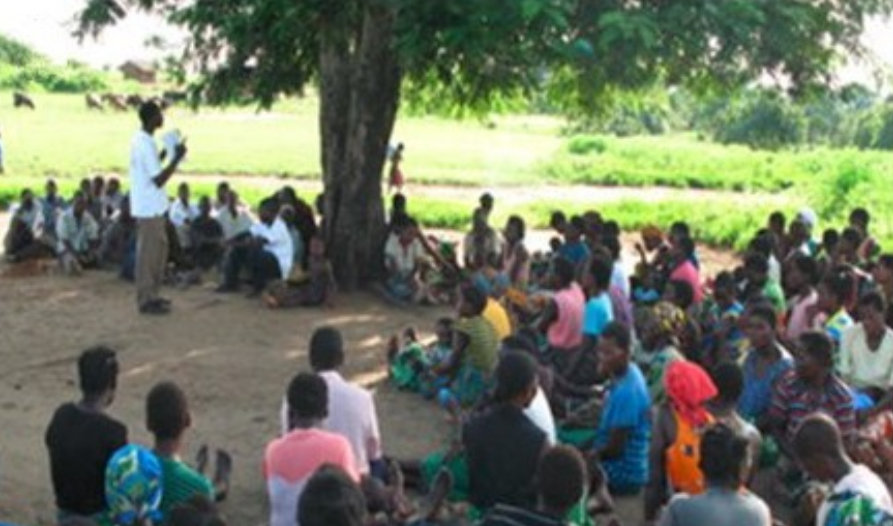
All HAs initially underwent a 2-day introduction on the Vision, Commitment, and Action workshop concept (VCA). This concept involves creating a vision for the future of the community, committing to achieving the vision, and formulating a specific action plan to achieve the vision. The HAs then took part in a 5-day training course based on a malaria manual that was translated into Chichewa, the local language. The manual included 24 learning units prepared for a series of workshops to be completed in an annual cycle. The main topics were interactive, with questions from the facilitator (the HA) and responses from participants, who numbered 10-15 people per workshop. Each workshop began with a short play, poem, or song with a malaria message.
After the HA training, MMP briefed all village chiefs about the workshops, emphasising the need for their support and involvement. The village chief sent a message in the village a day prior to and on the day of the workshop and attended the workshop as well.
One individual served as a rapporteur responsible for evaluating the workshop using a standard evaluation form. Also, the implementation fidelity of the workshops was independently assessed by MMP personnel in 4 randomly selected workshops. Furthermore, 3 focus group discussions (FGDs) with 8-12 HAs were conducted from October to December 2015, and 7 in-depth interviews (IDIs) with HAs were conducted between October 2016 and February 2017.
Seventy-seven HAs from all focal areas completed the 5-day malaria HA training, and there were 3 annual cycles of workshops. The total number of community workshops from January 2015 to June 2017 in all focal areas was 2,704. All focal areas reported attendance of the village chief in 100% of the workshops, and about 90% of the workshops on average had a village health committee member in attendance. The qualitative interviews suggested that the authority of the chief was used to advertise and invite people to attend the meetings; if the chief was well respected, attendance would be high.
According to the qualitative interviews of HAs, most of the workshop attendees were women, though occasionally men and the youth would attend. Some of the reasons for low male attendance and participation were: (i) need to earn a living for the household, (ii) other activities occurring in the village, such as football matches (a potential platform to disseminate health messages to the men), and (iii) a belief that health information and activities are the responsibility of the woman in the household.
The interviewees revealed that the workshops were first met with scepticism due to the novelty of information delivery method. The community perception of the possibility of existing without malaria prevented them from accepting the information in the workshops at the start of the programme. However, according to the responses to open questions on the self-reporting forms, there was active interaction and involvement of the participants in the workshops. According to the HAs, the measure of understanding was based on the frequent interaction with the crowd. People asking questions signified a high level of critical thought. The HAs said that, by explaining the causal pathway and the role of an intervention in ending the life cycle of malaria, it seemed people were better able to understand the use and importance of malaria control interventions.
Some of the HAs mentioned in interviews that they already had some understanding about malaria before the introduction of the programme and were making use of bed nets and adopting desirable behaviours for malaria prevention. Other HAs believed malaria could not be controlled in their community prior to their training, similar to the community beliefs. Equipped with a change of mindset and new knowledge on the cause of malaria and prevention methods, they made sure to lead by example through the choices made in their own home to influence their peers to take seriously and implement the lessons shared in the workshops - e.g., by sleeping under a bed net. The most frequently reported change noted by the HAs was the adoption and practice of seeking treatment early when fever develops.
When there is community buy-in, with behaviour change taking place, the challenge may be unavailability of adequate interventions. That is, in some instances, the message promoted by the HA may have been understood but could not be acted upon due to weaknesses in the service provision of the health systems in their communities. For example, the HAs promoted testing for malaria to confirm infection, but some health centres did not have a supply of malaria rapid diagnostic tests; consequently, the clinic treated presumptively.
In reflecting on the findings, the researchers suggest that implementation of community workshops on malaria, as part of a broader development strategy, was feasible in this rural setting. Trained community volunteers were able and willing to successfully implement community workshops for more than 2 years. Continued attendance of workshops by the community, with active participation and discussion, indicate that workshops were acceptable to them. The status gained by HAs in the community motivated them to continue conducting the workshops: They had accepted and taken up their role as change agents.
In conclusion: "By introducing simplified malaria-related information in the local language, communities with a low level of education, many of whom were illiterate, had access to information on various aspects of malaria, including transmission, signs and symptoms, diagnosis, treatment, prevention and risk factors. The community was also involved by actively discussing how to apply this information to their daily lives....The use of the community workshops is not limited to malaria control, but can potentially be used to address other health problems requiring behaviour change in a rural setting."
Globalization and Health (2017) 13:84. DOI 10.1186/s12992-017-0309-6 - sourced from email from Kent Mphepo to The Communication Initiative on January 2 2022. Image credit: H. van den Berg, Malawi, 2015 and 2016
- Log in to post comments