










































Lifting Lockdown Policies: A Critical Moment for COVID-19 Stigma
London School of Hygiene & Tropical Medicine (Hargreaves); University of Toronto (Logie); Women's College Hospital (Logie)
"As we have learned from HIV, it is critical that a wave of COVID-19 stigma is not allowed to flourish."
Misinformation, stigma, and conspiracy theories are prevalent with respect to COVID-19, and these factors can reduce healthcare engagement and adherence to public health practices, as seen with Ebola and HIV. Where risk of infection is perceived as related to the behaviour of others, this can result in fear and blame. This article suggests that the repeal and alteration of lockdown policies marks a critical moment for COVID-19 stigma. Drawing on experience from the HIV pandemic, the authors outline policy recommendations for "lockdown lifting" that could limit COVID-19 stigma.
As the authors explain, "Stigma arises when people are 'marked' as carrying a trait or identity and 'othered' within society[,]...and marked individuals can be feared, blamed and judged. Discrimination occurs when these underlying processes bubble to the surface in the form of gossip, verbal or physical abuse, or reduced healthcare, housing, employment and educational opportunities....Disease stigma intersects with existing inequalities and may exacerbate existing prejudice, such as racism." For example, some public figures have used the term "China virus", which may inflame xenophobia.
Continuing, the authors note: "Stigma can have powerful, negative public health impacts....For instance, people living with HIV may not wish to pick up medicines for fear of being seen and abused at, or on the way to, the clinic....If analogous effects occur with COVID-19 stigma, this will undermine global efforts to bring the COVID-19 pandemic under control."
The concern is that, when lockdowns are lifted, there is a symbolic transfer of responsibility for epidemic control from state to individual, which can catalyse fear, blame, and judgement within and between populations. To combat this undesirable impact, the authors suggest 3 policy priorities to minimise potential increases in COVID-19 stigma:
- Limit fear by strengthening risk communication - The authors make the following suggestions, among others:
- As lockdowns lift, the public should be engaged, through local discussion and debate, in the policy choices and risks associated with them.
- Policymakers must recognise the role of accurate, available information from trusted authority sources.
- Public health messages should be tailored for different populations and contexts and should demonstrate congruence between engaging in safe practices and personal/social norms.
- Increasing awareness of COVID-19 stigma alongside prevention messaging can itself reduce the expression and experience of stigma. Messaging can proactively tackle racism and prejudice linked with COVID-19, particularly toward groups who may experience xenophobia.
- Focusing on threat and fear messaging for COVID-19 prevention risks exacerbating stigma and increasing helplessness; instead, messages may be more helpful if they appeal to nurture (care for others), feelings of comfort, and affiliation (conforming to social norms). Similarly, a focus on behavioural drivers such as pleasure may motivate uptake of HIV preventive practices such as condom use.
- Efforts should also be made to build the skills to identify misinformation, conspiracy theories, and assess the credibility of COVID-19 news.
- Engage communities to reduce the emergence of blaming - Cooperation between different political groups, communities, and countries in the COVID-19 response can strengthen cooperation and reduce blaming, the authors assert. Furthermore, approaches to COVID-19 prevention, testing, and care that reduce social divisions and mistrust should be emphasised. Mutual aid and cooperation, as reinforced, by example, through interpersonal in-group interventions, can be leveraged to reflect community strengths and shared identities that emphasise empathy, caring, and concern. There is a large evidence base of HIV stigma reduction interventions to leverage.
- Emphasise social justice to reduce judgement of others - "Reducing the conditions that fuel stigma will require policy choices that engender trust rather than judgement, and signal the value, worth, and dignity of affected persons. Multiple tactics are required including protecting rights and expanding access to services, promoting education to change public opinion through mass media and advertising, resource distribution, skills building and inter-personal intervention....Efforts are required to train health providers in stigma reduction to enhance access to COVID-19 testing and care."
The authors urge caution in use of the law: "Rather than judging individuals for not adhering to public health orders, leaders should explore barriers and facilitators to adhering and provide resources to support community systems."
In conclusion: "Strengthening risk communication, building enabling environments and implementing social justice oriented policies should be priorities across diverse global settings as lockdown is eased."
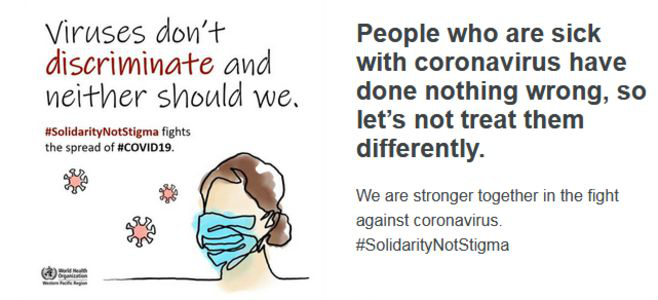
Global Public Health, DOI: 10.1080/17441692.2020.1825771. Image credit: World Health Organization (WHO) Western Pacific Region
- Log in to post comments