










































Lessons on Integrating Scientific and Community Knowledge of Climate Change to Develop Adaptation Plans in Lower Mekong Basin
"Participatory processes employed in the co-development of these [community-based climate adaptation] plans are important to foster two-way learning between NGOs and communities, allowing the resulting adaptation options to gain greater support from communities in their implementation, while also building local adaptive capacity and understanding of climate change."
In order to assist in addressing the impacts of climate change on rural communities in ecologically sensitive areas of the Lower Mekong Basin (LMB), which spans Laos, Thailand, Cambodia, and Vietnam, the United States Agency for International Development (USAID) Asia designed the Mekong Adaptation and Resilience to Climate Change (USAID Mekong ARCC) project in partnership with the International Union for Conservation of Nature, the Asian Management and Development Institute, and the World Food Programme. Produced for review by USAID, this publication was prepared by Development Alternatives, Inc. (DAI) and the World Resources Institute (WRI). Following the introduction, section 2 presents the research framework to co-develop adaptation plans (click here to learn more) and the 4 steps taken to merge scientific knowledge and community knowledge in order to develop adaptation plans. Section 3 focuses on the methodology used to collect information for this report, and section 4 describes the process of combining scientific climate information and community climate stories to develop adaptation plans. Section 5 highlights the lessons learned when integrating scientific and community understanding of climate change, and Section 6 ends with reflections on how implementing partners (IPs) and communities may implement adaptation plans going forward. The intent is for these lessons to help practitioners, government planners, donors, researchers, and others to understand how scientific knowledge can integrate with local knowledge to enable communities to co-develop adaptation plans with implementing partners (primarily made up of non-governmental organisations - NGOs) and scientists.
As detailed here, in an effort to build adaptive capacity in USAID Mekong ARCC's intended communities, the project (2011-2016) focuses on the development of participatory adaptation plans that factor in both scientific information and local knowledge. Baseline awareness surveys indicate that, while 83% of respondents in project sites said they noticed significant changes in weather over the last 5 to 10 years, only 4% feel prepared to adapt to climate change (DAI 2014). The hypothesis is that, although these and other local communities can draw upon their history of dealing with shocks and crisis to develop strategies for coping with weather-related hazards, the development of formal, long-term adaptation plans can help move them from coping to actively addressing both current and future threats, "which markedly strengthens their resilience to climate change."
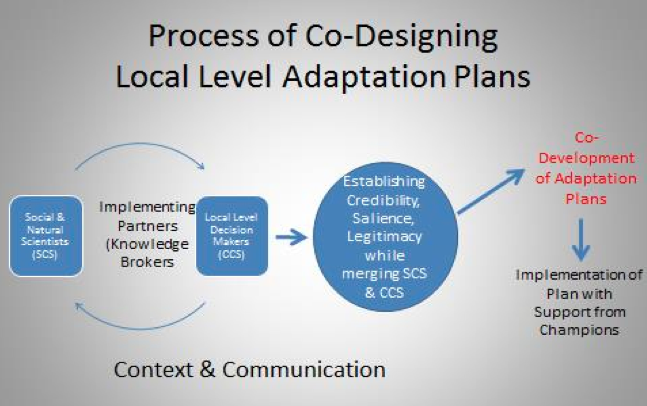
Figure 1, pictured above, shows that there are 3 main actors in the process of co-designing adaptation plans. These actors include scientists, implementing partners (inclusive of local and international NGOs), and local-level actors who both implement the plans and benefit from the co-developed adaptation plan. "Context determines the extent to which the three groups of actors can establish credibility, salience, and legitimacy....For instance, the socioeconomic or political context, level of dependency of a population on a particular natural resource, governance systems and public participation are all factors that can influence the process of designing an adaptation plan....In addition to context, communication methods influence both the relationship between actors and the process of designing adaptation plans....For instance, local level actors may not understand climate science. Scientists may also not easily understand adaptation needs of local actors. Differentiating between climate variability and change is also problematic. Explaining uncertainty in projections is also difficult...Therefore, the role of knowledge brokers is critical in translating and merging scientific knowledge and community understanding of climate change." Champions, who are usually a member of the local community, "usually do not have high levels of technical capacity to co-develop adaptation plans but can effectively play an advocacy role to help implement the plan because they have influence among other decision makers and stakeholders."
There is a 4-step process described that is designed to merge scientific and community knowledge on climate change. In brief, it involves:
- Scientists develop scientific climate stories (SCS), which contain information on climate hazards and projections from the USAID Mekong ARCC Climate Study (USAID, 2013). Because scientists are not present in the field, IPs, who are the knowledge brokers between scientists and community members, ensure they understand the SCS to convey information from SCS to communities. Scientific information allows farmers to go beyond planning for the future based on weather trends and use scientific information to plan for the future to strengthen resilience and prevent maladaptation.
- Knowledge brokers/IPs facilitate the development of community climate stories (CCS) by leading community members through a process that involves various communication and participatory rural appraisal (PRA) methods, such as participatory community maps, hazard maps, resource maps, historical timelines, future timelines, and transect walks. IPs also carried out a climate awareness survey to understand community awareness and knowledge about climate change. Such information helps IPs tailor programmes based on local knowledge. Through this "bottom up" discussion, IPs help community members articulate how weather is changing in their area and how these changes are impacting their livelihoods (see Annex 3 for a diagram of the CCS process).
- IPs help community members understand the basics of climate change and the climate projections from the SCS. Site-based projections from the SCS are used to facilitate discussion on how the scientific climate projections would exacerbate current climate threats and how they would affect livelihoods (DAI, 2014). IPs also explain the difference between "weather" and "climate" using visual aids and PRA methods. Discussions between IPs and community members allow participants to compare community vulnerabilities identified when developing CCS with projected vulnerabilities from SCS, re-rank hazards identified in Step 2, capture changes in understanding, and validate findings. "The participatory bridging process between SCS and CCS ultimately leads to a shared understanding of scientific and community knowledge on climate change upon which adaptation plans are developed."
- IPs ask the community members to take part in an outcome mapping exercise to visualise and plan for the future based on merging of CCS and SCS in Step 3. Through outcome maps, a vision for the future is first developed, and follow-up discussions allow community members to assess what they can do to realise their vision through actions taken today, 5 years from now, and when their children are grown (roughly 35 years from now, which is 2050). Several options are developed, and at the end of the planning stage, knowledge brokers ask community members to rank the options and then designate roles to implement the most highly ranked plan.
WRI designed semi-structured, qualitative questionnaires to understand the process by which scientific knowledge merged with local knowledge to co-design adaptation plans. The first questionnaire helped understand the perceived challenges and enabling factors that could influence the co-designing process prior to IPs merging scientific and local knowledge. Gathering information about perceived challenges helped USAID Mekong ARCC address potential difficulties in merging CCS and SCS before IPs actually merged the knowledge sets. WRI administered the first questionnaire over Skype in May 2014. Building on findings from the first questionnaire, WRI developed a second questionnaire to capture lessons from the actual process of merging scientific and local knowledge to develop adaptation plans based on the 4-step process. Questions focused on: the relationship between IPs and local level community members; how they established credibility, salience, and legitimacy that led to co-designing adaptation plans; and how context and communication influenced the process. The author administered the second questionnaire in person during the USAID Mekong ARCC annual IP meeting in Thailand in November 2014.
Section 4 presents that how scientific knowledge merged with community understanding of climate change in Thailand, Vietnam, and Laos. (Cambodia is not included, as they joined the project at a late stage). Please see this section for details.
Here is a summary of lessons learned:
Community Engagement:
- Knowledge brokers enabled community members to legitimately participate, and therefore, empower them to develop their own CCS by facilitating discussions on climate change. Example from Thailand: "International Union for Conservation of Nature (IUCN) in Thailand is the IP/knowledge broker in two provinces where climate change impacts rice production. IUCN worked extensively in Chiang Rai Province, and therefore, knows the local context well and has working relationships with communities in the province. Although IUCN does not have a long history of working in Sakon Nakhon Province, they are familiar with the local context, know the village heads and how the local administration operates....The local planning and decision making context allows for a consultative and participatory environment where those at the sub-district can work together with those at the village level. The consultative environment enabled IUCN to engage legitimately with those at the village level to implements steps 2-4 in a participatory manner with different social groups to capture local experiences with climate change. Various ethnic, religious, and gender groups provided their perspectives on climate change in small focus group settings."
- Awareness about local context is key to establishing effective participation and community-level engagement. In order to establish effective participation among community members when developing CCS and merging CCS and SCS, knowledge brokers in all sites first acknowledged the local context that could affect participation, such as culture and social tensions. Example from Laos: "Although targeted farmers in Nakai District do not have high levels of decision-making autonomy, they freely participated in developing CCS and eventually merging CCS with SCS. Initially, men participated more than women did because culturally men play a larger role in public engagement. Women eventually participated with the help of knowledge brokers who spoke to women individually and encouraged them to contribute to the discussions. Knowledge brokers played an important role in giving women the voice to speak publically."
Learning and Communication:
- Learning about climate change is a process. Knowledge brokers across all sites expressed that learning about climate change and livelihood vulnerabilities does not happen in one session but over time. Repeated visits to field sites and using powerful communication methods remind community members what is climate change and why community members should engage in the process of merging SCS and CCS. This is especially important in areas that have limited access throughout the year. Engaging community members in the learning process needs to be an ongoing activity so that community members do not forget what they have learned. Example from Thailand: "In Chiang Rai, communities comprised of ethnic hill tribe groups, such as Akha and Lisu, who generally communicate in local languages and do not regularly speak Thai. In order to address this communication barrier, knowledge brokers worked with village leaders to understand how best to communicate climate change. Village interpreters helped translate from Thai to local languages. Use of interpreters helped but sustained learning about climate change was a key concern of the IP. For example, when the IP returned to the sites to present the SCS, they realized that community members had forgotten the discussion they had before on the concept of climate change. When the IP returned to merge the SCS and CCS, only some people remembered the concept of climate change. Because learning and understanding about climate change takes time, IPs acknowledged that teaching climate change through a scientific lens cannot be accomplished immediately but needs to be part of a continuous dialogue over time."
- Making SCS credible and salient depends on communication methods. An important part of Step 3 is to use the scientific findings from SCS to strengthen CCS and update hazard rankings. In all sites, knowledge brokers found it challenging to make SCS credible and relevant to the community members because the concept of climate change was new to most community members. Example from Vietnam, where the Asian Management Development Institute (AMDI) in consortium with the Vietnam Red Cross (VNRC) is the IP/knowledge broker in the Thuan Hoa Commune of An Minh District in Kieng Giang: "AMDI used multiple communication tools to promote discussions to merge CCS and SCS and to explain the relevance of the SCS (step 3). Simple, visual aids on temperature rise and droughts were most effective across all sites....The image shows shrimp struggling for life as the sun gets brighter and water temperatures rise....Visuals, accompanied by contextually relevant, short, and sharp information provided by AMDI helped to explain the images. Community members also watched a video entitled 'It's Getting Hot in Here' (developed by Live and Learn Vietnam) to help them understand the climate impacts in Vietnam. Knowledge brokers used songs and games to keep the participants engaged, even though these songs and games are not related to climate change. The use of 'edu-tainment' that mixes 'serious' and 'fun' approaches led to good feedback from the participants. In the future, the IP suggests conducting more in-depth group discussions on particular topics instead of general discussions about climate change."
Methodology:
- Local-level climate studies are critical for designing adaptation plans. Although the USAID Mekong ARCC Climate Change and Impact Study downscaled climate science to the provincial level, this SCS was not adequate for communities to develop localised adaptation plans. The SCS provided information as to how the climate has and will change in the future across the province, and how this will affect key provincial livelihood alternatives and natural systems, but this information wasn't localised to a site context.
- One way in which to address adaptation planning is to break down the planning into the present, intermediate future (5 years from now), and long term (35 years from now) when developing outcome maps. Most people are able to plan for the present and possibly the intermediate future but planning beyond 5 years requires people to connect the future with something tangible in the present: their children and immediate climate threats.
Adaptation plans will be reviewed by external experts to assess whether they can be funded and implemented (Annex 7 contains expert views). The assessment is based on whether the plan addresses sustainable development and adaptation to climate change. The plans must show an improvement in climate resilience of rural livelihoods in the project sites. "Once this decision is made, IPs will go back to communities to present the plan that has been approved. There will be some iteration between IPs and community members before implementing the plan....According to DAI, implementation may be most successful...when community members are available to participate depending on their seasonal migration and farming patterns. Considering that the USAID Mekong ARCC project is highly participatory, there is a high chance that communities already support adaptation plans since they helped co-develop them, and therefore, implementing adaptation plans may be a smooth process."
weADAPT website, October 14 2015, accessed October 26 2015.
- Log in to post comments