










































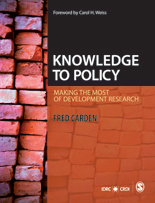
Knowledge to Policy
International Development Research Centre
Knowledge to Policy examines the consequences of 23 research projects funded by Canada's International Development Research Centre (IDRC). Key findings and case studies from Asia, Africa, and Latin America are presented in order to investigate the effects of research in the field of international development. It sets out to show how research can contribute to better governance in at least three ways: by encouraging open inquiry and debate; by empowering people with the knowledge to hold governments accountable; and by enlarging the array of policy options and solutions available to the policy process. It discusses a range of issues that determine how much effect research studies have on the bureaus, legislatures, and administration of governments in developing countries.
According to this document, when ‘applied research’, now commonly known as policy research, became a strategy for guiding governance, it was assumed that knowledge is power. Good research would lead to better policy. However, it was found that social research was less influential in policy than research related to economic advancement. Findings showed that policy makers value social research for a number of reasons, including as a spark collective discussion and perhaps rethinking of policy, and as a source of news, new concepts and ideas, and different visions on old dilemmas. New research gives those in authoritative positions an opportunity to reconsider what they were doing and not doing. In addition, features of the larger environment - "such as the number of points of access through which research findings can flow, the openness of the system to the entry of new ideas, the democratic nature of decision making - seem to make a system more or less responsive. It is these kinds of characteristics that cross-national comparisons begin to highlight."
The investigators of these 23 case studies of research-into-policy did not expect them to have direct and immediate effects on policy in the nations studied. "Rather they were sensitive to the subtle and diverse ways in which knowledge gleaned from research can seep into the ideas of policymakers over time. They sought the channels of communication and identified the communicators, intended and unintended, who brought the message into arenas of decision. They were alert to the different kinds of effects that can emerge from confrontation with research evidence."
Among the findings are the following:
- "To maximize the influence of development research on public policy and action, the best first step is to assess how that policy is actually made....
- History points to three critical moments when research can become exceptionally influential:...economic crisis, unambiguous policy failure or radical political change; ...societies and political systems undergoing transition; [and] ...the advent of new and pervasive technologies...."
- Research output communication methods and products of various case study projects included in the summary Table 1.1 Cases at a Glance include:
- A provincial database and poverty monitoring maps, including a computerised information system for data management, as well as development of a Computable General Equilibrium (CGE) model and training on its use.
- A computerised trade database, analysis using 3 models conducted on distribution and equity impact of fiscal policy and trade reform.
- Working papers and policy briefs, including dissemination via website, newsletters, conferences, training courses, meetings with officials, and consultancies.
- A land use map, a degradation hazard map, and a land capability map.
- A report to the International Water Tribunal II which led to findings against the practices of a mining company and changes in its policies and practices.
- Increased demand from households for greywater kits, workshops on irrigation requirements, workshops to train plumbers and electricians on management of systems, proposed building code revisions, graduate research on greywater reuse... [this research led to a revision of national housing codes and establishing a national committee to create greywater reuse guidelines], replication of the greywater treatment kits in the Middle East and North Africa, [ratification of the Hyderabad Declaration], and a network of policymakers, researchers, private sector [personnel], and beneficiaries.
- A body of Ukrainian environmental legislation collated, published, and made available to non-governmental organisation (NGOs) and public and educational institutions; training of 90 individuals.
- A book and two studies published.
- A special publication series developed for 50 research projects produced.
- Creation of databases including over 13,000 documented local innovations disseminated in six local languages; network of over 1,000 local groups supported by newsletters and other means.
- Developed 10 tools to collect, organise, and present data on mortality and disease, analysed data for policy options.
- Surveys and research studies on telecentres as well as issues around rural access, and studies on the development of relevant content commissioned to provide background information and answers to specific policy questions.
- Representation in bodies developing local and national ICT [information and communication technology] policies and strategies, and hosting fora on ICT policy and implementation, involving the government, the private sector, and the public.
What works in presenting research to decisionmakers includes:
- Clear Government Demand - a situation in which decision makers express a real and specific interest in receiving research information or guidance.
- Government Interest in Research, but Leadership Absent - where official interest is evident but implementation leadership is absent, the research team may need to cultivate leadership by cooperating with relevant decision makers, for example, providing training along with timely and relevant policy information.
- Government Interest in Research, but with a Capacity Shortfall - creating popular support for the project among the general public - support that attracts and holds policymakers’ attention to the research; enhancing governmental research capacities and promoting the issue up the priority list confronting the policymakers.
- New or Emerging Issue but Policymakers Uninterested - a three-part strategy: assemble a strong research team, implement a coherent plan of advocacy, energise popular interest in the issue. "...Share research discoveries and policy prescriptions with a diverse public with a stake in the policy outcome. Ideally, communities are engaged in the research itself, almost from the start; as a result, community members understand the implications of the research, and stand ready to apply their own efforts in favour of government action."
The document concludes that communication is essential for achieving policy influence: "Among our cases, communication contributed to every success. But communication is not confined to delivering information when it happens to emerge from research. Effective communication is a long-term, organized process of engaging with policymakers and with the public - heeding their concerns while keeping them abreast of the research under way, and highlighting its utility and pertinence to their interests. Researchers have to ask: Does the research design include a pragmatic communication strategy and operational plan? Have the researchers identified key communication channels, both formal and informal? Has the research team formed links with allies and potential advocates for the research - people who can help tell the story of its relevance to policymakers? Is the research team establishing genuine rapport in neighbourhoods and villages, with the people whose lives this research is meant to improve? Communication connects research to policy, in part by mobilizing interest and action. It belongs at the heart of any development research enterprise."
e-CIVICUS newsletter, Issue No. 436, May 1 2009; and email from Bill Carman to The Communication Initiative on March 19 2010.

- Log in to post comments