










































Knowledge Attitude and Practice Survey: Results in U.P. and Bihar Highlight Areas for Concentrated Effort
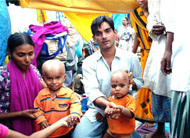
This 2-page report shares key findings from a knowledge, attitudes, and practices (KAP) study conducted by the United Nations Children's Fund (UNICEF) in 2 states of India to inform the 2009 focus and strategy of the communication effort for polio. The study of 9,600 randomly selected mothers and fathers of children under 5 years of age was conducted in high-risk blocks of Uttar Pradesh (U.P.) and Bihar during September and October 2008. Probability Proportional to Size (PPS) methodology was used to select villages and wards within each of the blocks to get an equal distribution of rural and urban populations and a representative mix of Hindu and Muslim respondents.
Selected findings include:
Knowledge [The main sources of information on polio were reported to be family, neighbours and friends, and health workers]:
- 97% of parents surveyed have heard about polio.
- Over 85% of parents in U.P. and 93% of parents in Bihar were able to identify at least one of the two main symptoms of polio; however, this figure dropped to 75% among lower socio-economic classes and scheduled castes in western U.P.
- Over 80% of respondents in U.P. and Bihar were aware of the Government's Polio Eradication programme. However, among respondents in Western U.P., this number was 68%, as compared with 92% in Eastern U.P.
- Over 80% in both states believed that polio could be eradicated forever.
- 72% of respondents in both states correctly identified the benefits of oral polio vaccine (OPV), with 13% incorrectly thinking that OPV cures polio. 16% of respondents in Bihar and 13% in U.P. did not know how polio drops would help their child.
- While 94% of respondents in Eastern U.P. felt very strongly that polio drops were effective, only 62.8% felt the same way in Western U.P.
- 17% of respondents in U.P. and 32% in Bihar said they were aware of the method of inactivated polio vaccine (IPV).
Attitudes:
- Among those who reported the frequency of polio rounds in their area to be once a month, approximately 20% of respondents in both U.P. and Bihar felt the rounds were too frequent.
- 85% of respondents in U.P. felt that OPV was "totally safe". In Bihar, only 53% felt OPV was "totally safe", though this is likely due to the fact that 40% did not respond to this question for unknown reasons. While only 7.2% of respondents in U.P. felt OPV was not safe or were not sure, 11.3% felt this way in Western U.P. compared to 3% in Eastern U.P. Muslim mothers in Western U.P. had the highest rate of uncertainty, with 15% saying they were not sure how safe OPV was or felt it was unsafe.
- While 26.3% of urban mothers in Western U.P. felt polio affected particular communities more than others, only 7% of mothers and fathers at the state level felt this was the case.
- Muslim mothers in Eastern U.P. (28.7%) and Western U.P. (42.2%) were significantly above the state average of 15% when asked whether they had heard rumours on OPV - largely about polio drops causing sterility.
- Over 98% of respondents in both U.P. and Bihar felt that children should receive every dose of OPV until they reach their 6th birthday.
- 95% of respondents in U.P. and 64% of respondents in Bihar were willing to give their children polio drops 7-8 times until their child reaches his or her 2nd birthday, suggesting that newborns and infants in Bihar are still an age group requiring more intense focus.
- Approximately 88% of respondents in U.P. and 90% in Bihar expressed their willingness to give their children IPV if they would be told the injection would provide their child better protection than polio drops.
Practices:
- 99% reported that they immunise their child during each polio round.
- In U.P. 41% of parents reported immunising their children at the booth, and 58% during house-to-house visits.
- 53% of parents in U.P. and 76% in Bihar said they collected information from the booth or from health workers about immunisation during each polio round.
The November 2008 India Expert Advisory Group for Polio Eradication (IEAG) recommended at least 2 rounds of the KAP study in 2009; the next round will be carried out by April. A core set of key indicators will be maintained throughout all rounds of data collection in order to establish trend data, with new data added to each round to capture additional data on programmatic and strategic shifts made to the communication strategy.
India Communication Update from UNICEF, Volume XVII, January 2009.
- Log in to post comments