










































Key Findings Report: Innovation for Data-Driven Agriculture Workshop
"Opportunities and challenges relevant to smallholder agriculture in emerging economies are increasing thanks to the continued proliferation of smartphones, sensors, and advanced analytics globally." - Karina Lundahl, Facilitator, Innovation for Data-Driven Agriculture Workshop
This report details the key findings from the Innovation for Data-Driven Agriculture Workshop, hosted by the United States Agency for International Development (USAID), April 27-28 2017, at the Sustainability Innovation Lab at the University of Colorado (SILC). The workshop was the second in a series focused on building a community of practice in data-driven agricultural development, bringing together a group of 45 researchers, technology innovators, development practitioners, and funders. Three primary themes emerged during the workshop, including 1) the opportunities and challenges surrounding data collection, analysis, open sharing, and appropriate distribution, 2) the need to better understand and incorporate smallholder farmer concerns throughout the design and implementation of programmes and ventures, and 3) defining and engaging an "innovation ecosystem" of cross-sector actors addressing smallholder needs with data-driven approaches to agricultural development. The report is organised according to these themes.
Through a series of presentations, panels, and workshop activities, the group identified promising examples of current data collection and analysis. To cite only one: The Seeing a Better World Program at DigitalGlobe is collecting and analysing satellite imagery aided by spectral analysis. Their data offers insights into population distribution, land use, crop yields, crop health, and key vulnerabilities such as food security in areas otherwise inaccessible due to conflict or other crises. DigitalGlobe also employs crowdsourcing to identify items of interest within imagery. Crowdsourcing results are then used to train machine-learning algorithms to improve the accuracy of automated object identification.
For all the opportunities, challenges remain in data collection and sharing for agricultural development. One of the challenges discussed is the fact that, once data is collected and processed, in order to make information actionable, timely sharing and dissemination through appropriate channels is required. Workshop attendees voiced the need for faster agricultural data sharing at scale. Ways of aiding data sharing discussed included 1) sharing data promptly, 2) sharing metadata, and 3) standardising and organising data in a way that supports analysis. Generally, they say, there is an ethos of sharing, but the data being shared is often delayed and is shared following different approaches. As data collection innovations proliferate and databases grow, there is an increasing need for standardised data and open sharing platforms to reduce redundancy, facilitate collaboration, and make information actionable for smallholders. Relatedly, identifying appropriate channels for sharing and engagement with smallholders remains an active challenge.
In addition to the observation that researchers often conduct data collection and analysis without an informed focus on smallholder farmer needs, a separate but related issue of concern voiced by attendees was a lack of feedback from farmers on their perception of information and dissemination channels. While digital technologies and channels offer an opportunity to engage smallholders at scale, many attendees expressed a desire to understand available channels, how to best employ them, and how to gather farmer reactions through them. This raised the question of how to best close the feedback loop and incorporate farmer reactions into iterations of technology and information provided. In response, Adam Reineck, Design Director and Studio Lead with IDEO.org, described the use of human-centred design (HCD) to address smallholder needs and concerns. HCD is a rigorous and iterative design process employed by IDEO.org that centres on the needs of the end-user from the beginning of every project to arrive at a contextually-relevant and actionable solution. For instance, in illiterate populations, IDEO.org has employed a combination of audio and visual channels - such as interactive voice response (IVR), photography, and iconography - as well as locally-relevant analog approaches, such as community events. "Reaching a community through the most familiar and accessible channels, like community events, may not bring forth the most technologically advanced approach, but may be the most effective solution in a given context."
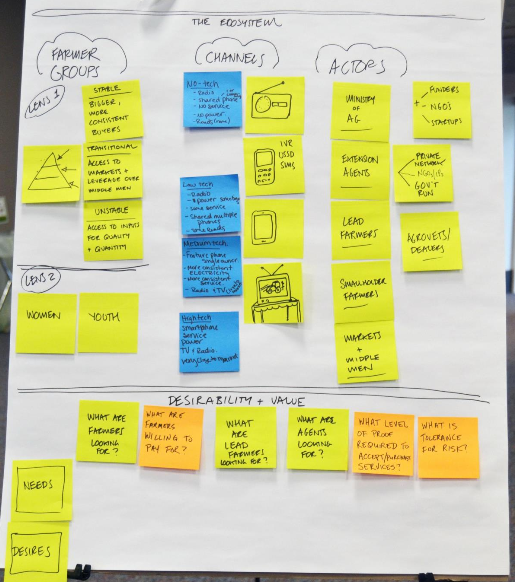
Meeting participants noted that, when designing a technology or choosing a channel for information dissemination, it is important to understand the full context of smallholder farmers' ecosystem, including other actors such as extension agents, agrovets, lead farmers, and middlemen. Each actor is driven by her or his own needs and concerns, which come into play when designing and implementing a new service or product. There was some discussion dedicated to defining an "innovation ecosystem" - the constellation of cross-sector actors that will best facilitate innovation in data-driven agricultural development. Sector-specific perspectives, corresponding strengths, and areas of shared interest emerged.
Attendees discussed possible collaborations and made individual commitments to taking what they learned forward into future actions and conversations. Possible actions attendees discussed and committed to are: 1) hosting a follow-up workshop, with a focus on further defining the innovation ecosystem and inviting more collaborators to the table, such as participants from the insurance industry, 2) moving forward with individual conversations started at the workshop, 3) facilitating connections between workshop attendees and colleagues, 4) exploring potential collaborative pilot engagements, 5) co-writing concept notes and best practice guides, 6) sharing applicable key documents and resources with the group, 7) hosting related webinars, hackathons, and data jams, and 8) initiating trial exchanges of data and/or database systems. A follow-up event to learn about the outcomes of these commitments and actions is described here as something that would be beneficial to supporting and building this innovative community of practice.
"Opportunities and Challenges for Data-Driven Agricultural Innovation", by Karina Lundahl, ICTWorks, June 14 2017 - accessed on June 20 2017.
- Log in to post comments