










































It's Not All about Autism: The Emerging Landscape of Anti-vaccination Sentiment on Facebook
University of Pittsburgh School of Medicine (Hoffman, Chu, Shensa, Williams, Primack); University of Pittsburgh (Felter, Primack); Kids Plus Pediatrics (Hermann, Wolynn)
"[J]ust as vaccination is needed to prevent the spread of infectious disease, interventions are needed to prevent the spread of anti-vaccination messages on social media."
Although opposition to vaccination has existed for centuries, the internet, and specifically social media, may be facilitating the spread of anti-vaccination misinformation. Previous studies suggest that common themes of anti-vaccine social media posts include skewed scientific information, shifting hypotheses, political arguments centred on parental freedom of choice, lack of trust in the medical community, conspiracy theories, and personal narratives related to negative vaccination experiences. However, research has yet to examine multiple characteristics of the individuals who publish anti-vaccination content on Facebook. This study aimed to systematically characterise: individuals known to publicly post anti-vaccination content on Facebook, the information they convey, and the spread of this content. The hope is that analysis of comments posted online by anti-vaccine advocates can help physicians tailor conversations with parents who are hesitant to immunise their children.
The data set consisted of 197 individuals on Facebook who posted anti-vaccination comments on a local (Pittsburgh, Pennsylvania, United States (US)) paediatric clinic's Facebook page. These individuals posted comments in response to a 90-second video produced by the clinic that promoted the human papillomavirus (HPV) vaccine as an anti-cancer vaccine, as recommended by the US Centers for Disease Control and Prevention (CDC). Nearly one month after the video was posted, the clinic's Facebook page began to receive thousands of comments that were "distinctly anti-vaccination" (DAV), which the researchers defined as being either (1) threatening (e.g., "you'll burn in hell for killing babies") and/or (2) extremist (e.g., "you have been brainwashed"). The paediatric clinic blocked users posting these messages. The researchers chose to focus on individuals who posted on this single clinic's page, instead of a wide variety of pages, to more precisely investigate the spread of anti-vaccination beliefs across Facebook.
The article describes how the researchers systematically analysed this publicly-available content using quantitative coding, descriptive analysis, social network analysis, and an in-depth qualitative assessment. The final codebook consisted of 26 codes.
The majority (89%) of individuals identified as female. Among 136 individuals who divulged their location, 36 US states and 8 other countries were represented, suggesting that, through social media, a local post can gain international attention. Individuals in the sample spanned the political spectrum, but the majority of individuals for whom political affiliation could be determined (28%, n=55) identified as supporters of Donald Trump (56%, n=31), a conservative and the 2016 Republican nominee for President (later the President). Of the 116 individuals with at least one public anti-vaccination post from 2015 to 2017, posts about "educational material" (73%), "media, censorship, and 'cover up'" (71%), and "vaccines cause idiopathic illness" (69%) were the most common topics. ("Educational material" refers to content that claims to provide scientific evidence for the negative impact of vaccines.)
Deeper qualitative analysis of all 197 individuals' profiles found that many of them consistently posted content related to "naturalness", including attitudes against genetically modified food (anti-GMO), circumcision, and water fluoridation. Some of these individuals also expressed vegan activism.
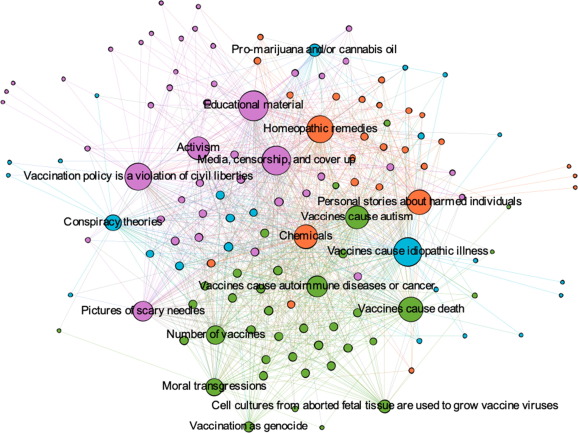
In a 2-mode network of individuals and topics, modularity analysis revealed 4 distinct sub-groups - that is, 4 areas of concern among the commenters:
- trust, which underscored their suspicion of the scientific community and concerns about personal liberty;
- alternatives, which stressed the use of chemicals in vaccines and suggested the use of homeopathic remedies instead of vaccination (e.g., that eating yogurt cures HPV);
- safety, which focused on the perceived risks and concerns about vaccination being immoral; and
- conspiracy, which suggested the government and other entities were hiding information that this group believes to be facts (e.g., that poliovirus does not exist and that pesticides cause clinical symptoms of polio).
According to the researchers, the presence of distinct sub-groups cautions against a "blanket" approach when developing interventions or educational programming; countering a single theme or argument is not likely to succeed with all anti-vaccine beliefs. For example, telling someone in the "trust" subgroup that vaccines don't cause autism may alienate them because that isn't their concern to begin with. Instead, it may be more effective to find common ground and deliver tailored messages related to trust and the perception that mandatory vaccination threatens their ability to make decisions for their child.
These findings suggest several possible avenues of intervention to increase the level of community protection against the propagation of anti-vaccination messaging on social media:
- Media literacy, which teaches individuals about the effect of mass media on attitudes and behaviour, may offer a framework to help people better evaluate anti-vaccine content on social media. Many posts in the sample included data showing parallels between rates of vaccination and cancer mortality rates. Broad investments in media literacy may provide individuals with the tools necessary to critically examine the presentation of these data and associated claims and be more effective than attempts by clinicians to counter individual social media posts.
- The use of entertainment narratives may be an effective avenue for intervention. The persuasive power of entertainment narratives likely occurs through identification with characters and decreased reactance from transportation into the narrative. Through these mechanisms, storylines that feature unvaccinated characters who contract a vaccine-preventable disease may highlight disease severity and counter anecdotes shared on social media by anti-vaccination activists.
- The identification of distinct sub-groups suggests an opportunity for clinicians to leverage social networks to deliver more effective, targeted interventions. For example, one avenue of intervention for the alternatives sub-group could be the development of health communication campaigns that present vaccines as triggering our natural immune systems.
- It may be valuable for medical professionals to be more active on social media. The findings could inform the development of toolkits to help clinicians and researchers cultivate trust in the medical community and respond to DAV comments.
The researchers conclude that "Individuals from around the globe who are opposed to vaccination are connecting via social media, suggesting the need for clinicians and researchers to develop interventions to combat the propagation of misinformation about vaccines on social media....Moreover, while current arguments against vaccination are varied, they remain consistent within sub-groups of individuals. Thus, it may also be valuable for interventions or educational programming to use social networks to deliver targeted messaging tailored to specific anti-vaccination beliefs. Future research should focus on the development and evaluation of these interventions."
Vaccine. 2019;doi:10.1016/j.vaccine.2019.03.003.
- Log in to post comments