










































Independent Monitoring Board of the Global Polio Eradication Initiative: Eleventh Report
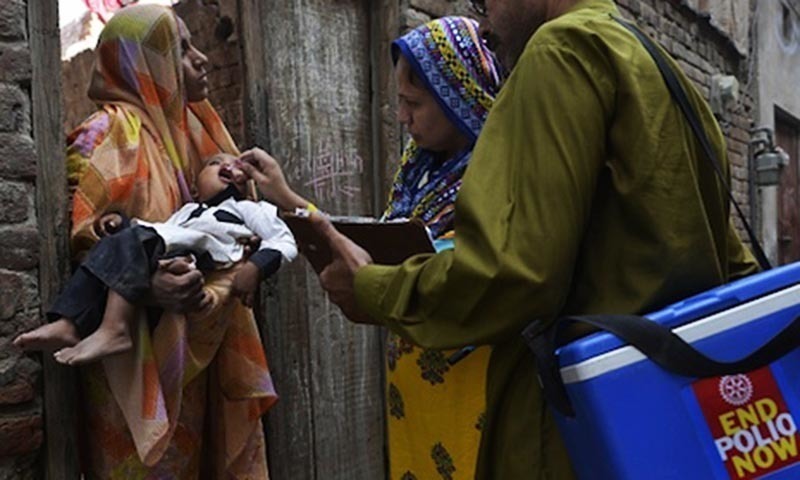
"There is a real sense of collaboration - between the different parties that govern the country and its provinces; between the civil administration and the military; and, between the [polio eradication] programme's partners."
This report from the Independent Monitoring Board (IMB) provides an independent assessment of the progress being made by the Global Polio Eradication Initiative (GPEI) in the detection and interruption of polio transmission globally. This eleventh report follows the IMB's twelfth meeting, held in Abu Dhabi from April 29-30 2015.
"Overall, the global programme in 2015 is a better one than when the IMB started its work nearly five years ago. The programme's progress is a predictable and direct result of following advice and adopting new ways of working. The programme has responded well to the challenges set by the IMB in a number of domains, particularly:
- Understanding and addressing the reasons why children are repeatedly missed by vaccination campaigns
- Strengthening accountability throughout the programme, so that expectations are clear and enforced
- Improving collaborative working between partners, so that the strengths of each can contribute to the effort as a whole
- Getting the best staff to the places where they are needed the most
- Putting governments in the lead of their countries' polio eradication programs, with partners in support
- Enhancing urgency, so that business as usual cannot prevail
- Encouraging innovation and the spread of successful ideas
- Emphasising demand, not just supply, through stronger people-centred offerings to key population groups
- Ensuring that armed conflict and political sanctions are not allowed to be absolute barriers to reaching every child with the polio vaccine
- Focusing effort on the small geographic areas ('sanctuaries') where most polio virus resides
- Putting more emphasis on outbreak preparedness and response, not allowing the endemic countries (though important) to monopolise focus.
Notably, most of these have little to do with the virus or the vaccine directly, and everything to do with people, communication and management. When these fundamentals have been addressed, progress has been seen. When they have been disregarded, progress has been slow or absent."
The report includes country insights, such as this one from Nigeria: "A great deal rests in the hands of Nigeria's new government. With strong commitment, there is good potential that Nigeria will eradicate polio within their term, and will be able to celebrate a great Nigerian victory. But if the polio programme loses momentum or support, the country could be responsible not only for polio coming back to Nigeria, but elsewhere in Africa too.
India faced and met the challenge of staying polio-free between its last detected case and its official polio-free declaration. The IMB judges that Nigeria currently falls short of the levels of programmatic excellence achieved in India. The areas of risk we have described mean that Nigeria is not yet safe. Nigeria must build further resilience and, over the next six months, move its programme from good to great. The IMB is very concerned that national, state and local government politicians, as well as the Nigerian public, will now start to believe that polio is gone permanently from Nigeria. It needs to be made absolutely clear that Nigeria has not yet been certified polio-free. The programme and its partners need a clear, coordinated communication and advocacy plan to ensure that the public and political leaders understand the substantial work that lies ahead. In the meantime, the growing triumphalism surrounding the prospect of a polio-free Africa must be halted."
Amongst the communication-related recommendations for specific polio-endemic countries:
- Pakistan's National Task Force (NTF) should meet at least once in a month to oversee strict implementation of the National Emergency Action Plan (NEAP).NTF needs to resolve a payment issue of frontline workers, as the high morale of members of this crucial group is "essential for the success of anti-polio campaigns".
- Afghanistan is advised to follow the concept of Pakistan's National Emergency Operation Centre (EOC), stating that "recent experience in Pakistan demonstrates that change can happen fast". The IMB suggests that Afghanistan teams visit Pakistan's EOC.
- The IMB recommends that the new President of Nigeria makes a clear public declaration that polio cannot yet be considered gone from Nigeria, and sets out and leads a plan to achieve polio-free certification in 2017.
In terms of the GPEI system, the report focuses on:
- The "power of people": e.g., "when global eradication is reached, it should be celebrated as a victory for the many programme workers - especially those who have risked their lives. This is not only the right and proper course to take - it can also help galvanise the momentum needed to continue down the path, and then to move on to other health-boosting endeavours."
- The need for "an architecture for coordination": e.g., "it is no good sending 500 police officers into an area without in-depth joint planning to work out the logistics of the public health activity, as well as ensuring that sophisticated preparatory communications engage the local populations and preserve the perceived neutrality of the vaccinators."
- The need to address border areas and crossings - e.g., "The IMB was disappointed to hear that a recent planned cross-border meeting between Afghanistan and Pakistan has been delayed by many weeks, following a last-minute cancellation for security reasons. The problem is not the mere fact of this delay, but that it demonstrates too little belief that cross-border collaboration between the two countries is one of the essential keys to interrupting transmission. Such collaboration is crucial to ensuring that every child is reached as they cross the border. It is also vital for ensuring that during vaccination campaigns there are no spaces between where each Afghanistan team's vaccination finishes and their counterpart Pakistan team's vaccination starts."
- The problem of persistently missed children - e.g., "Afghanistan, Nigeria and Pakistan between them have an estimated 760,000 children who have never received even a single drop of polio vaccine."
- "The work of ensuring that polio vaccine of the right kind is available in the right quantities at the right time in the right places" - e.g., "In May 2014, the IMB highlighted that many countries were requesting more vaccine than they actually needed, because they were not taking proper account of vaccine stock already available in country. The IMB welcomes the work that UNICEF [United Nations Children's Fund] has led to start to address this. Technical staff deployed through the STOP [Stop Transmission of Polio (STOP) - see related summaries, below] programme are now being trained in vaccine management."
- The withdrawal of trivalent oral polio vaccine (tOPV) and switch to using bivalent oral polio vaccine (bOPV) - e.g., "If an outbreak in Nigeria, Pakistan (or elsewhere) delays this process, it is liable to cause chaos, confusion and great expense."
- The importance of strong Acute Flaccid Paralysis (AFP) surveillance - e.g., "the IMB remains alarmed by the gaps that still exist. Only nine of the 70 countries in AFRO [the World Health Organization (WHO) African region] and EMRO [WHO Regional Office for the Eastern Mediterranean] meet both surveillance standards in every sub-national area."
- The failure to standardise best practice - e.g., "The IMB continues to be surprised by the variable quality of polio vaccination campaigns around the world."
- The need to reflect on the October 2013 GPEI management review - e.g., in areas such as communicating the programme's mission.
- The need to fully engage - e.g., "It means three things: Firstly, a level of political leadership within countries that goes beyond commitment, to taking full ownership of the challenge of polio eradication....Secondly, 'fully engaged' means programme management aligned from global, to national, to provincial, to neighbourhood level that completely understands the value of making quality improvement drive every aspect of its work; thirdly, 'fully engaged' means a programme dedicated at all levels to the importance of people, from getting the best staff in the most difficult jobs, to treating the front-line vaccinators with dignity and respect, to weeding out bullying and corruption, to letting parents know how important they are to the whole endeavour."
"Monitoring board sees signs of progress in polio eradication", by Ikram Junaidi, Dawn May 20 2015. Image credit: AFP.
- Log in to post comments