










































Immunization Communication in Mister Rogers' Neighborhood: Inoculation Theory, Health Messaging, and Children's Entertainment Television
Dartmouth College (Compton): Pittsburg State University (Mason)
"Some things (like immunizations, x-rays, or wearing bicycle helmets) that children need in order to be healthy may be scary, strange, or uncomfortable for them. When we can help them talk about their concerns, children are more likely to manage better." - Fred Rogers
This article offers a rhetorical analysis of immunisation messaging on the North American children's television programme "Mister Rogers' Neighborhood". The show features a gentle, kind host who explores early childhood themes through his interaction with friends and neighbours and through puppet stories. The article suggests that Fred Rogers' rhetorical framing of immunisation in one key episode mirrors that of the inoculation theory of resistance to influence, presenting "weak" challenges to his young viewers to help them to build resistance to stronger challenges encountered later. In this sense, the authors argue, "the episode inoculated against inoculation fears".
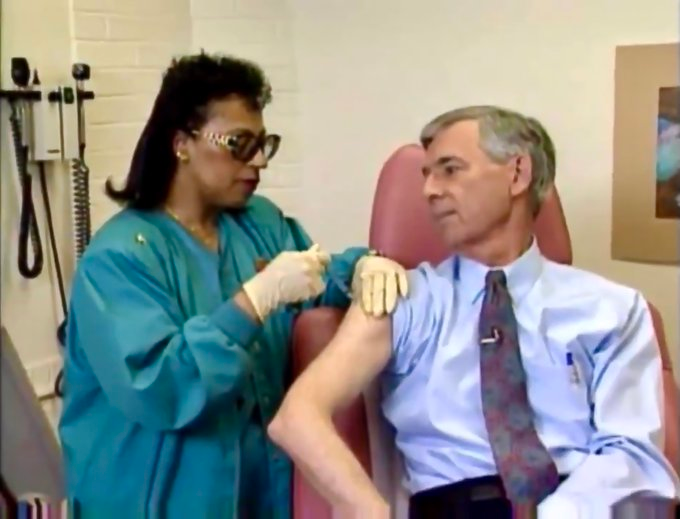
After an analysis of some of the strategies used in the entertainment-education initiative, such as the process of viewer engagement through para-social interaction (PSI), the paper examines Episode 1709 of Mister Rogers' Neighborhood, "Brave & Strong", which was first broadcast in the United States on August 29 1996. To start this episode, instead of the typical pattern of putting on his cardigan and then greeting his "television neighbours", Rogers pauses to explain that he wants to talk about his upcoming immunisation at the health clinic. (Research cited here indicates that, when entertainment personalities look into the camera and directly address the audience, increased levels of PSI are reported.) Rogers rolls up his shirt sleeve, noting that this will be the location of his immunisation and telling his viewers that the shot is designed to help him remain in good health. In the next scene, Rogers enters a health clinic and asks permission to visit the children's waiting area. Later, during the process of administering the (influenza) immunisation, the doctor is careful to tell Rogers what she is about to do before she does it. The pattern, which is repeated throughout the episode, is to forewarn Rogers (and, thus, viewers) of what is to come and to refute - or at least diminish - possible concerns. Dialogue about the procedure teaches viewers as it prepares them to encounter and overcome challenges (e.g., fear).
In fact, these and other moments in the episode follow "an inoculation messaging pattern: counterarguments and refutations, or, to use terminology more apt for considering the gentle nature of Rogers' rhetoric, concerns and reassurances. The question of why a shot is needed is answered with a simple response. The idea that the shot will be a little painful could also be seen through an inoculation perspective: The shot will hurt (counterargument/concern), and the pain will be short-lived, more like a pinch (refutation/reassurance)."
The immunisation complete, the scene transitions back to Rogers' television house, where he talks about going to the doctor to get shots when he was a little boy. He fetches a doll and toy medical kit out of a cupboard and tells viewers that, before he would visit the doctor when he was a child, he would pretend-play with his doll, Phil. "He notes that this made him braver. Here, Rogers is modeling a unique form of inoculation - a preparation for challenges by preemptively playing through the challenges." After visiting the Land of Make Believe, where a puppetry play focuses again on bravery, Rogers rolls up his sleeve, exclaiming there is no sign of the injection, and sings his closing song, "It's Such a Good Feeling".
The close analysis of this episode suggests that Rogers functions not only as a children's entertainer, but as a teacher who "models sound communication theorizing and rhetorical strategy....This study argues that Rogers is inoculating (attitudinally) for worries about inoculation..."
In conclusion: "Rogers has actually addressed a number of health issues on his show, and evidence suggests - at least anecdotally - the effectiveness of covering such topics on children's understanding and health behaviors....Rogers (2001) notes: 'I have long believed that whatever is mentionable is manageable' (p. 72). This study argues that his approach worked with immunization, too, in a way that was mentionable and manageable, by paralleling some of the central tenets of inoculation theory."
The Midwest Quarterly Vol. 63, Iss. 1, (Fall 2021): 11-18; email from Josh Compton to The Communication Initiative on January 4 2022; and The Neighborhood Archive, January 5 2022. Image credit: The Mister Rogers Neighborhood Archive via Twitter
- Log in to post comments