










































HPV Vaccine Coverage in Australia and Associations with HPV Vaccine Information Exposure among Australian Twitter Users
Macquarie University (Dyda, Shah, Surian, Martin, Coiera, Dunn); The University of Sydney (Dey, Leask)
This study is based on the conviction that localised measures of what Twitter users post as tweets (as well as estimates of the information to which they may be exposed) could improve knowledge and attitudes about human papillomavirus (HPV) vaccines by enabling better targeted health promotion and media messaging. In light of the fact that HPV vaccine coverage in Australia is 80% for females and 76% for males, these researchers examined exposure to HPV vaccine related topics among Australian Twitter users to examine associations with HPV vaccine coverage.
Regional differences in information exposure were estimated from 1,103,448 Australian Twitter users and 655,690 HPV-vaccine-related tweets posted between September 6 2013 and September 12017. To derive measures of potential information exposure, the researchers used a machine learning method to classify all known tweets related to HPV vaccines into topics and described groups of similar topics within 6 themes. They then identified any Australian Twitter users who may have seen those tweets by inferring location from their user profile information, aggregated those data into a set of 25 Australian regions, and constructed multivariable regression models examining how differences in exposure to certain themes was correlated with differences in HPV vaccine coverage across those regions, comparing the results to baseline models constructed using information about levels of employment and education.
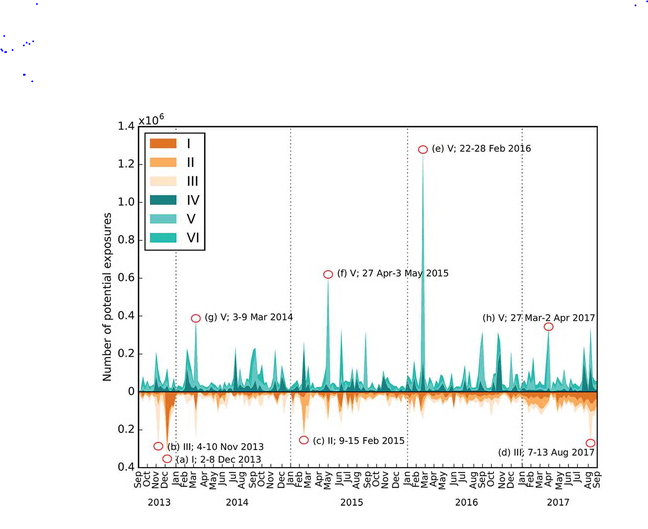
Exposure to the individual topics and groups varied over time and region, exhibiting the typical burst-like patterns associated with issues that receive intermittent news media coverage. Australian Twitter users often follow users posting international news and information about HPV vaccines, showing that what happens elsewhere in the world is an important part of the information diet of Australians. Most stories associated with the largest peaks in potential exposure related to news media events, including the release of new data and research about the impact that HPV vaccines are expected to have on cervical cancer in Australia and elsewhere, or debates about the representation and amplification of vocal vaccine critics in the news media.
Specifically, peaks correspond to: (a) Australian research showing cervical cancer risk was reduced; (b) Canadian and Australian research showing cervical cancer risk was reduced; (c) reduction in cervical cancer risk in the United States (US); (d) discussions of coverage rates in Australia and reduction in risk in New Zealand; (e) research showing that one dose may be enough; (f) debates about the representation of HPV vaccines on a US television show hosted by Katie Couric; (g) responses to the reversal of a false balance story written in the Canadian newspaper Toronto Star; and (h) videos and stories of adverse events and harm.
Models using topic exposure measures were more closely correlated with HPV vaccine coverage (female: Pearson's R = 0.75 [0.49 to 0.88]; male: R = 0.76 [0.51 to 0.89]) than models using employment and education as factors (female: 0.39 [-0.02 to 0.68]; male: 0.36 [-0.04 to 0.66]). In Australia, positively-framed news tended to reach more Twitter users overall, but vaccine-critical information made up higher proportions of exposures among Twitter users in low coverage regions, where distorted characterisations of safety research and vaccine-critical blogs were popular.
The researchers suggest that a surveillance system that monitors information exposure via social media may provide a complementary source of information for informing the design of public health communication campaigns and broader communication planning that is low-cost, provides localised information, and is effectively real-time.
Human Vaccines & Immunotherapeutics https://doi.org/10.1080/21645515.2019.1596712
- Log in to post comments