










































Driving Change in Immunisation
Date
Summary
This report details the role of the National Immunisation Office (NIO) in Ireland. It describes the expansion of service, collaboration with stakeholders on developing and implementing standards on best practices, development of informational materials, implementation of immunisation campaigns, and future challenges.
Communication elements include the following examples:
- In February 2007, an assessment "identified the absence of an agreed standardised immunisation training programme and variability in immunisation training both in frequency and content across the country. In response to these findings, the NIO introduced a number of initiatives to ensure a standardised approach to training on issues related to immunisation in Ireland in line with best practice."
- The training manual “A Practical Guide to Immunisation” was produced in 2008, along with training slides, used in conjunction with the national immunisation guidelines for Ireland to "provide health professionals with up-to-date information on the core components of an immunisation programme as follows:
- History and aims of immunisation
- National immunisation schedule
- Immunity and how vaccines work
- Vaccine preventable disease
- Storage and handling of vaccines
- Legal aspects of immunisation
- Communicating with parents
- Vaccine administration
- Adverse events following immunisation and anaphylaxis"
- A quarterly newsletter is published and distributed to general practitioners (GPs), practice nurses, public health departments, local health offices (LHOs), and others involved in immunisation.
- National immunisation conferences and training days are scheduled to support dissemination of best practices.
- School guidelines were initially focused on the Human Papillomavirus (HPV) vaccine programme launched in 2010 but were then expanded in 2011 to cover the entire school immunisation programme.
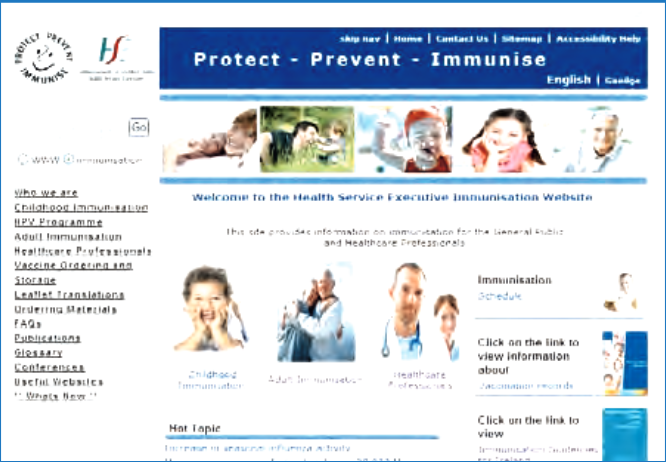
- A national website was created in 2005. The site includes: a section on frequently asked questions (FAQs); links to national and international sites; a section for health professionals highlighting any changes to the national immunisation advisory committee (NIAC) immunisation guidelines for Ireland and details on new programmes and current topics; and factual information for the public on childhood and adult immunisation.
- Patient information leaflets in Irish and English, reviewed by the National Adult Literary Association (NALA) or Plain English Campaign United Kingdom, were created and translated into a number of additional languages including French, German, Arabic, Simplified Chinese, Polish, Portuguese, Romanian, and Russian.
- Your Child's Immunisation - A Guide for Parents is a 40-page booklet for parents with accompanying: posters and fridge magnets with the immunisation schedule; immunisation passports for parents to keep as a record of the immunisations; and a one-page sheet covering what to expect after vaccination and details of the next health visit.
- Standardised consent forms were created.
- A media campaign is run each year on influenza vaccination. "Focus group research with those over 65 years, those in the medically at risk groups and healthcare workers was carried out in 2011. This research examined the impact of the influenza vaccination media campaign and the results will inform changes to future campaigns". Radio advertising was developed in 2008/9 for the pneumococcal catch-up campaign.
- Participation in the World Health Organization European Immunisation Week initiative through the launch of a campaign or document on an immunisation issue.
- National media campaigns have been created, including, for example, the pneumococcal conjugate vaccine (PCV) catch-up campaign, beginning with a "Call to Arms” to inform parents that the campaign would be commencing and advising them when to bring their children for vaccination. This was done through national and local press and radio. An information pack including a scheduling “wheel” for GPs and other health professionals was developed and distributed.
Source
Protect - Prevent - Immunise website, April 17 2014.
- Log in to post comments