










































Deployment of a Smart Handwashing Station in a School Setting During the COVID-19 Pandemic: Field Study
Designworks Group Pty Ltd (Herbert, Wall); Queensland University of Technology (Horsham, Ford, Hacker)
"[A] personalized feedback approach using technology can successfully be implemented at a school and can provide a platform to improve hand hygiene among school-aged children."
Hand hygiene, one means of preventing the spread of COVID-19, among other diseases, is often not sufficiently practiced, with studies reporting compliance rates between 40% and 60% in both the community and among healthcare workers. Previous studies have shown that health education on hand hygiene alone is often ineffective at changing hygiene behaviours. Thus, the present investigation used the Internet of Things (IoT), wherein ordinary items are upgraded to include connectivity, allowing them to transmit information without requiring human interaction. Specifically, the researchers developed a smart handwashing station as a performance feedback approach to improving hand hygiene in a school setting in Australia. Performance feedback interventions aim to increase awareness of behaviours and may serve as a motivator.
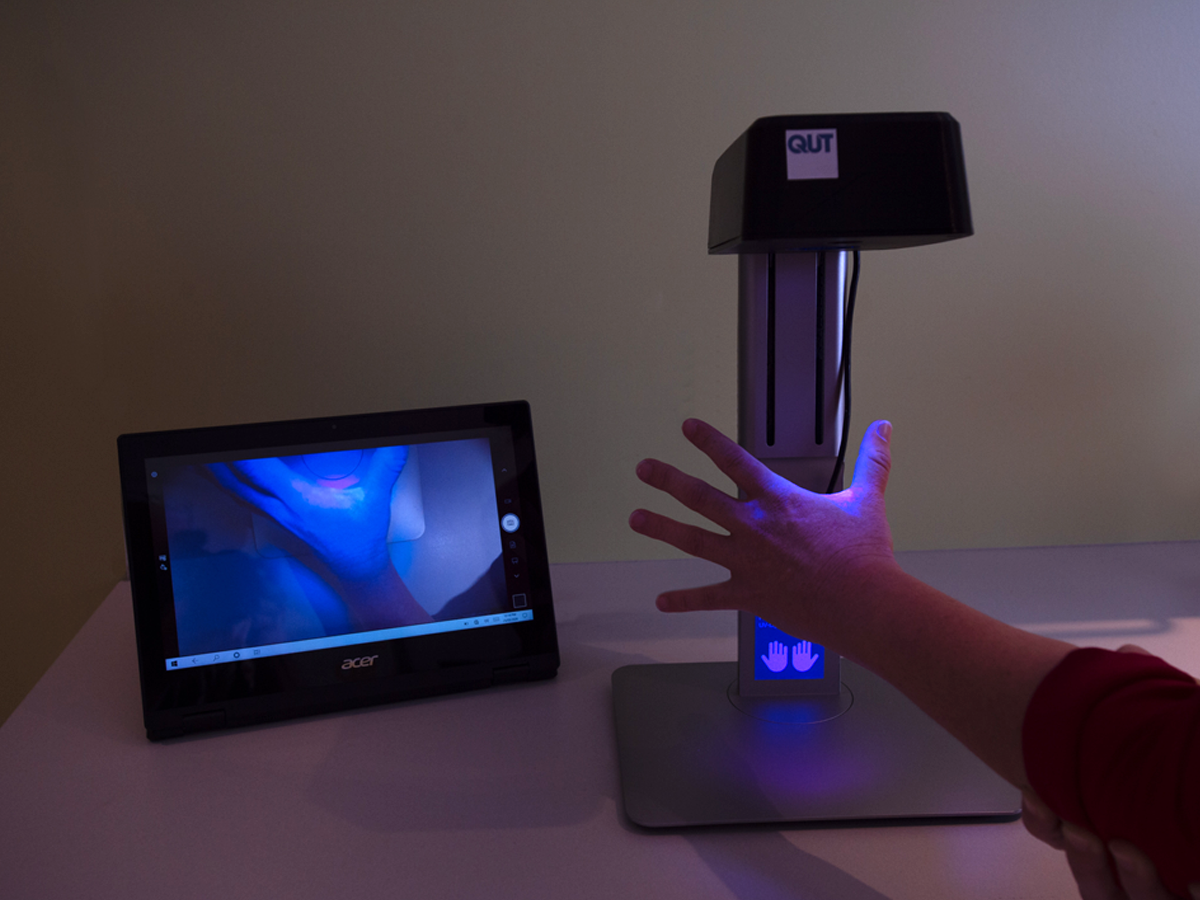
Measuring compliance with hand hygiene recommendations typically involves either self-report via interviews or questionnaires or by direct observation; both methods have their downsides. In contrast, the smart handwashing station integrates IoT approaches to track usage and collect images of users' hands. The station features a software application that triggers a digital camera to take a photo each time a person stands on a pressure sensor mat, and then every 5 seconds he or she remains there. First, the user applies a moisturizer that contains a UV-fluorescent compound. Second, the user washes his or her hands and checks hands at the station (without having to touch or rest hands on any surface). Any areas highlighted have not been washed enough to remove the moisturizer, indicating missed areas that require further washing. In other words, the visualisation tool provides personalised feedback about where improvements can be made for each user.
The field study was conducted in April and May 2020, when messaging about the importance of handwashing was particularly emphasised globally during the COVID-19 pandemic. One smart handwashing station was deployed to a school in Queensland, Australia whose 1,500 pupils were aged 5-18 years. The station, which is on rollers and so is movable, was placed near the school entry and outside handwashing facilities in a high-traffic area accessed by all students. The researchers solicited feedback from end users, including teachers and teaching assistants, to refine the device's design.
Observational testing of the smart handwashing station demonstrated perfect agreement with observed handwashing and station-recorded usage. No complaints, adverse events, or concerns were logged from users or teachers during the 10 days the smart handwashing station was deployed. A COVID-19 case was reported at the school several weeks prior to the deployment of the station; during deployment, no transmission of COVID-19 was recorded at the school. Furthermore, the laptop provided sufficient power via the USB connection during field testing.
Reflecting on the experiment, the researchers note that a school environment is "an ideal setting to introduce health information to young children and teenagers. Children are prone to acquiring acute respiratory illness due to a tendency to put items and their hands in their mouths and noses regularly; such illnesses are transmitted to parents in more than 30% of cases....Studies suggest that modelling handwashing for children, either in-person or by video, when combined with other strategies, can increase correct handwashing..."
Other advantages, per the researchers, is that the station captures data to provide insights into hand hygiene without being resource intensive; it does not require any infrastructure, such as installed sensors in washrooms. The mobility of the station is also a key design feature; as it is a small unit, it can be shipped and deployed in many configurations. Key technical considerations include appropriate design for use by school students, with a robust structure, a software system that operates with current organisational platforms, and careful consideration of the configuration to ensure privacy and minimise security risks.
In conclusion: "The smart handwashing station data could be used to inform targeted training as part of health programs in areas with poor handwashing, as well as assist inventory management systems to ensure appropriate levels of soap are always available....To assist schools to protect their students from outbreaks, the smart handwashing station could help build awareness of the importance of hand hygiene and provide personalized feedback. The usage data generated by this device could also benefit health programs by informing public health authorities of areas with low handwashing where targeted training may increase hand hygiene."
JMIR Public Health Surveillance 2020 (Oct 19); 6(4):e22305. Image credit: © Queensland University of Technology
- Log in to post comments