











































Decision-making Tool for Family Planning Clients and Providers
Image
SummaryText
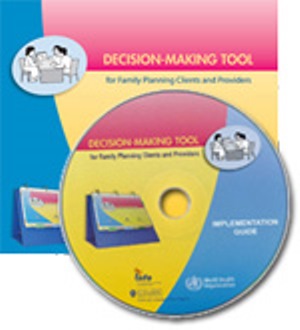
This tool aims to support family planning providers in counselling their clients in choosing and using a contraceptive method. The tool is designed as a flip-chart which can be read simultaneously by clients and providers who each will view an audience-specific page of the tool. The client side of the tool contains pictures to help illustrate concepts, while the providers' side contains additional text and supporting information.
The tool aims to guide a step-by-step family planning counselling process, and provides detailed technical information on 14 different contraceptive methods. Designed in PowerPoint, the files which make up the tool can be downloaded and adapted for use in national family planning programmes.
The tool contains a number of sections to help counsel clients with different needs, including clients choosing a method, returning clients, those needing dual protection, and clients with special needs. In addition, a separate section is devoted to each of the following contraceptive methods:
The tool aims to guide a step-by-step family planning counselling process, and provides detailed technical information on 14 different contraceptive methods. Designed in PowerPoint, the files which make up the tool can be downloaded and adapted for use in national family planning programmes.
The tool contains a number of sections to help counsel clients with different needs, including clients choosing a method, returning clients, those needing dual protection, and clients with special needs. In addition, a separate section is devoted to each of the following contraceptive methods:
- Emergency contraception
- IUD
- The pill (combined oral contraceptives)
- The mini-pill (progestogen-only pill)
- Long-acting injectables (DMPA and NET-EN)
- Monthly injectables
- Implants (Norplant)
- Vasectomy
- Female sterilisation
- Male condom
- Female condom
- Vaginal methods (including diaphragm and spermicides)
- Lactational amenorrhea method (LAM)
- Fertility awareness-based methods
Languages
This tool has been translated into: Arabic, Bahasa Indonesia, Bengali, Burmese, Chinese, Dari, Divehi, Farsi, French, Hindi, Kosovar, Mongolian, Nepali, Romanian, Spanish, Turkish, and Vietnamese.
Number of Pages
230
Source
WHO Department of Reproductive Health and Research new publications press release, September 30 2005; WHO website; and emails from WHO to The Communication Initiative on November 1 and November 2 2005.
- Log in to post comments