










































Community Radio and Sustainability: A Participatory Research Initiative
Ideosync Media Combine
"The study shows that Community Radio will have to continue a high level of engagement with its community over a longer period of time, enabling listening audiences and community members to play successively bigger roles in all aspects of its decision making - not just in terms of content design but also in institution building and internal policy decisions - to be able to raise resources from within the community."
In 2014, the United Nations Educational, Scientific and Cultural Organization (UNESCO) and the Commonwealth Educational Media Centre for Asia (CEMCA) launched a participatory research initiative to explore the sustainability parameters for community radio (CR) stations in the South Asian region. The study was conducted by Ideosync Media Combine across 8 CR stations in India and 2 stations each in Nepal and Bangladesh. The principal questions the study sought to answer were: "What are the practices that CR stations are trying to sustain? And what challenges do they encounter in the process?" This final report emerging from the study describes the research and its key findings.
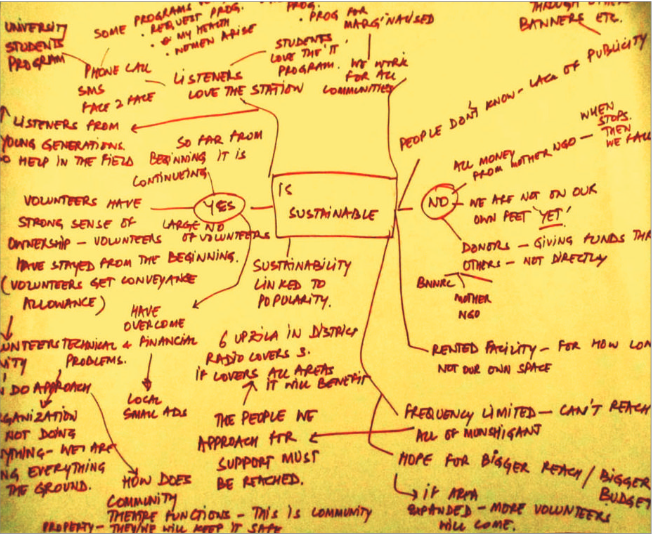
The 12 stations were selected in a manner that ensured adequate representation in terms of institutional set-up, governance, geography, and the duration of broadcast. Validated by key stakeholder groups, the research methodology involved both qualitative and quantitative tools, and was founded on the principles of ethnographic action research. Community researchers from each participating CR station (CRS) were trained in ethnographic research tools. Data were collected over 6 months and included weekly diary notes, significant good practice stories, brief survey questionnaire, annual budgets, and monthly expense sheets of the CRS. Ideosync researchers undertook field visits and in-depth interviews with CR staff, volunteers, and management committee members. Another ethnographic data tool used during the research was mind-maps (see above), which were drawn up to gather data around linked ideas for "sustainability" during focus group discussions with CR stations and volunteer teams. These sessions were conducted at the community level by CR researchers and/or the Ideosync research team. Along with the data sent by the CR stations, the research included a 2-day observation visit by the Ideosync team to 10 CR stations in India and Bangladesh. A desk research guided the formulation of key ideas around sustainability, which are outlined in the report. For example, as part of its Media Development Project, UNESCO has identified several decisive factors to ensure sustainable functioning of CR stations: strong community ownership, effective training and capacitation of the community, and a technical sustainability system. Analysis of the data involved exploring relationships between different sets of data and triangulating the information gleaned from all the different methods. (The annexures in the report provide access to all of the research tools.)
Key outcomes indicate that, overall, CR stations have evolved several ways in which to engage and enable partcipation of their geographical communities, especially in content creation. Almost all CR stations in the study are perceived as being "for the community" - both by the volunteers and team members working at the station as well as listeners. Most CR stations are able to reflect a fairly high presence of women among their staff and volunteers. Overall, the percentage of live programming is very low across the broadcast of the CR stations that participated in the study. (Live broadcast is described here as a key component for community engagement, as well as critical for breaking the myths around technology and access for remote and marginalised communities. More could be done to enhance this aspect of CR in the region.) Some of the study's other key findings are:
- Much remains to be done for CR stations to attain financial independence and sustainability. CR stations run by large and medium non-governmental organisations (NGOs) have been fairly successful in building financial sustainability. Stations with large parent organisations enjoy greater infrastructural stability, but fear the possible closure of the CR station if the parent organisation's support is withdrawn. Stations in remote, resource-poor, and sparsely populated areas, on the other hand, would require some form of public funding to diversify their funding sources. CR stations that have had prolonged years of community engagement stand a better chance of community funding.
- While gender parity is high at most stations, less than 50% of the stations studied had formally adopted a gender policy. Although women from the community might play a leadership role with respect to the station's day-to-day content and broadcast management, this is not necessarily the case with respect to financial, technological, or institutional decision-making roles.
- Data indicate that 25% of CR stations in the study are able to create spaces for decision making by marginalised community members. However, the presence of marginalised community members in staff teams or management committees does not always give them a voice in guiding the perspectives of the station's programmes or internal policies. Not all CR stations are able to have open house meetings with their volunteers, and retaining volunteers continues to be a challenge.
- Stories that emerged as significant good practices show a high number of good practices around content and production, while fewer or almost no stories around internal CR policies.
- A few CR stations undertake in-depth engagement that involves regular conversations with their community members by visiting them and organising focus group discussions and undertaking in-depth interviews, which inform the content and the perspectives of their programmes. Many stations have live call-in segments to some of their programmes or have a special feedback programme to enable listeners to provide inputs to the CRS. Some CR stations have an online presence through a website or Facebook that allows community members to stay abreast of and comment on various ongoing activities at the CRS. Some stations have evolved a way to make physical feedback collection points available to their listeners. Some of the qualitative data show that, despite mobile telephony and possibilities for call in, the face-to-face interaction of community events and meetings has its own space for enabling and building stronger relationships, and these opportunities should be supported, even though they are time-consuming and more resource-intensive.
- Most CR stations have articulated a vision and mission statement. These statements mostly focus around issues of local social and cultural empowerment, information provision, and preservation of culture, art, and language. A content analysis exercise undertaken by using the text of all the mission and vision statement shows that ideas of local information provision, especially to rural audiences like farmers, emerge as a key focus. The in-depth interviews undertaken during the research reflect a paucity of evolved debate and in-depth understanding of the overall purpose of CR and the reasons for advocating for a more pluralistic and diverse media environment in the region.
The study shows that while CR stations in the region continue to evolve practices and mechanisms that lead them towards greater social sustainability, much needs to be done to help them become independent media institutions. This will require further capacity building in terms of: (i) clarifying the purpose and goals of free, pluralistic, transparent, and accountable community media; and (ii) defining and articulating the principles and practices for strengthening the overall institutional sustainability of CR stations.
Email from N. Ramakrishnan to The Communication Initiative on August 18 2016; and UNESCO New Delhi website, August 23 2016.
- Log in to post comments