










































Co-Immune
"...short, focused programs can be efficient at mobilizing diverse communities in a rapid manner and harvesting ideas from various domains to address global health challenges."
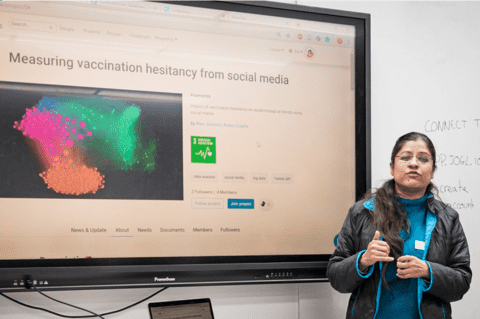
Experience around the world highlights the positive outcomes of incorporating social participation in efforts to address public health issues, such as more meaningful dialogue, more sustainable solutions, and more trust from citizens in health system institutions or in the decisions that are made. In that vein, the persistent rise of vaccination hesitancy has led to the exploration of new solutions, including participatory research, citizen science, hackathons, and challenge-based approaches. One such effort is Co-Immune, a collaborative open innovation programme that was run from March 2019 to January 2020 to address vaccination hesitancy and access to vaccination. The programme was designed to: (i) foster a collaborative, open, and transdisciplinary dynamic; (ii) promote the emergence of accessible knowledge and innovative solutions; (iii) support participants in the elaboration and development of their project; and (iv) disseminate the outputs and results in an open science framework.
Co-Immune's aim was to develop an environment that favours the creation and development of citizen science and open innovation projects addressing the contemporary challenges of vaccination in France and around the globe. The Co-Immune programme gathered participants and partners from various backgrounds in a newly formed community to facilitate the creation of new projects as well as the continuation of existing projects to address the issues of vaccination hesitancy and access. In an open framework, the projects made their data, code, and solutions publicly available.
Activities included: 10 offline and online events; support for the development of citizen science projects by 13 partners in the health, technology, and social sectors; and assessment and awards for projects participating in the challenge-based competition. More specifically:
- Co-Immune participants (n=234) used Just One Giant Lab (JOGL), a decentralised mobilisation platform designed for use in collaborative research and innovation platform, to document their projects and recruit collaborators throughout the course of the programme. Twenty project leads created 22 projects with teams of up to 11 members. Fifteen of the projects proposed to develop software covering web technologies, mobile apps, algorithms, data lakes, data modeling and analysis, and visualisation tools. The other 7 projects included hardware development and interventions involving biotechnologies, game design, behavioural sciences, education, and communication. Overall, one-third of the projects focused on knowledge transfer. Example project: The HEROIC Santé project developed and tested a short questionnaire using engagement approaches from the social sciences to engage healthcare professionals and users around flu vaccination.
- In addition to online events, there were 4 on-site events, 2 of which were hackathons aimed at motivating participants to join the programme, and 2 were aimed at fostering collaboration around the most advanced projects. The facilitation of the hackathon-style events relied on the use of participatory and collective intelligence design and problem-solving techniques. In particular, participants were encouraged to form multidisciplinary teams including both professionals and students. Some of the partners mobilised their teams to act as mentors during these events. Given the diversity of backgrounds and level of expertise across the participants, it was necessary to engage a similar diversity among the mentors.
- The assessment of projects by experts was designed to be an opportunity for learning and growth. To be assessed, teams were asked to provide a video pitch summarising their project and detailed documentation on their project page on the JOGL platform, including links to their open access data and code. Out of 22 projects, 7 provided sufficient documentation on JOGL to be assessed by the pool of independent experts. JOGL awarded the winners physical space for showcasing their project during the 2020 ChangeNOW forum at the Grand Palais in Paris, France, as well as tickets for an innovation event.
Immunisation and Vaccines
In reflecting on the project, the researchers note that:
- Mentorship during events, the assessment and feedback from experts, and the connection with a wide range of partners supported participants in the elaboration of their project. In the future, the sustainability of the newly created project efforts could potentially be improved by using incentives, such as microgrants or fellowship programmes, for continuing projects in the postprogramme period.
- More inclusive participation geared toward people with diverse socioeconomic statuses and geographic situations is desirable in the future to give them agency over solving the problems that affect them.
- Similarly, greater representation of people affected by poor access to vaccines and people who are hesitant would be desirable to strengthen the alignment between the solutions developed and needs at the local level.
- There was no further growth of the community after the end of the programme, which highlights that in order to build a sustainable community using open innovation to tackle global health challenges, one needs to facilitate the entry and exit of members, provide resources to support the current ones, focus on building on existing communities and projects, design inclusive environments for collaboration, and empower members to run their own activities.
- Future implementations should ensure that, at a minimum, pre- and postprogramme data are collected in order to assess the full impact of the programme. For example, one Co-Immune participant, HERA: A Health Platform for Refugees, opened its code, enabling any individual to replicate it. However, the lack of a thorough evaluation strategy prevents a more definitive conclusion on the effective replication of this and other Co-Immune projects.
Implementing the Co-Immune Open Innovation Program to Address Vaccination Hesitancy and Access to Vaccines: Retrospective Study, by Camille Masselot, Bastian Greshake Tzovaras, Chris L B Graham, Gary Finnegan, Rathin Jeyaram, Isabelle Vitali, Thomas Landrain, and Marc Santolini. Journal of Participatory Medicine 2022 (Jan 21); 14(1):e32125; and Co-Immune website, January 24 2022. Image credit: Co-Immune
- Log in to post comments