










































Chakruok Radio Drama
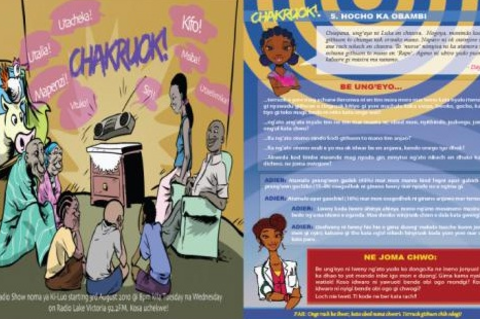
Launched in 2010, Chakruok was a 24-part serial radio drama and weekly discussion show designed to expand access to integrated Reproductive Health and Family Planning and HIV services for married adolescent girls in rural Nyanza district in Kenya. Created and distributed by Well Told Story for the Population Council and United States Agency for International Development (USAID), the radio series was accompanied by illustrated leaflets, SMS, social media, and Community Health Worker (CHW) activities.
The radio drama Chakruok was the centrepiece of a communication campaign implemented as part of the APHIA II Operations Research Project. The story focuses on the life of a married adolescent girl, and was aired over eight months on three radio stations in Nyanza. According to Well Told Story, married adolescent girls in Nyanza Province are usually out of school, beyond the reach of most formal communications systems, and strongly influenced by their traditional context. Chakruok was recorded in Nyanza in Dholuo language and was designed to draw the wider Luo community into a conversation about girls, gender, sexuality, and health.
The programme included an interactive component, where listeners could contribute their thoughts through phone calls and text messages. Listeners could also hold further discussions on the drama through a Facebook page. Leaflets and posters, which had information on specific topics that had been raised in the radio drama, were also produced and distributed in the community and directly to married adolescent girls.
To accompany the radio drama, community health workers (CHWs) conducted home visits to reach married adolescent girls and to provide information on reproductive health and HIV, as well as make referrals for services. Two hundred CHWs were trained on the reproductive health and HIV information and service needs of married adolescent girls and given tools and incentives to enable them to follow up with the girls in the community.
HIV/AIDS, Youth, Women’s reproductive health
According to Well Told Story, research has found that married adolescent girls in Nyanza Province, Kenya, face higher risks of HIV infection than unmarried but sexually active girls their age in the province and other parts of the country. One study indicated that 32% of married adolescent girls in Nyanza were HIV-positive, compared to 22% of their unmarried peers. In addition, it has been established that married adolescent girls’ use of reproductive health services, including family planning, is poor.
An assessment of the project found that 58% of married adolescent girls (MAG) were aware of the radio programme, and of these, 81% listened to the radio programme, 71% listened with their spouse, and 73% were visited by a CHW in the past year.
Well Told Story, Population Council, United States Agency for International Development (USAID)
- Log in to post comments