










































Can Your Preschooler Learn Anything from an iPad App?
Early Education Initiative, New America Foundation
"...[W]e have to keep testing interactivity's value: Is that touchscreen triggering actions and ways of thinking that could come in handy in the real world - or merely leading our kids to touch another button?"
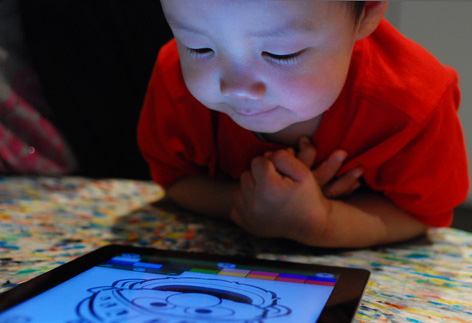
This article from Slate explores a few of the studies that have been carried out to understand how interactive screen time - touchscreen tablets and e-readers - affects early childhood development and learning. Author Lisa Guernsey calls for more such research.
For instance, Guernsey describes a Georgetown University study, published in 2010, which randomly assigned children, ages 30 to 36 months, to one of three groups. Each experienced a different version of a show that took place in a laundry room, where puppets would pop out from baskets or from behind pyjamas hanging on the clothesline. In one version, the children watched the show play out on video. In another, they viewed the action on a computer screen and had to touch the keyboard's space bar whenever they wanted to find out where the puppets were hiding. The third - the live version - asked children to watch an enactment of the show in a room set up to look exactly like what their peers were seeing on-screen. They watched through a window-like opening the same size as a TV or computer monitor. After watching or playing, each child was unleashed into that room to find the puppets. The kids who had played the interactive game or watched the live demonstration did quite well, with most of them heading straight for the right place. Something about interacting with the content - about pressing that space bar to make puppets appear from their hiding places - seemed to improve their ability to learn from the screen.
According to the article, in earlier studies, 24-month-old children struggled with these "seek and find" tasks after watching non-interactive video unless they had a guide on-screen: a person or character whom they felt compelled to respond to or communicate with.
However, as reported here, other research suggests that interactivity may be more about attracting a child's attention than teaching him or her. Some e-book studies at labs at Temple University and the University of California at Riverside show that the "wow factor" of the device and the presence of interactive "hotspots" on e-book pages may interfere with children's ability to recall the storyline of the book. Research carried out at the University of Virginia indicates that even traditional print-and-cardboard pop-up books can lead children at 2.5-3 years old to learn less from the story than they would have otherwise.
Guernsey explains that child development specialists say young children learn best when they are fully engaged and imbued with a feeling of control. They encourage parents to seek out more open-ended games and toys in which children can explore and create at their own pace. Yet a recent Australian study showed that only 2% of "education" apps (application software, or software for specific purposes) in the iTunes Store allow for open-ended discovery and exploration.
She concludes by sharing a strategy for assessing when and how to use screen media with young children: the Three C's:
- Content - Be selective about the content of what children see on-screen, and when choosing interactive titles, seek out those that put children in control without so many dead-ends and distractions. One tool Guernsey cites is this Common Sense Media website, which rates apps for their learning potential.
- Context - Be aware of what is happening before, during, and after children play their games or watch their shows, taking time to talk about what they have seen, and play some games together.
- Your Child - Tune in to which games and shows really interest your children: what piques their curiosity and helps them relate to people and things around them.
Sesame Workshop website, August 6 2012. Image credit: Sesame Workshop
- Log in to post comments