










































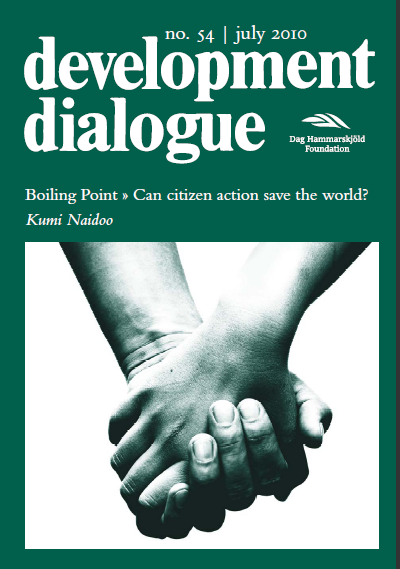
Boiling Point: Can Citizen Action Save The World?
Executive Director, Green Peace
This book is part of the Development Dialogue Series and offers the insights and reflections - both critical and self-critical - of civil society activist Kumi Naidoo, who has been engaged in local and global struggles for emancipation for over 30 years. On the basis of his own experiences in many different contexts, he pleads for the involvement of ordinary people in the work for greater justice in this world. His point of departure is that civil society cannot be strengthened in a vacuum. Its achievements must be the result of actions by real people dealing with real problems. Naidoo defines this volume as "an examination of the functioning of democracy, and the way in which civil society steps in where democracy no longer serves the purpose it sets out to do...(democratic deficit)."
While being guided by a notion of non-violent forms of resistance, the author nonetheless promotes radical alternatives to the existing reproduction of societies as a necessity to meet the challenges in securing the survival of the human species and a decent life for all. He starts from the premise that organising - "unleashing the power of the people" - requires civil society organizations (CSOs) and people themselves to act as full-blown citizens, rather than clients or beneficiaries.
Nine chapters deal with the following issues arising out of global movements engaged in struggles for justice and equality:
- Citizen action and the democratic deficit: "the importance of engaging citizens at a local level in the process of civil society, the only way in which ordinary people can generally have an impact on both their local issues and the vast, global issues of poverty, climate change and injustice."
- Re-defining what change means and how it occurs: "working on three different levels – macro (governance changes), meso (policy changes), micro (implementation and delivery of social services" to bring about participatory governance: "participation of all sections of society in the decision-making process and the formulation and implementation of policies."
- Accountability: Civil society should have proper modes of accountability for its own organisations so as not to undermine its own position in making vigorous critiques of the organisations it is seeking to influence, reform, or transform.
- Citizen organisations and the business community: Civil society and business need to reinvent their relationship with civil society, recognising the citizenship of businesspeople and creating a context in which to challenge business to face up to its responsibilities towards the planet and people. The challenge for both sides is to find a way to engage in dialogue in order to harness the resources business can bring to bear on the problems of today, while challenging business's influence on national and global decision making.
- Secular and religious civil society dynamics: CSOs have to take the following into account: religious institutions have the widest reach in terms of membership, resources, and depth of commitment. Religious institutions therefore must be engaged in campaigns on issues of climate change and poverty eradication.
- Poverty: The issue must be addressed at the macro, micro, and meso levels, addressing both service delivery (micro) but also the policy issues at the meso and macro levels. Organisations must realise that poverty crosses over directly to the issue of human rights and justice and that, in fact, human rights, human development, and human security are interdependent.
- Climate change: We are obliged to make sure that the largest number of people are able to participate in the intersection between poverty and climate change, recognising that there is no time for small steps. If we fail, "it won’t matter if you from the global North or global South. Our fates will be sealed together."
- The prospects and limitations of civil society in challenging environments: Civil society free from the constraints of "short-termism" can help societies afflicted by conflict towards meaningful recovery and reconciliation. "Creating political institutions might take six months. It might take six years to create a viable economy. But it will probably take 60 years to create a genuinely civil society."
- The challenge of youth citizenship: Organising youth and capturing their energy and courage are essential.
- The majority are socially excluded: The elderly, indigenous groups, and women are among the most excluded. "Humanity should be judged not on the economic achievements of those who are already privileged but by the most socially excluded. For democracy to have any value, policy-makers and civil society organisations must address the issue of justice for socially excluded, marginalised groups."
Proposed communication-related strategies for citizen action include:
- More citizen journalism that helps to frame the debate, share information, and act as an early warning system to equip others with important details to protect themselves or their communities, or develop strategies to deal with day-to-day events. (Mainstreaming the issues – governments respond to large constituencies expressing themselves in mainstream, public environments).
- Policy advocacy that is not at odds with adaptation and mitigation (to climate change, for example). Each would benefit from greater integration and intelligence sharing with the other.
- Engagement with national governments and intergovernmental organisations through principled non-engagement, selective engagement, and comprehensive engagement.
- Breaking down the barriers within civil society through cooperation and collaboration across sectors between the broadest spectrum of CSOs working in the interrelated areas of human rights, human development, and human security, as well as regional cooperation and collaboration in order to support policy change at transnational levels, where the real power of influencing policy change is increasingly found. Coalition building is one manner of cooperation.
- Intelligence sharing - the exchange of practical, on the ground learning and best practices among organisations.
- Capacity building (training and empowerment) that builds the skills of recipients, enabling them to become empowered or increasingly self-subsistent and capable of confronting the underlying issues that have created the challenges they face.
- Reclaiming civil disobedience - non-governmental organisations (NGOs) need to take risks, because history teaches us that systemic policy change occurs when decent people put their lives or livelihoods at risk through civil disobedience and activism.
- Participatory governance, the "participation of all sections of society in the decision-making process and the formulation and implementation of policies." Advocacy and activism should aim for more than simple electoral democracy.
In his conclusion, the author reminds readers that his key message is that civic groups should focus more on what unites them than what divides them and agree to respectfully disagree on the latter while finding creative ways to work together on the former.
CIVICUS website on November 28 2011.
- Log in to post comments