










































Why we are not the experts
Summary
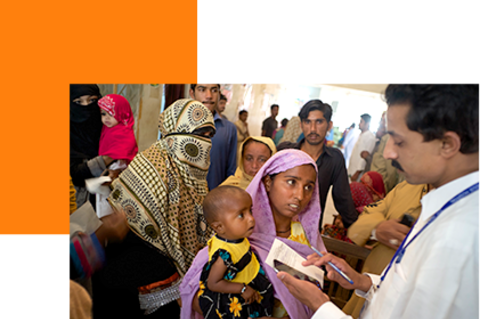
In this talk, the Community Engagement Centre a joint venture by the Indus Health Network's Global Health Directorate and Interactive Research and Development explores the ground-realities of working on community health in Pakistan. Health does not exist in a vacuum and often social determinants create a webbed system that promotes or degenerates well-being. As such, we discuss evidence from Pakistan that impoverished communities have the capacity to build their own local responses and systems to overcome challenges. Utilizing the example of a community in Karachi, we discuss one community's response to their needs and the means through which this knowledge was uncovered. Learning about home-grown solutions from local contexts provides important information for practitioners to adapt and apply such approaches in other similar contexts, thereby questioning the traditional colonized model of healthcare delivery. This inevitably strengthens interventions: being integrated into existing mechanisms allows interventions to be better accessed, adopted, and utilized by local populations, thus generating a sustainable and evolving solution. Such an approach can strengthen networks between professionals and local experts, building new innovations for healthcare delivery in challenging contexts. This allows the community and health practitioners to connect the dots necessary for human development in contextually diverse settings. This critical engagement mechanism has allowed the CEC to walk with the community, trace its journey, and shoulder their obstacles, to generate a learning hub to transfer knowledge from one community to another, thereby redefining what it means to be an 'expert' in the field.
Background/Objectives
Entrenched within the epistemology of community engagement programmes are ideas about how things should be. Symptomized as passive sufferers, communities are viewed from a macro perspective: their problems generalized, personal struggles and efforts often ignored. The imposition of how things should be distorts their unique human experience. In this session, we review the ground-realities of working with community health in Pakistan. Acknowledging that health does not exist in isolation instead, reliable systems are required we discuss evidence that impoverished communities can build these systems on their own, and often, local systems are invisible to practitioners and organizations.
Description Of The Big Idea/experience/innovation And Its Importance To The SBCC Field:
In this session, we showcase an example from the Community Engagement Centre's work. The acknowledgment of local, hidden systems is two-pronged: it can strengthen health, education, and other interventions by integrating communities' own responses and actions from a cultural and contextual lens, and it emancipates health workers (HWs), activists, practitioners, and organizations from the barriers, preconceived ideas, and the 'symptomizing' quality that often accompanies planning programmes and interventions for development. Arguably, the collective 'we' of a community should also comprise of the people working with them on the challenge area. This allows intervening bodies to work alongside communities to identify what areas of concerns there are, and what methodologies can work. Through a combination of participatory approaches and community competency building, health workers are able to become part of an indigenous community and see their problems as they are, rather than through the superimposed lens of an outsider. This allows for HWs to represent community interests with intervention agencies and develop programmes that most suit those particular contexts.
Discussion/Implications For The Field
An inclusive approach which considers indigenous responses, integrating home-grown interventions, ensures that the local population remains the pivotal stakeholder in all actions and actively takes ownership for them. In the community life competency process, practitioners entering local spaces must assess a community's current competency which includes any formal or informal systems that may already exist to address concerns. It is becoming increasingly apparent that an isolated clinical model for health is not an appropriate intervention in low-resourced settings where social determinants of health create a webbed system for which an interdisciplinary approach is likely more suitable.
Abstract submitted by:
Mehek Ali - Indus Health Network
Kausar S. Khan - Interactive Research and Development
Approved abstract for the postponed 2020 SBCC Summit in Marrakech, Morocco. Provided by the International Steering Committee for the Summit Image:credit: Interactive Research and Development (IRD)