










































2011 Humanitarian Action for Children
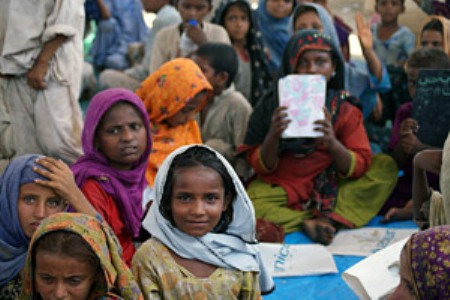
The 2011 Humanitarian Action for Children repor from the United Nations Children’s Fund (UNICEF) outlines UNICEF's response to 32 emergencies and its efforts to break repeated cycles of crisis. It is available in English, French, Spanish, and Arabic.
Its main section, entitled "Fostering resilience, protecting children: UNICEF in humanitarian action - A world of increasing complexity and risk" states: "There are some commonly considered dimensions of resilience that can offer crucial insights into how the humanitarian community can identify entry points for better supporting resilience. These dimensions are:
• flexibility - the ability to change, including the speed and the degree of adjustment;
• diversity - the variety of actors and approaches that contribute to the performance of a system’s essential functions;
• adaptive learning - the integration of new knowledge into planning and execution of essential functions;
• collective action and cohesion - the mobilization of capacities to jointly decide and work towards common goals;
• self-reliance - the capacity to self-organize, using internal resources and assets, with minimal external support."
In order to support resilience, UNICEF reframed its Core Commitments for Children (CCCs) in Emergencies as the Core Commitments for Children in Humanitarian Action. The document cites the way forward as using resilience as a guiding principle for insights into priority areas requiring improvement. These areas include the following:
• "Partnership - Building resilience is a multi-stakeholder endeavour. Humanitarian organizations must seek creative and context-specific alliances, ranging from the private sector to community development organizations.
• Innovation - Humanitarian organizations must deliberately foster experimentation and diffusion of promising institutional and technological solutions.
• Risk management - Humanitarian organizations need continually to better understand and analyse high-risk operating environments in order to find programme opportunities and access populations. Risk management should enable and not just control.
• Fundamentals - Accountability, participation, capacity development and local and national ownership continue to be essential for effectively supporting a community in crisis to build a path to sustainable recovery.
• Social transformation - Resilience is achieved through social processes whose outcomes defy precise measurement. To encourage investments by donor and developing countries that are truly sustainable, donors should review and revise their own performance monitoring and reporting systems."
For more information, contact:
Humanitarian Action for Children website, June 10 2011.
- Log in to post comments